Use this as a quick reference for scalars, vectors, unit vector notation, and sign convention.
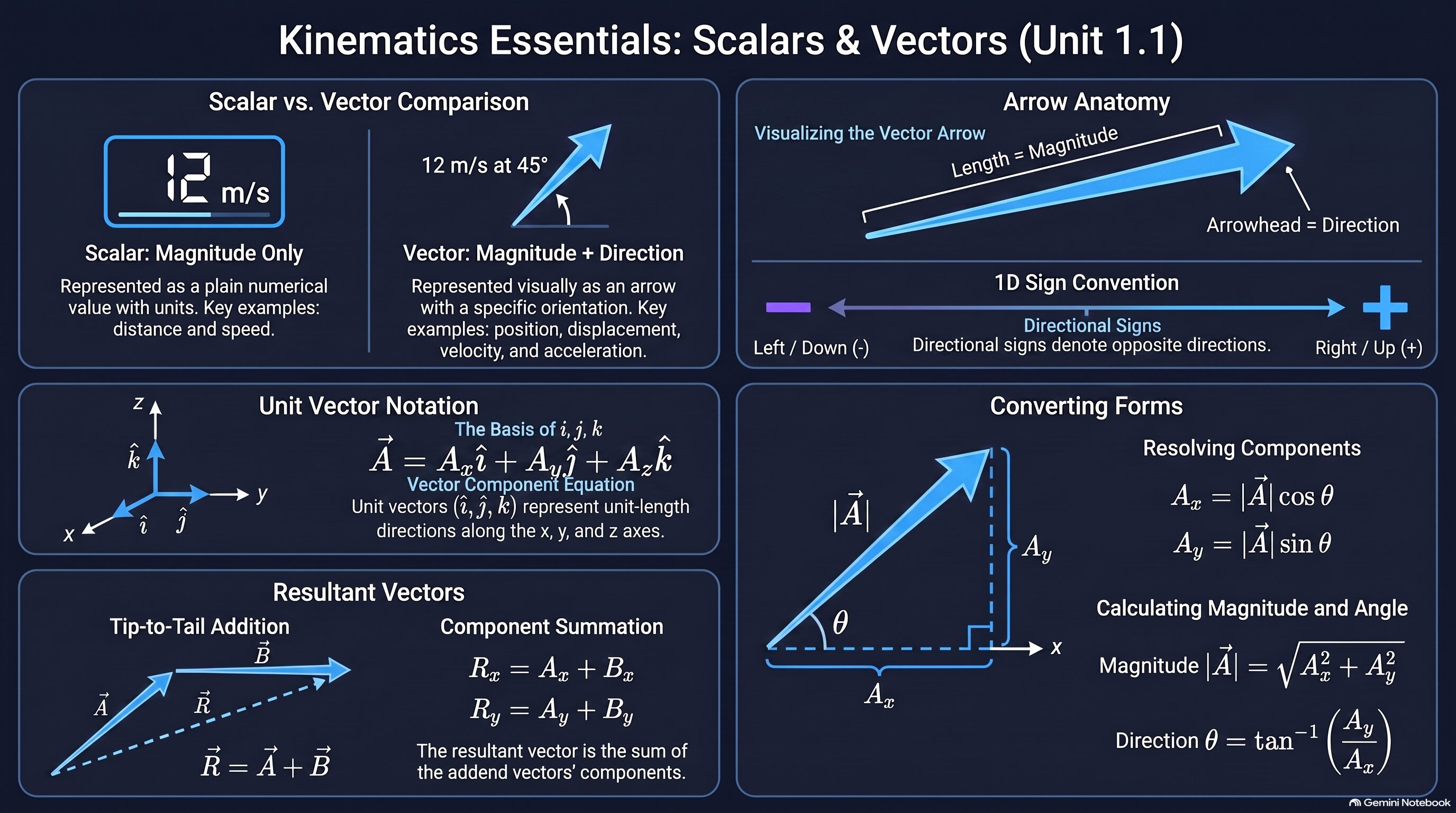
🧭 Plot Summary
Every quantity you'll use this year is either a scalar — just a number — or a vector — a number and a direction. That distinction is the foundation of everything else in AP Physics C: Mechanics. Once you can spot the difference, you'll learn two ways to write a vector down: as an arrow with magnitude and direction, or in unit vector notation using î, ĵ, and k̂ to break it into x-, y-, and z-components. From there, you'll learn how to add vectors by adding their components — the method you'll use in every unit that follows, from projectile motion to rotational dynamics.
What you'll do in this lesson
- Distinguish scalars (magnitude only) from vectors (magnitude and direction).
- Represent vectors as arrows — length shows magnitude, arrowhead shows direction.
- Classify distance, speed, position, displacement, velocity, and acceleration correctly.
- Write vectors in unit vector notation using î, ĵ, and k̂ for the x-, y-, and z-directions.
- Convert between component form and magnitude-and-direction form.
- Find a resultant vector by summing the components of the addend vectors.
- Use positive and negative signs to encode direction in one-dimensional problems.
Why it matters
Unit vector notation is the mathematical backbone of this entire course. Once vectors are broken into components, you can treat each direction as its own independent 1D problem — which is exactly how you'll solve projectile motion in Topic 1.5, forces in Unit 2, and everything after. Get comfortable with î, ĵ, and k̂ now, and the rest of the year gets easier.
✅ Self-Check Before You Roll On
Check off each item as you get there. These aren't grades — they're your own signal.