Use this as a quick reference for reference frames, relative velocity vector addition, and why acceleration doesn't depend on the observer.
🧭 Plot Summary
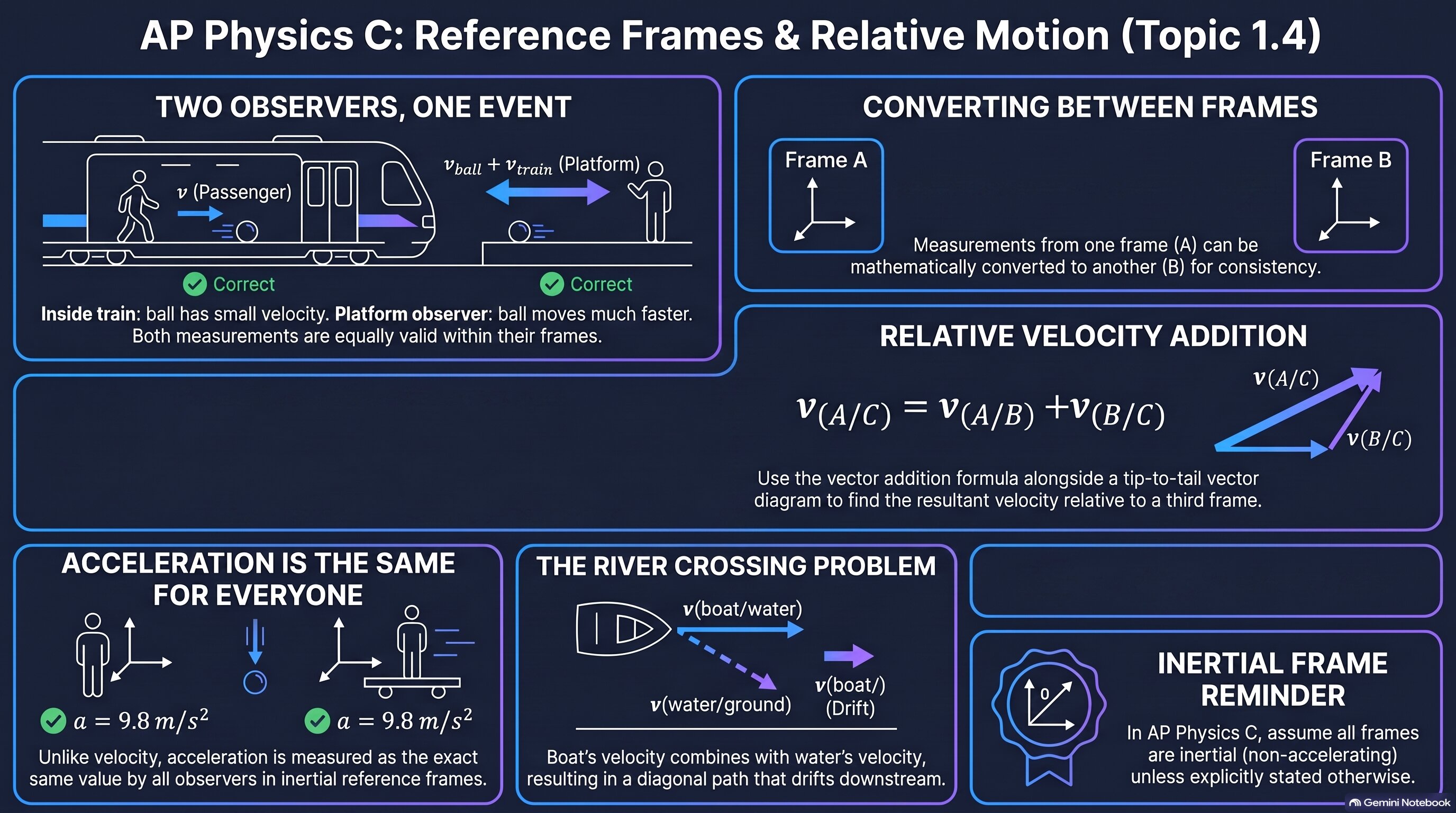
Every measurement of motion is made from somewhere — a reference frame— and the frame you're standing in changes what you see. A ball tossed inside a moving train looks different to a passenger than it does to someone standing on the platform. Neither observer is wrong; they're just measuring from different frames. This lesson gives you the tool to translate between them: an object's velocity in a new frame is just the object's velocity plus the frame's own velocity, added as vectors. One surprising exception survives the switch between frames, though — acceleration. Every observer in an inertial (non-accelerating) reference frame measures the exact same acceleration for a given object, no matter how fast their own frame is moving.
What you'll do in this lesson
- Describe how the choice of reference frame determines the direction and magnitude of a measurement.
- Convert measurements from one reference frame into another.
- Combine an object's velocity and an observer's velocity by vector addition or subtraction.
- Apply relative velocity to classic scenarios — river crossings, moving walkways, passing vehicles.
- Explain why acceleration is the same for all observers in inertial reference frames, even when velocity isn't.
Why it matters
This lesson is short, but the reference-frame habit of mind shows up constantly — whenever you set up a problem, you're implicitly choosing a frame. Getting comfortable with switching frames now makes later topics (projectile motion in a moving reference, momentum in collision problems) much less confusing.
✅ Self-Check Before You Roll On
Check off each item as you get there. These aren't grades — they're your own signal.