Use this as a quick reference for reference frames, relative velocity, and acceleration invariance.
🧭 Plot Summary
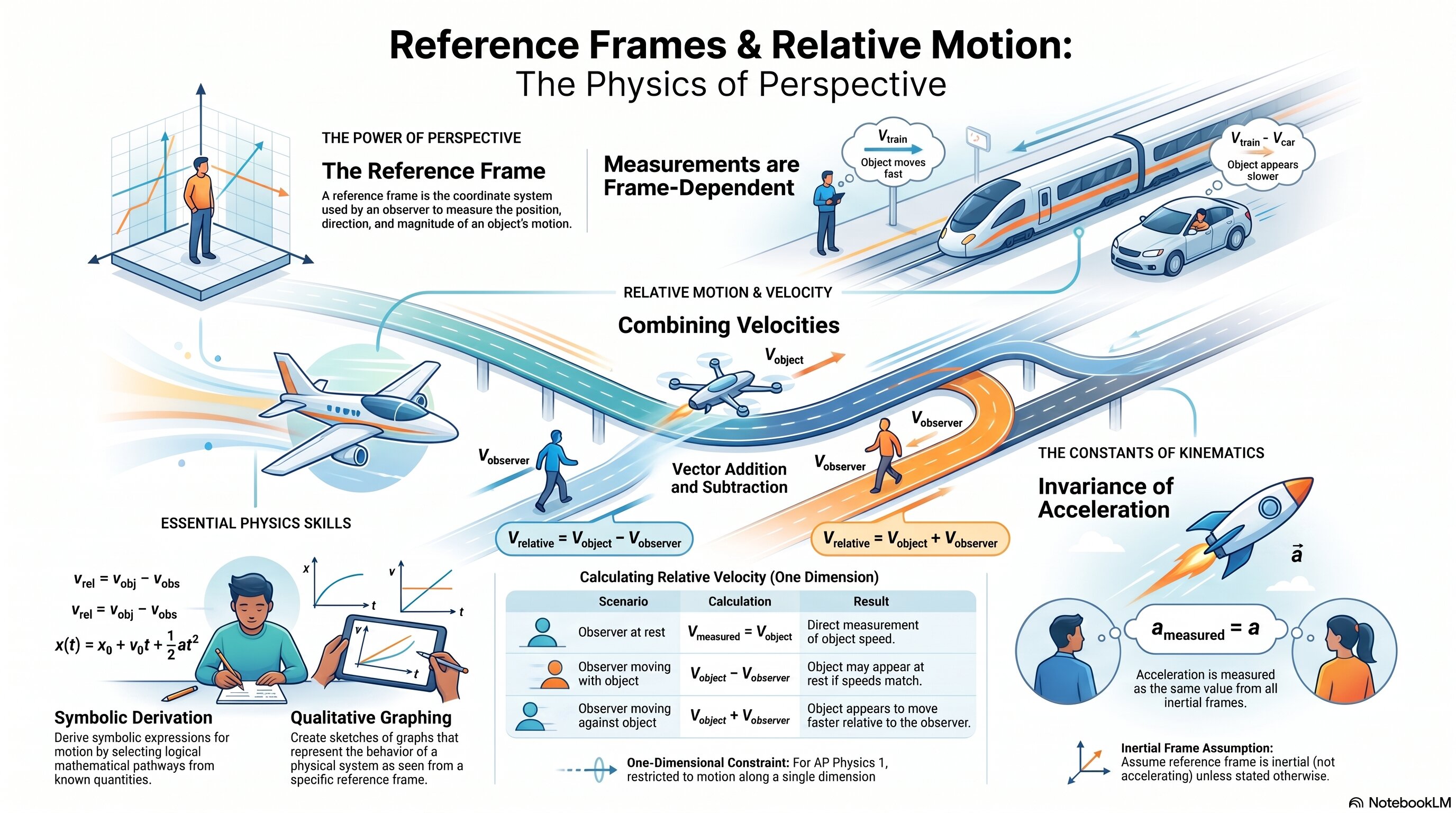
Up to now, you've measured motion from a single fixed point. In this lesson, the observer starts moving too. A reference frame is just the coordinate system attached to whoever is watching — and what they measure depends entirely on how they're moving. Two people watching the same car will report completely different velocities, and both will be right. The key equation is simple: relative velocity = object's velocity − observer's velocity. The twist is keeping track of signs when they move in opposite directions.
What you'll do in this lesson
- Define a reference frame as the coordinate system an observer uses to measure motion.
- Recognize that position, velocity, and direction all depend on which frame you measure from.
- Convert measurements between two reference frames moving at constant velocity.
- Calculate relative velocity by adding or subtracting the observer's velocity from the object's velocity.
- Apply the one-dimensional constraint — relative velocity problems in AP Physics 1 stay on a single axis.
- Explain why acceleration is frame-independent across all inertial reference frames.
Why it matters
Reference frames show up in collisions, orbital mechanics, and any problem where two objects are both moving. More immediately, this lesson answers one of the essential questions from the CED: why does it feel like you're moving backward when a faster car passes you on the highway? That's relative motion — and now you can calculate it.
✅ Self-Check Before You Roll On
Check off each item as you get there. These aren't grades — they're your own signal.