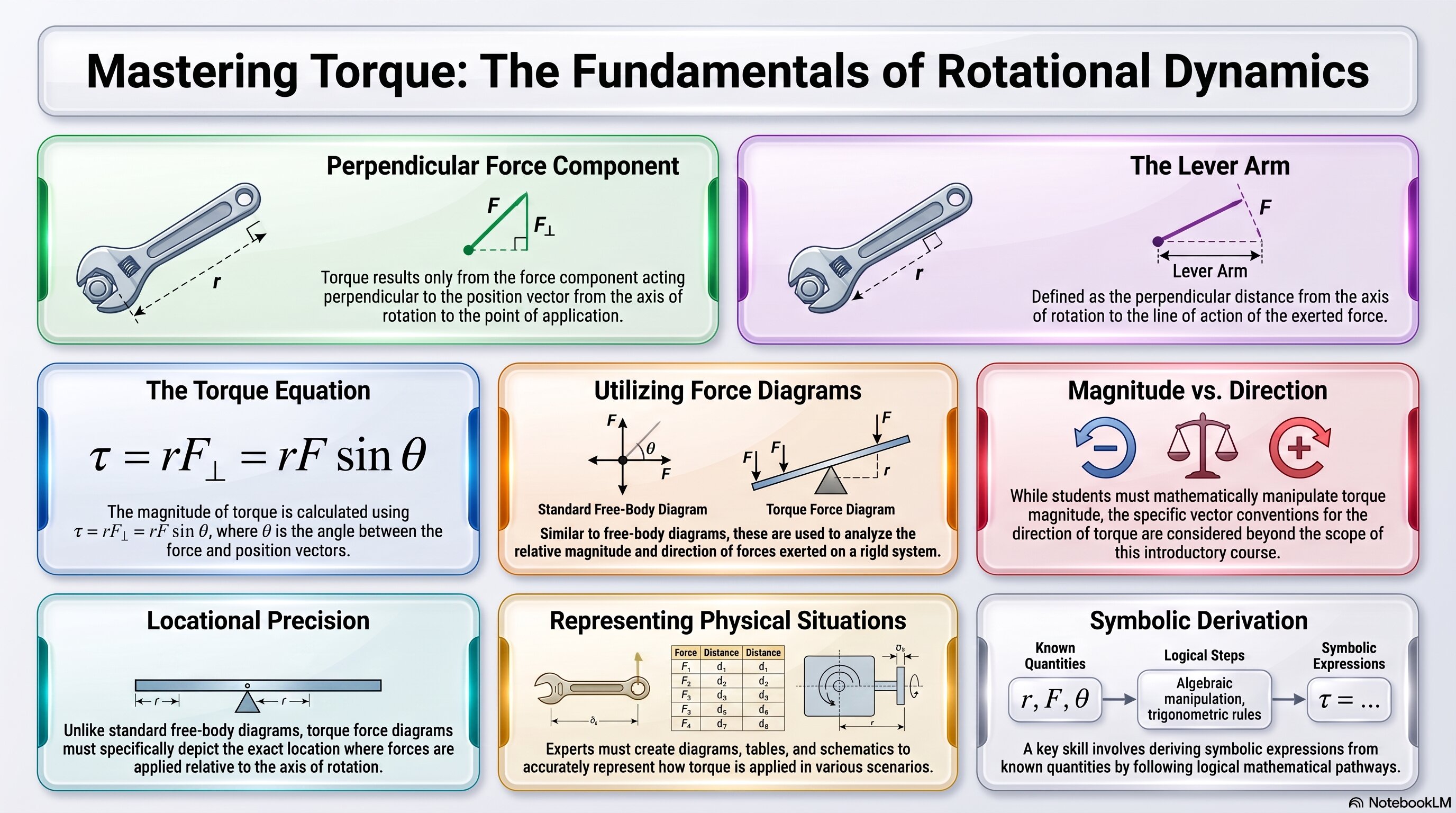
Use this as a quick reference for tau = rF sin theta, the lever arm, force diagrams, and sign convention.
🧭 Plot Summary
Force causes linear acceleration. Torque causes angular acceleration. But unlike force, torque depends not only on how hard you push — it depends on where you push and at what angle. Push a door near the hinge and it barely moves. Push it at the edge, perpendicular to the door, and it swings easily. Same force, completely different rotational effect. That difference is torque.
The formula captures all three factors: tau = r * F * sin(theta). The distance from the axis r, the force magnitude F, and the sine of the angle between them. Equivalently, tau = F * d_perp where d_perp is the lever arm — the perpendicular distance from the axis to the line of action of the force.
Two equivalent forms
tau = r * F * sin(theta)
Component form
Use when you know the angle theta between r and F. sin(theta) extracts the perpendicular component of F.
tau = F * d_perp
Lever arm form
Use when you can identify the perpendicular distance from the axis to the line of action of F. Often simpler geometrically.
What you will do in this lesson
Define torque as the rotational analog of force: tau = r*F*sin(theta).
Identify the three quantities in the torque equation: r, F, and theta.
Calculate torque using the perpendicular force component: tau = r*F_perp.
Calculate torque using the lever arm: tau = F * d_perp.
Apply the CCW = positive, CW = negative sign convention to torques.
Draw torque force diagrams with forces at their exact points of application.
Why it matters
Torque is the input for everything that follows in Unit 5. Newton's Second Law for rotation (tau_net = I*alpha in 5.4) and rotational equilibrium (tau_net = 0 in 5.5) both require you to calculate individual torques first. Master the geometry of r, F, and theta here — you will use it in every remaining lesson.
✅ Self-Check Before You Roll On
Check off each item as you get there. These are not grades — they are your own signal.