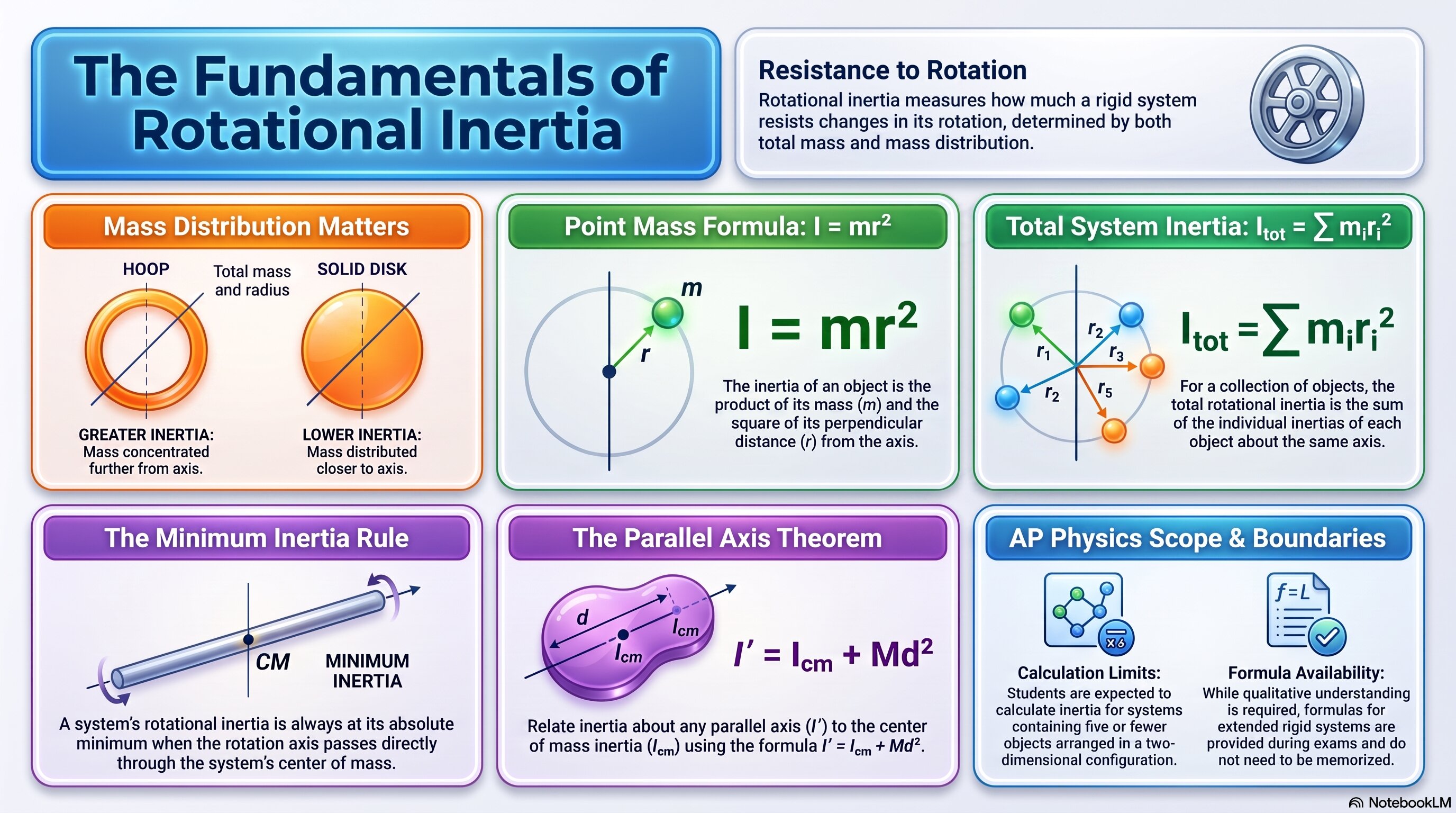
The rotational analog of mass — resistance to angular acceleration depends on how mass is distributed, not just how much there is · Approx. 2–3 class days
Use this as a quick reference for I = mr², mass distribution, the minimum inertia rule, and the parallel axis theorem.
🧭 Plot Summary
In Lesson 5.3 you learned that torque is what causes angular acceleration. This lesson asks: what resists it? The answer is rotational inertia — the rotational analog of mass. But unlike mass, rotational inertia depends not just on how much matter an object has, but on how that mass is distributed relative to the axis of rotation. Mass farther from the axis contributes much more to I because of the r² factor.
The key insight from your infographic: a hoop and a solid disk of identical mass and radius have different rotational inertias. The hoop has all its mass at the rim — maximum distance from the axis. The disk spreads mass from center to edge — average distance is smaller. Same mass, same radius, but the hoop resists rotation more. This is why mass distribution is the story of this lesson.
Hoop vs. disk — same mass, same radius
Hoop (ring)
I = MR²
All mass at r = R. Maximum possible I for given M and R.
Solid disk
I = ½MR²
Mass spread from 0 to R. Average r² is smaller. I is exactly half the hoop.
What you will do in this lesson
Define rotational inertia I as resistance to changes in rotation — the rotational analog of mass.
Calculate I for a single point mass: I = mr².
Calculate total I for a system of point masses: I_tot = Sum(m_i * r_i²).
Explain why mass distribution matters: mass farther from the axis contributes more to I.
Apply the minimum inertia rule: I is minimum when axis passes through the center of mass.
Apply the parallel axis theorem: I' = I_cm + Md² for a parallel axis at distance d.
Why it matters
Rotational inertia I is the denominator in Newton's Second Law for rotation: alpha = tau_net / I (Lesson 5.5). The larger the I, the less angular acceleration for the same torque. This is also why a figure skater spins faster when they pull their arms in — they reduce I, so the same angular momentum produces more omega.
✅ Self-Check Before You Roll On
Check off each item as you get there. These are not grades — they are your own signal.