Use this as a quick reference for Στ = 0, the Newton's First Law analog, the rotational vs. translational independence, and the single-plane AP boundary.
🧭 Plot Summary
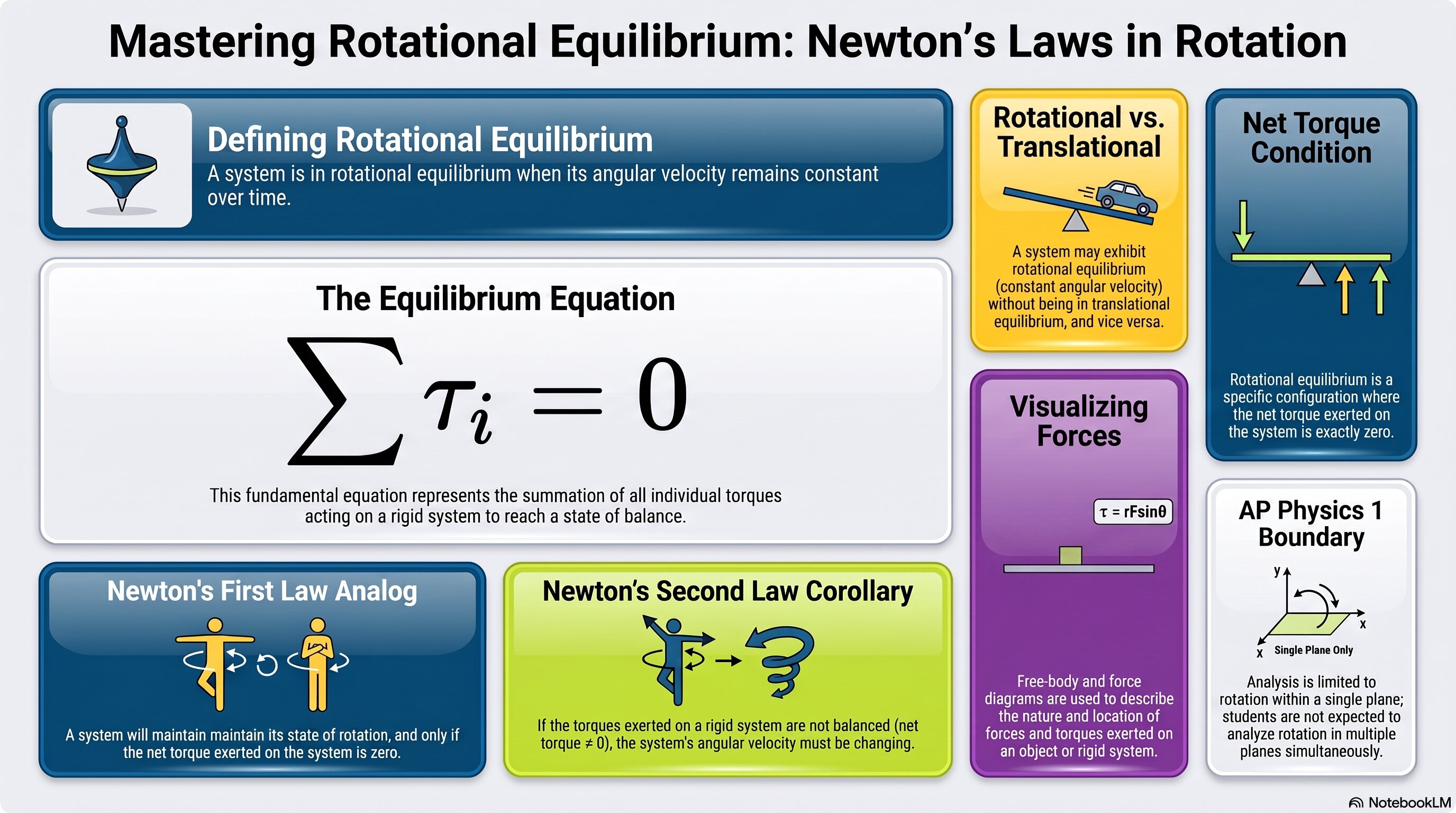
You now have all the tools — torque from 5.3, rotational inertia from 5.4. This lesson asks: what happens when torques balance? When the net torque on a rigid system is zero, angular velocity stays constant. That is rotational equilibrium — and it is the direct rotational analog of Newton's First Law: a system maintains its state of rotation unless acted upon by a net torque.
The most powerful skill in this lesson is pivot choice. Because Στ = 0 must hold for any pivot point, you are free to choose whichever axis makes the algebra simplest. Placing the pivot at the location of an unknown force eliminates it from the equation entirely — because a force acting at the axis has zero lever arm.
Two types of equilibrium — independent of each other
What you will do in this lesson
- State the rotational equilibrium condition: Στ = 0 (net torque equals zero).
- Explain that equilibrium means constant omega — including omega = 0 (static) or omega ≠ 0 (dynamic).
- Distinguish rotational from translational equilibrium — each requires its own separate condition.
- Choose a strategic pivot point to eliminate unknown forces from the torque equation.
- Set up and solve Στ = 0 for balance problems including seesaws, beams, and hinged structures.
- Draw torque force diagrams with forces at exact points of application.
Why it matters
Rotational equilibrium problems are the most heavily tested torque application on the AP exam. Seesaw balance, beam support reactions, and hinged structure problems all use Στ = 0. The pivot choice skill is what separates students who get these right quickly from those who get buried in simultaneous equations with multiple unknowns.
✅ Self-Check Before You Roll On
Check off each item as you get there. These are not grades — they are your own signal.