The season finale — tau_net = I*alpha ties together every concept in Unit 5 and unlocks the most powerful rotational problems on the AP exam · Approx. 3–4 class days
Use this as a quick reference for tau_net = I*alpha, the proportional and inverse relationships, and the combined linear+rotational analysis framework.
🧭 Plot Summary
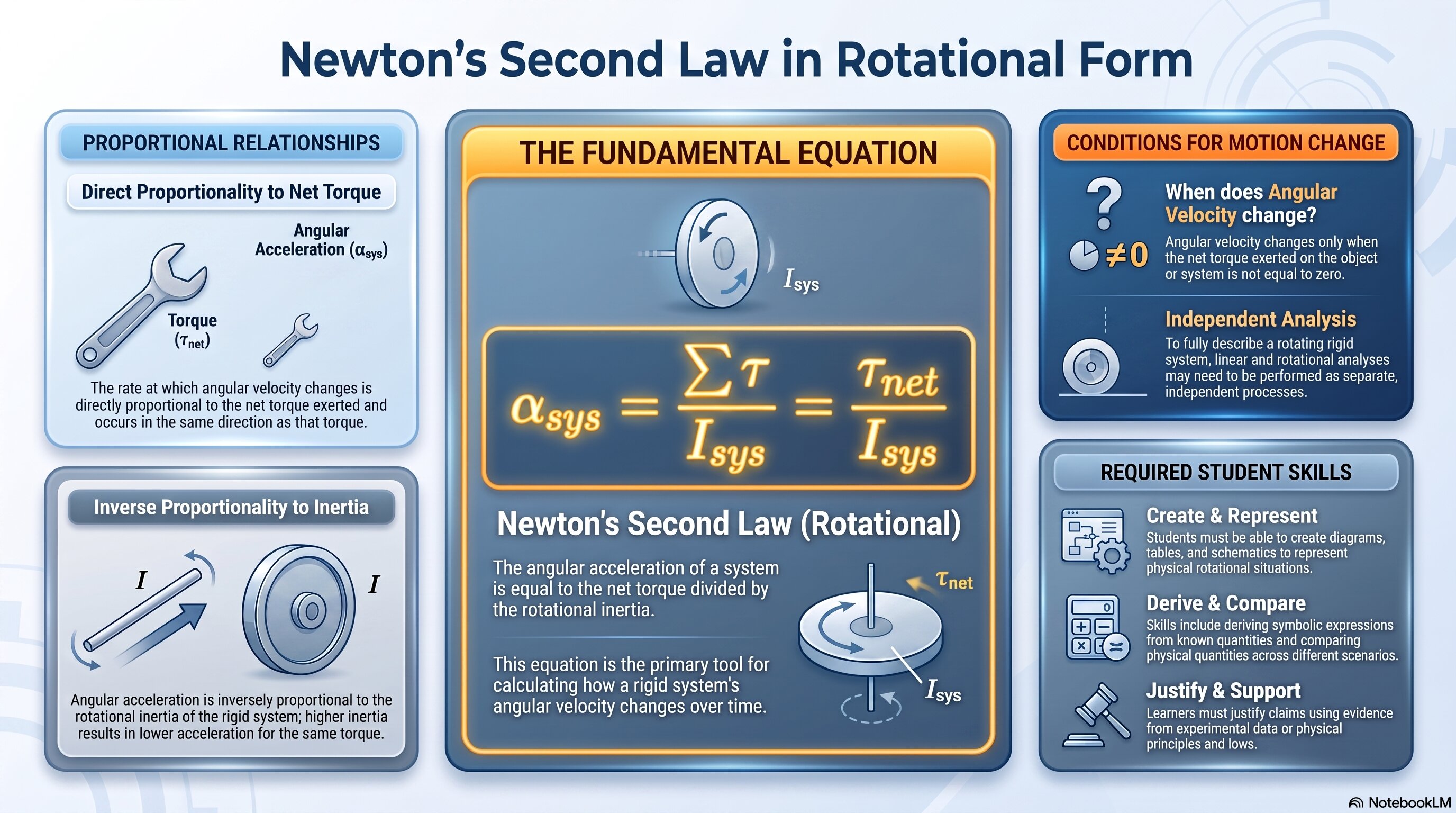
This is the season finale. Every lesson in Unit 5 has been building toward this moment: tau_net = I * alpha. Net torque equals rotational inertia times angular acceleration. It is F = ma in rotational form — the equation that predicts how a rigid system's rotation actually changes when torques are unbalanced.
The most powerful application is the combined linear and rotational problem — a hanging mass driving a pulley, a wheel accelerating on an axle, a yo-yo falling. These problems require two separate equations (one linear, one rotational) connected by the kinematic bridge a = r*alpha. That connection is the skill that distinguishes AP scores.
The two proportional relationships
Direct — torque and alpha
alpha ∝ tau_net
For constant I: doubling tau_net doubles alpha. The system spins up twice as fast when you apply twice the torque.
Inverse — inertia and alpha
alpha ∝ 1/I
For constant tau_net: doubling I halves alpha. A heavier, spread-out disk responds sluggishly to the same torque.
What you will do in this lesson
State Newton's Second Law in rotational form: tau_net = I * alpha (or alpha = tau_net / I).
Explain direct proportionality: doubling tau_net doubles alpha for constant I.
Explain inverse proportionality: doubling I halves alpha for constant tau_net.
Set up and solve combined linear + rotational problems using a = r*alpha to link them.
Recognize that angular velocity changes only when Στ ≠ 0.
Perform linear and rotational analyses as separate, independent processes then connect them.
Why it matters
tau_net = I*alpha is the single most important equation in Unit 5. It unifies torque (5.3), rotational inertia (5.4), and the equilibrium condition (5.5) into one predictive tool. The combined linear+rotational problem type appears on virtually every AP Physics 1 exam — master this and you are ready for the Progress Check and the full exam.
✅ Self-Check Before You Roll On
Check off each item as you get there. These are not grades — they are your own signal.