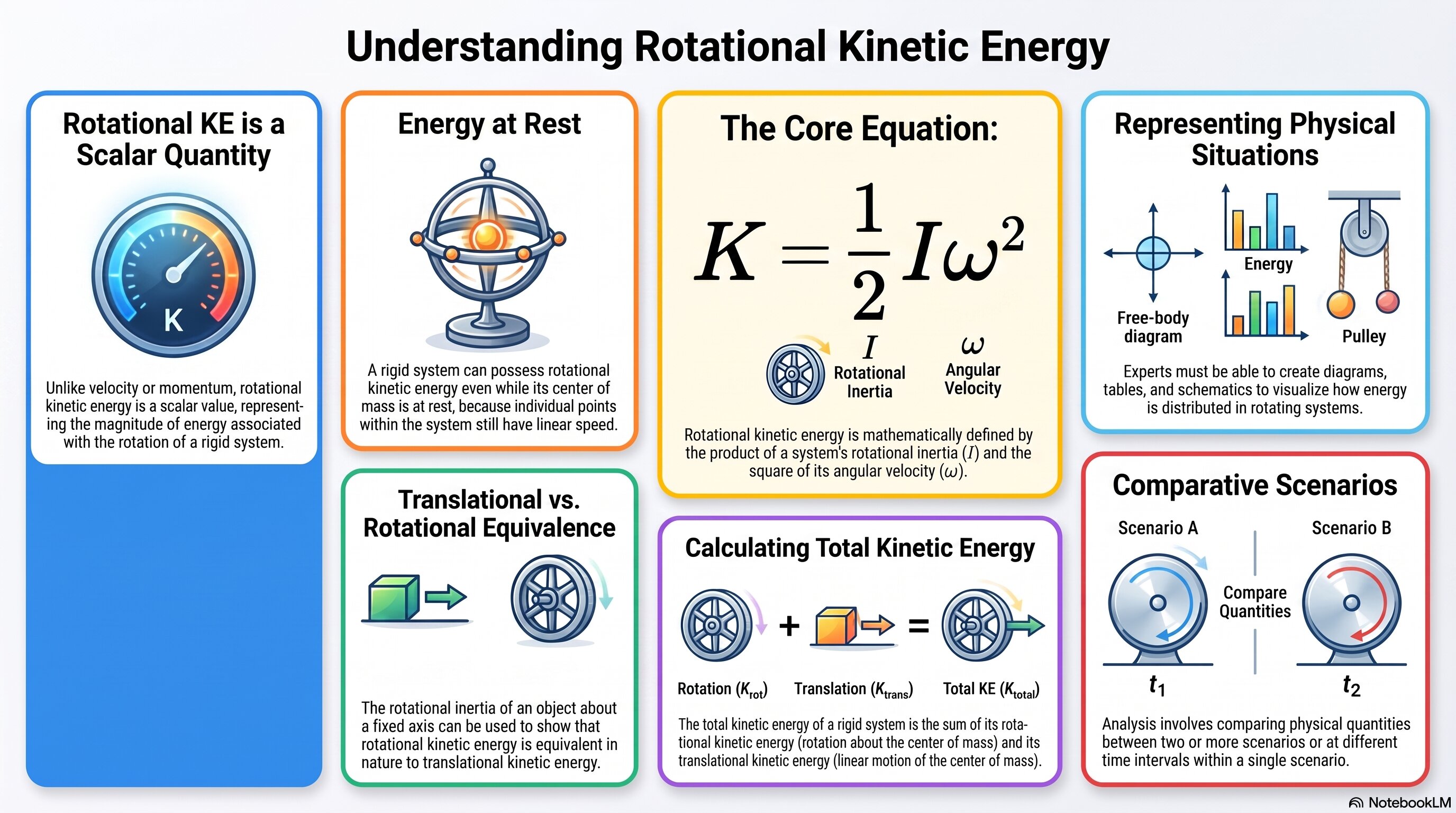
Use this as a quick reference for K = ½Iω², the energy-at-rest concept, and the total KE formula.
🧭 Plot Summary
In Unit 3 you learned that moving objects carry kinetic energy: K = ½mv². This lesson extends that idea to rotation. A spinning wheel has kinetic energy even if its center of mass never moves — because every point on the wheel is moving in a circle. That energy is rotational kinetic energy: K_rot = ½Iω². The structure is identical to the linear formula — rotational inertia I plays the role of mass, and angular velocity ω plays the role of linear velocity.
When an object both translates and rotates — like a rolling ball — its total KE is the sum of both contributions. The center of mass carries translational KE; the rotation about the center of mass carries rotational KE.
The structural analogy
Translational KE
K = ½ * m * v²
m = resistance to linear acceleration. v = linear speed of CM.
Rotational KE
K = ½ * I * omega²
I = resistance to angular acceleration. omega = angular speed of rotation.
What you will do in this lesson
Define rotational kinetic energy as K_rot = ½ * I * omega² — a scalar, always positive.
Explain the energy-at-rest concept: CM stationary but individual points have KE via v = r*omega.
Calculate total KE of a rigid system: K_total = ½mv²_cm + ½I*omega².
Apply the rotational work-energy theorem: W_net = DK_rot.
Compare K_rot across scenarios where I or omega changes by known factors.
Why it matters
Rotational KE is the energy accounting tool for everything that spins in Unit 6. Without it you cannot solve rolling problems (6.5), analyze the energy stored in a flywheel, or track energy conservation in a system where a falling mass drives a rotating pulley. It is also the energy side of the angular momentum story — both are needed to fully describe rotating systems.
✅ Self-Check Before You Roll On
Check off each item as you get there. These are not grades — they are your own signal.