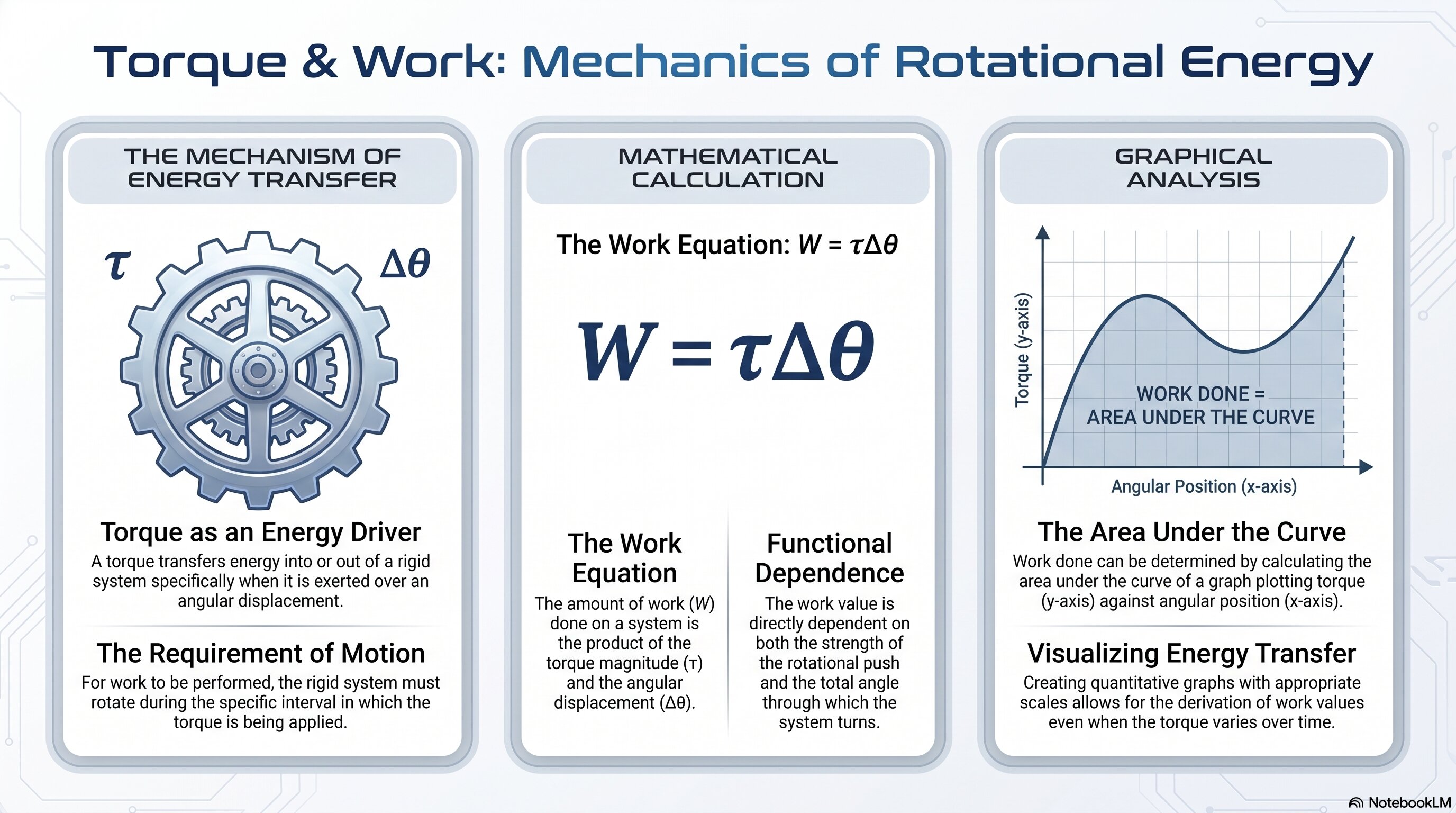
Use this as a quick reference for W = τΔθ, the area-under-the-curve graphical skill, and the requirement of motion.
🧭 Plot Summary
In Unit 3 you learned that work equals force times displacement: W = Fd. This lesson delivers the rotational counterpart. A torque acting through an angular displacement does work on a rotating system: W = τΔθ. The structure is identical — torque replaces force, angular displacement replaces linear displacement. The units work out to Joules either way.
The crucial condition: the system must actually rotatefor work to be done. A torque applied to a locked (non-rotating) system does zero work, regardless of how large the torque is — because Δθ = 0. This is the rotational analog of pushing on a wall: huge force, zero displacement, zero work.
The linear-to-rotational work analogy
What you will do in this lesson
- Define rotational work as W = tau * Dtheta for a constant torque acting through angular displacement Dtheta.
- Explain the requirement of motion: torque alone does no work without angular displacement.
- Find work from the area under a torque vs. angular position graph for variable torques.
- Apply the rotational work-energy theorem: W_net = DK_rot.
- Calculate rotational power: P = tau * omega.
- Determine the sign of rotational work from the alignment of torque and rotation direction.
Why it matters
W = τΔθ is the energy-input mechanism for all rotating systems. Every time a motor spins a wheel, a belt drives a pulley, or a wrench tightens a bolt, rotational work is being done. Combined with K_rot = ½Iω² from 6.1, it gives you the full rotational energy budget — what goes in, what comes out, and what gets stored.
✅ Self-Check Before You Roll On
Check off each item as you get there. These are not grades — they are your own signal.