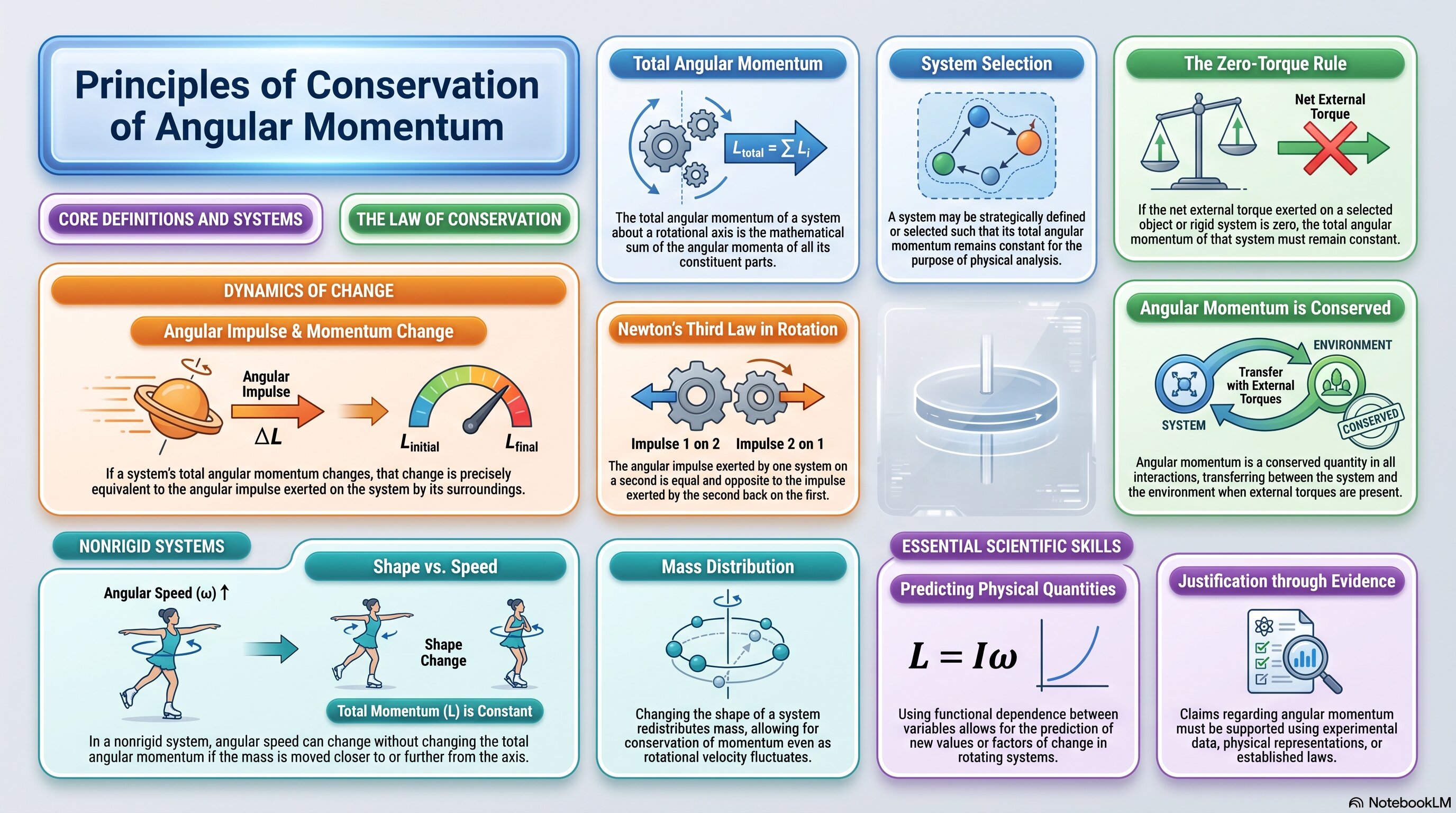
Use this as a quick reference for L_i = L_f, the zero-torque rule, nonrigid systems, system selection, and Newton's Third Law in rotation.
🧭 Plot Summary
This is the payoff of Lesson 6.3. You now know that angular momentum L = Iω can be changed by an angular impulse. This lesson asks: what happens when nothing outside the system applies a torque? The answer is the conservation of angular momentum — L_total stays constant forever, even as the system rearranges its mass, changes shape, or has internal collisions.
The condition is simple: net external torque = 0. When that holds, the total angular momentum of the system cannot change. For a nonrigid system that changes shape (like a skater pulling arms in), I decreases so ω must increase to keep L = Iω constant. For a collision between a spinning and a stationary object, L is shared between them after contact — but the total remains unchanged.
Three problem types in this lesson
What you will do in this lesson
- State the conservation law: L_total = constant when net external torque = 0.
- Apply L_i = L_f in the form I_1*omega_1 = I_2*omega_2 for shape-changing systems.
- Define the system strategically so that internal torques cancel and external torques are zero.
- Apply Newton's Third Law in rotation: equal and opposite angular impulses between interacting objects.
- Solve collision-style angular momentum problems where spinning and stationary objects interact.
- Justify conservation claims with evidence from physical representations and laws.
Why it matters
Conservation of angular momentum is one of the most fundamental laws in physics — it holds from spinning electrons to orbiting galaxies. On the AP exam it appears as FRQs requiring before/after diagrams, an explicit statement of the condition for conservation, and algebraic solutions. It also appears qualitatively: "what happens to omega if I is halved?" Answer: omega doubles.
✅ Self-Check Before You Roll On
Check off each item as you get there. These are not grades — they are your own signal.