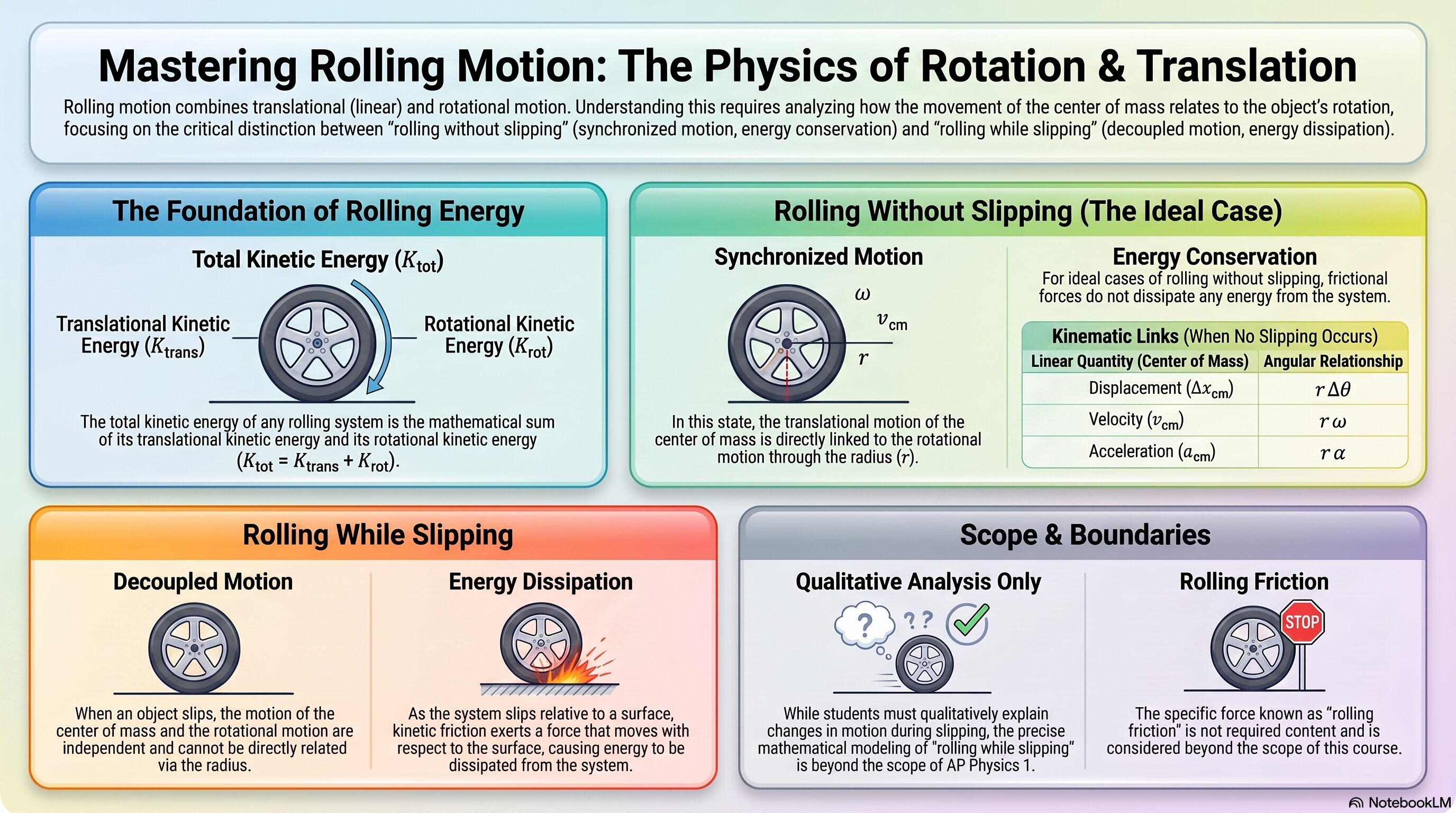
Use this as a quick reference for total rolling kinetic energy, the rolling-without-slipping kinematic links, energy conservation, and the boundary between qualitative and quantitative slipping.
🧭 Plot Summary
This lesson connects two ideas you already know from Unit 5 and earlier in Unit 6: an object moving through space has translational kinetic energy, and a spinning object has rotational kinetic energy. A rolling object — a wheel, a ball, a yo-yo — has both at once, so K_tot = K_trans + K_rot.
The interesting physics shows up when you ask how the translation and rotation are related. When an object rolls without slipping, the contact point with the ground is instantaneously at rest — that single fact locks v_cm, a_cm, and Δx_cm to ω, α, and Δθ through the radius r. When an object slips instead, that lock breaks: v_cm and ω go their own separate ways, and kinetic friction starts converting mechanical energy into heat.
Three flavors of rolling
What you will do in this lesson
- State K_tot = K_trans + K_rot for any object with both translational and rotational motion.
- Apply v_cm = rω, a_cm = rα, and Δx_cm = rΔθ for rolling without slipping.
- Explain why the contact point is instantaneously at rest relative to the surface when rolling without slipping — so static friction does zero work.
- Distinguish rolling while slipping, where v_cm and ω decouple from the radius r.
- Explain why kinetic friction dissipates energy when the contact point slides relative to the surface.
- Recognize the AP boundary: quantitative modeling of slipping, and rolling friction itself, are both beyond the scope of this course.
Why it matters
Nearly every wheel you have ever seen — bicycles, cars, yo-yos, bowling balls skidding down the lane before they grip — is either rolling without slipping or transitioning into it. On the AP exam this shows up as qualitative reasoning: identify whether an object is slipping, explain which way friction points, and explain why energy is or is not conserved. No new equations here — just careful reasoning about a single physical condition.
✅ Self-Check Before You Roll On
Check off each item as you get there. These are not grades — they are your own signal.