Use this as a quick reference for the central-object approximation, circular vs. elliptical orbit conservation laws, and the escape velocity derivation.
🧭 Plot Summary
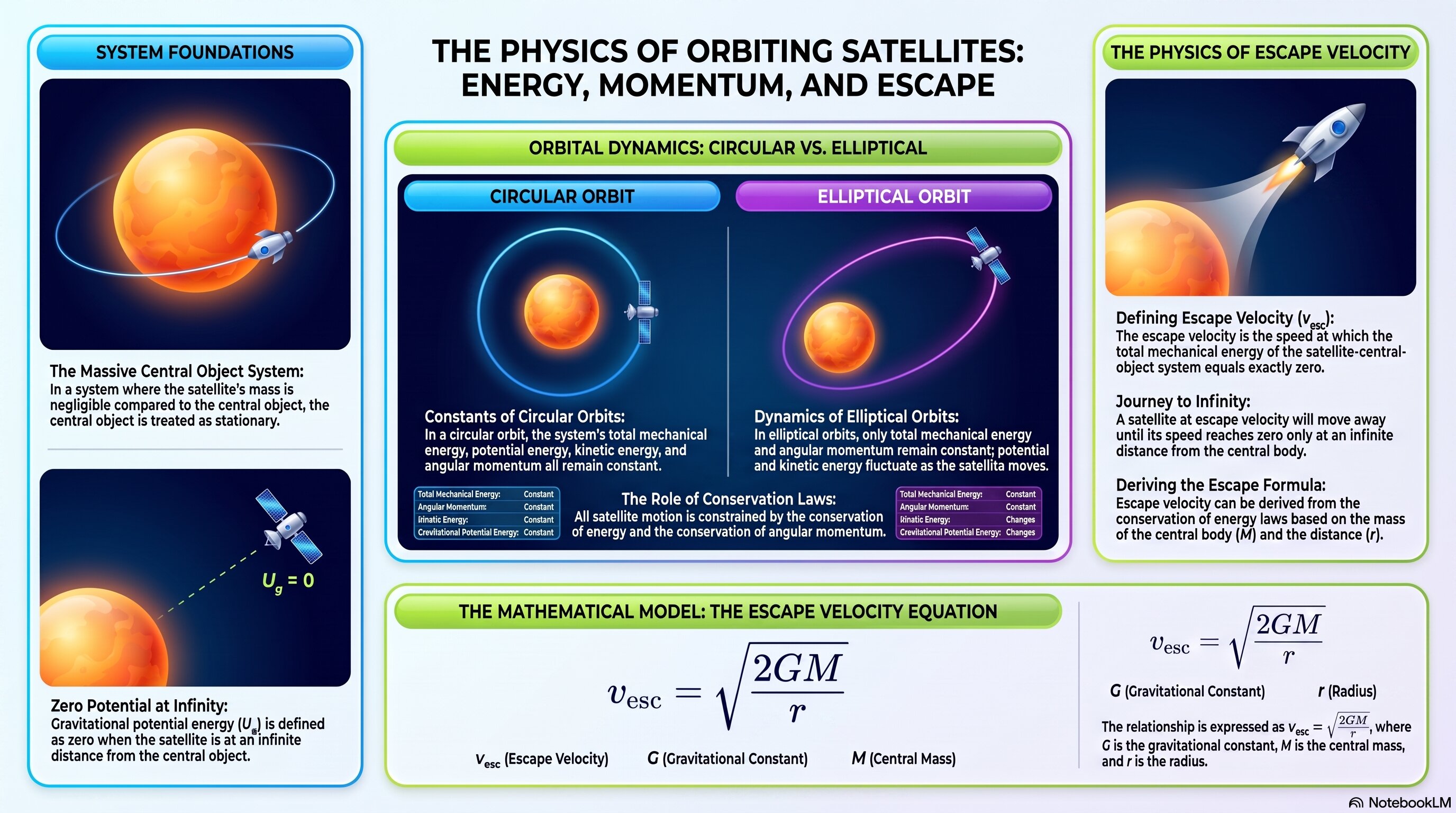
This is the capstone of Unit 6 — and it borrows from almost everything you've built so far. A satellite orbiting a much more massive central object is a two-body system in which the central object barely moves, so we treat it as stationary. What actually happens to the satellite is governed entirely by two conservation laws: conservation of energy and conservation of angular momentum.
In a circular orbit, the distance to the central object never changes, so every energy-related quantity is constant. In an elliptical orbit, the distance constantly changes — so gravitational PE and kinetic energy trade off continuously, even though the total mechanical energy and angular momentum never do. Push the energy trade-off far enough and you reach escape velocity: the exact speed at which total mechanical energy equals zero.
Three orbital regimes
What you will do in this lesson
- Treat the central object as effectively stationary when the satellite's mass is negligible by comparison.
- Identify which quantities stay constant in a circular orbit: E_total, U_g, KE, and L.
- Identify which quantities stay constant — and which change — in an elliptical orbit.
- Explain why U_g is defined as zero at infinite separation.
- Define escape velocity as the condition E_total = 0.
- Derive v_esc = √(2GM/r) from conservation of energy.
Why it matters
Every satellite, moon, and planet in orbit obeys exactly these two conservation laws — no new physics, just energy and angular momentum applied to gravity. On the AP exam this shows up as comparison questions ("is the satellite faster here or there, and why?") and as the escape velocity derivation, a classic multi-step FRQ pathway built entirely from conservation of energy.
✅ Self-Check Before You Roll On
Check off each item as you get there. These are not grades — they are your own signal.