Use this as a quick reference for periodic vs. harmonic motion, the restoring force, the equilibrium position, the F-vs-x proportionality, and the pendulum model.
🧭 Plot Summary
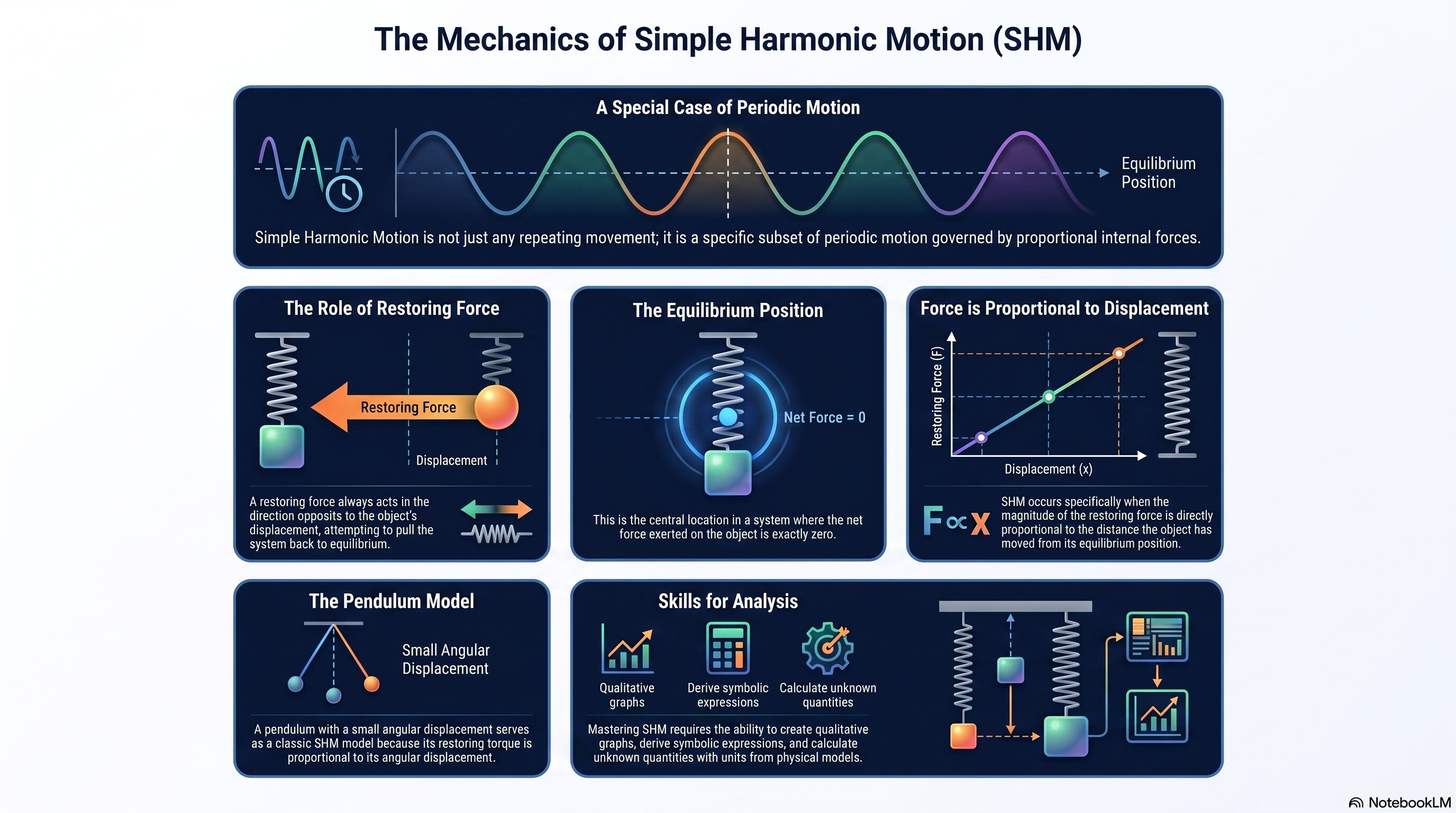
Unit 7 opens with a definition — and it's a more specific one than you might expect. Lots of things repeat: a bouncing ball, a satellite in orbit, a person walking. Simple harmonic motion (SHM)is periodic motion, but it's periodic motion of a very particular kind: motion driven by a restoring force whose magnitude is proportional to the object's displacement from equilibrium.
A restoring force always points opposite the displacement — it's always trying to pull the system back home. The equilibrium position is simply where the net force is zero. The most familiar example is an ideal spring, where Hooke's law F = -kx is the SHM condition written out explicitly. But the same condition shows up somewhere less obvious too: a pendulum swinging through a small angle, where the restoring torque is proportional to the angular displacement.
Two systems, one condition
What you will do in this lesson
- Recognize SHM as a special case of periodic motion — not every repeating motion qualifies.
- Identify the restoring force in a system: it always opposes the displacement from equilibrium.
- Identify the equilibrium position as the location where net force is zero.
- State the defining condition for SHM: restoring force magnitude ∝ displacement.
- Explain why a small-angle pendulum behaves like SHM through restoring torque ∝ angular displacement.
- Connect the general SHM condition to the specific case of an ideal spring, F = -kx.
Why it matters
Everything else in Unit 7 — period, frequency, the sinusoidal position/velocity/acceleration graphs, the energy trade-off between kinetic and potential — all of it follows from this one condition. Get comfortable spotting SHM (and spotting when something only looks like SHM) before moving on, because every later lesson assumes you already can.
✅ Self-Check Before You Roll On
Check off each item as you get there. These are not grades — they are your own signal.