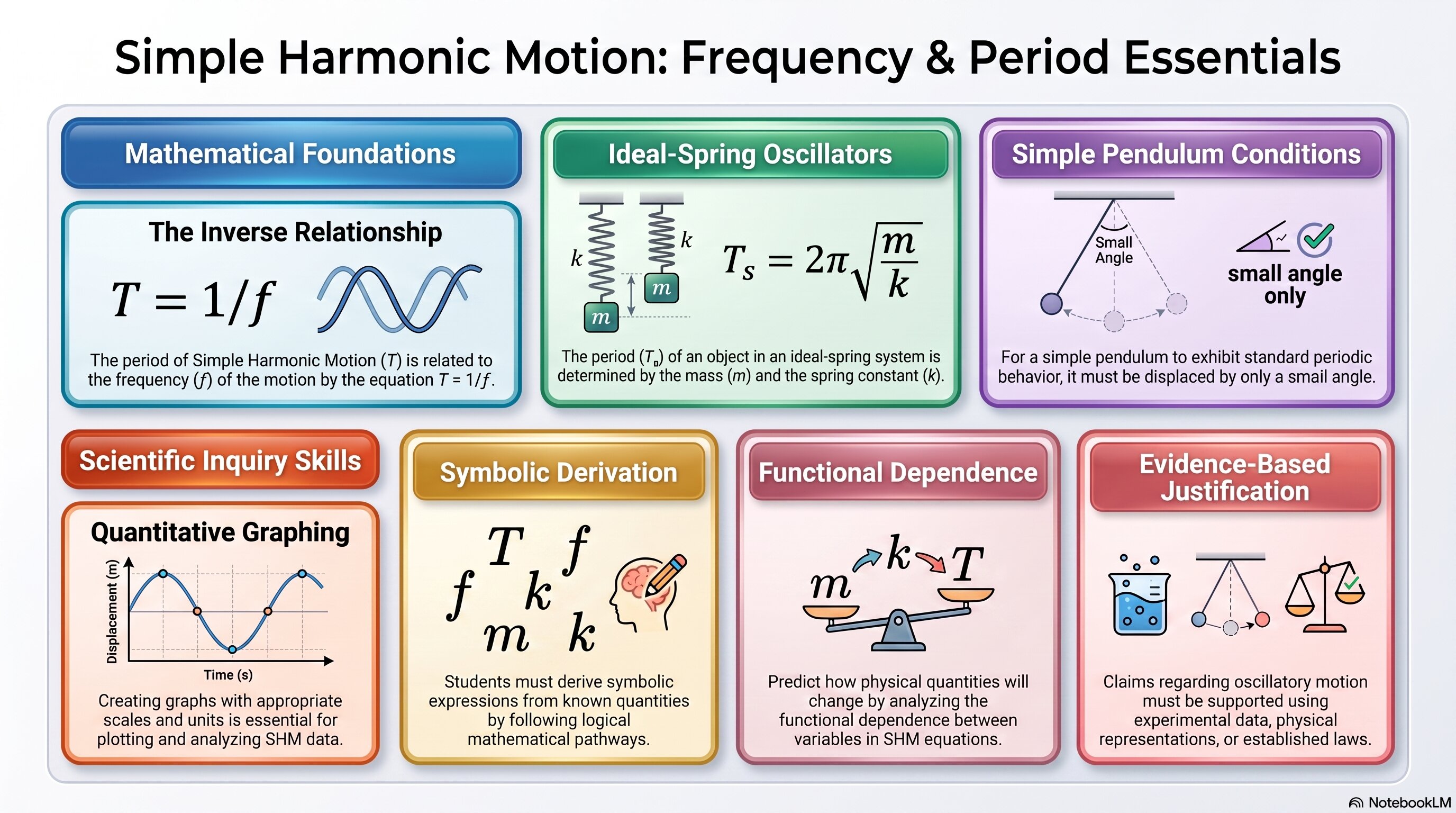
Use this as a quick reference for T = 1/f, the spring and pendulum period formulas, the small-angle condition, and the functional-dependence skill.
🧭 Plot Summary
Now that you can recognize SHM by its force condition, this lesson asks a very practical question: how long does one full oscillation take? The period, T, and frequency, f, are related the same way they always are — T = 1/f — but what determines T in the first place depends entirely on which system you're looking at.
For an ideal spring-mass system, T = 2π√(m/k) — heavier mass slows things down, a stiffer spring speeds them up. For a simple pendulum swinging through a small angle, T = 2π√(L/g) — a longer string slows things down, stronger gravity speeds them up. Notice what's missing from both formulas: neither one contains amplitude. How far you pull the mass back, or how wide you swing the pendulum, changes nothing about how long one cycle takes.
Two systems, side by side
What you will do in this lesson
- Relate period and frequency: T = 1/f.
- Apply the ideal spring oscillator period formula: T = 2π√(m/k).
- Apply the simple pendulum period formula (small angle only): T = 2π√(L/g).
- Recognize that amplitude never appears in either period formula — it simply doesn't affect T.
- Predict how T changes when m, k, L, or g changes by a given factor (functional dependence).
- Design and justify an experimental procedure to measure k or g using only length and time measurements.
Why it matters
This is where the "how does X affect Y" reasoning (functional dependence, skill 2.D) really kicks in — because both formulas involve a square root, doubling a variable never simply doubles the period. Experimentally, these two formulas are also how you can measure a spring constant with just a stopwatch, or measure the local acceleration due to gravity with nothing but a string and a ruler.
✅ Self-Check Before You Roll On
Check off each item as you get there. These are not grades — they are your own signal.