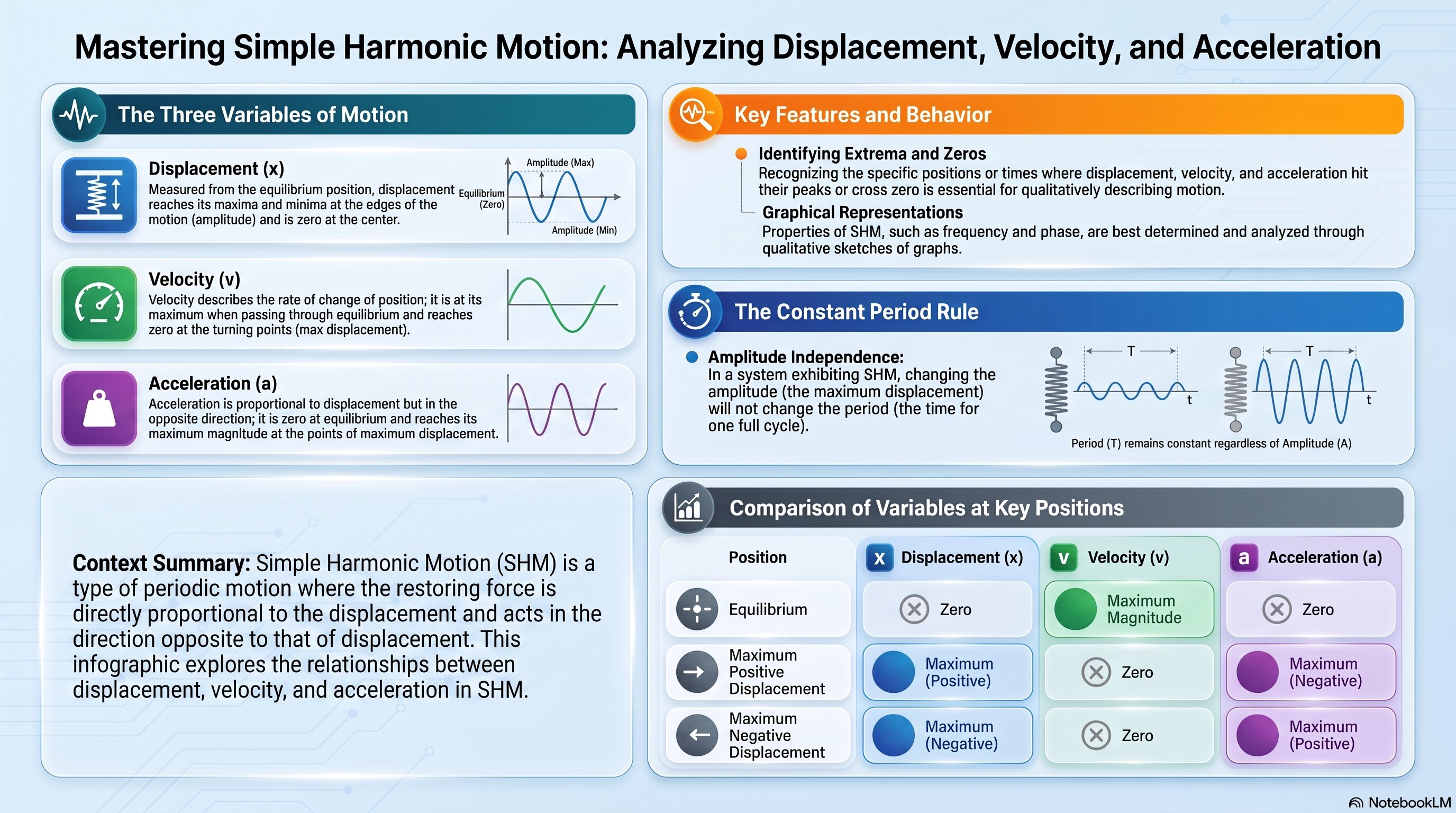
Use this as a quick reference for the three motion variables, their extrema/zeros, the constant-period rule, and the comparison table at key positions.
🧭 Plot Summary
You already know an object in SHM oscillates. This lesson is about the fact that displacement, velocity, and acceleration all oscillate too — just not in step with each other. Displacement can be written as x(t) = A cos(2πft) or x(t) = A sin(2πft), depending on where you start the clock: cosine if the object starts at maximum displacement, sine if it starts at equilibrium moving at full speed.
The real skill here is reading the relationships between all three variables without needing new formulas for v(t) and a(t) — just careful reasoning about where each one is maximum, minimum, or zero, and connecting that back to the SHM condition from Lesson 7.1: acceleration is always proportional to −x, so whenever displacement is at an extreme, acceleration is too — just pointing the other way.
Three variables, one cycle
What you will do in this lesson
- Represent displacement using x(t) = A cos(2πft) or x(t) = A sin(2πft), depending on initial conditions.
- Identify where x, v, and a reach their maxima, minima, and zeros during one cycle.
- Explain why velocity peaks at equilibrium and vanishes at the turning points.
- Explain why acceleration peaks (in magnitude) at the turning points and vanishes at equilibrium.
- Recognize that acceleration and displacement are always anti-phase — pointing in opposite directions.
- Translate between graphical, verbal, and mathematical representations of SHM — a core exam skill.
Why it matters
This is prime territory for the Translation Between Representations (TBR) free-response question — you may be asked to sketch a velocity graph given a position graph, or explain in words why acceleration is zero at a particular instant based only on a displacement graph. Fluency moving between graph, equation, and plain-English description is the actual skill being tested.
✅ Self-Check Before You Roll On
Check off each item as you get there. These are not grades — they are your own signal.