Use this as a quick reference for E_total = U + K, conservation of energy, the KE/PE trade-off, and how amplitude changes total energy.
🧭 Plot Summary
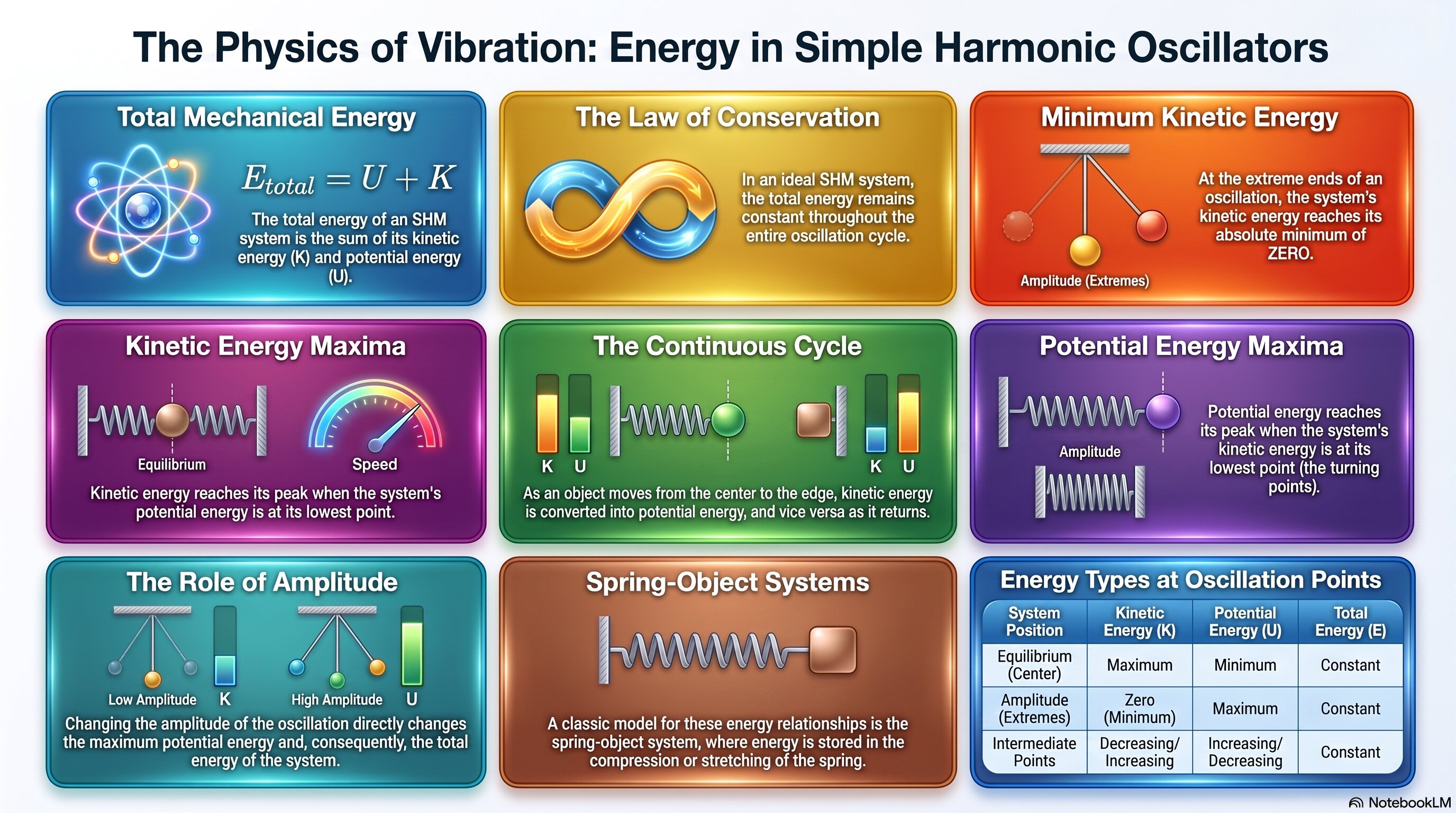
Unit 7 closes the way it started — with a sum. Back in Lesson 6.5 you learned K_tot = K_trans + K_rot. Here it's simpler still: an object in SHM has total mechanical energy E_total = U + K, and conservation of energy says that sum never changes across an entire cycle. What changes is the split between the two.
At equilibrium, kinetic energy is at its maximum and potential energy is at its minimum (zero) — the object is moving as fast as it ever will. At the turning points, it's the reverse: kinetic energy drops all the way to zero, and potential energy takes over completely. In between, the two are constantly trading off, but their sum stays locked at E_total the whole time.
Energy at three key positions
What you will do in this lesson
- State the total mechanical energy relationship: E_total = U + K.
- Apply conservation of energy: E_total stays constant throughout one cycle.
- Identify that KE is maximum exactly when PE is minimum, and vice versa.
- Recognize that minimum KE in SHM is exactly zero — occurring at the turning points.
- Explain why increasing amplitude increases both maximum PE and total energy.
- Apply U = ½kx² to a spring-object system to find energy or speed at any position.
Why it matters
This closes the loop on amplitude for the whole unit: 7.2 and 7.3 showed you amplitude doesn't touch the period. This lesson shows you amplitude absolutely does touch the energy — pull a spring back farther, and you've stored (and will eventually release) more total mechanical energy, even though it still takes the same amount of time to complete one cycle.
✅ Self-Check Before You Roll On
Check off each item as you get there. These are not grades — they are your own signal.