Quick reference for axial tilt, solstices/equinoxes, and noon sun altitude.
🧭 Plot Summary
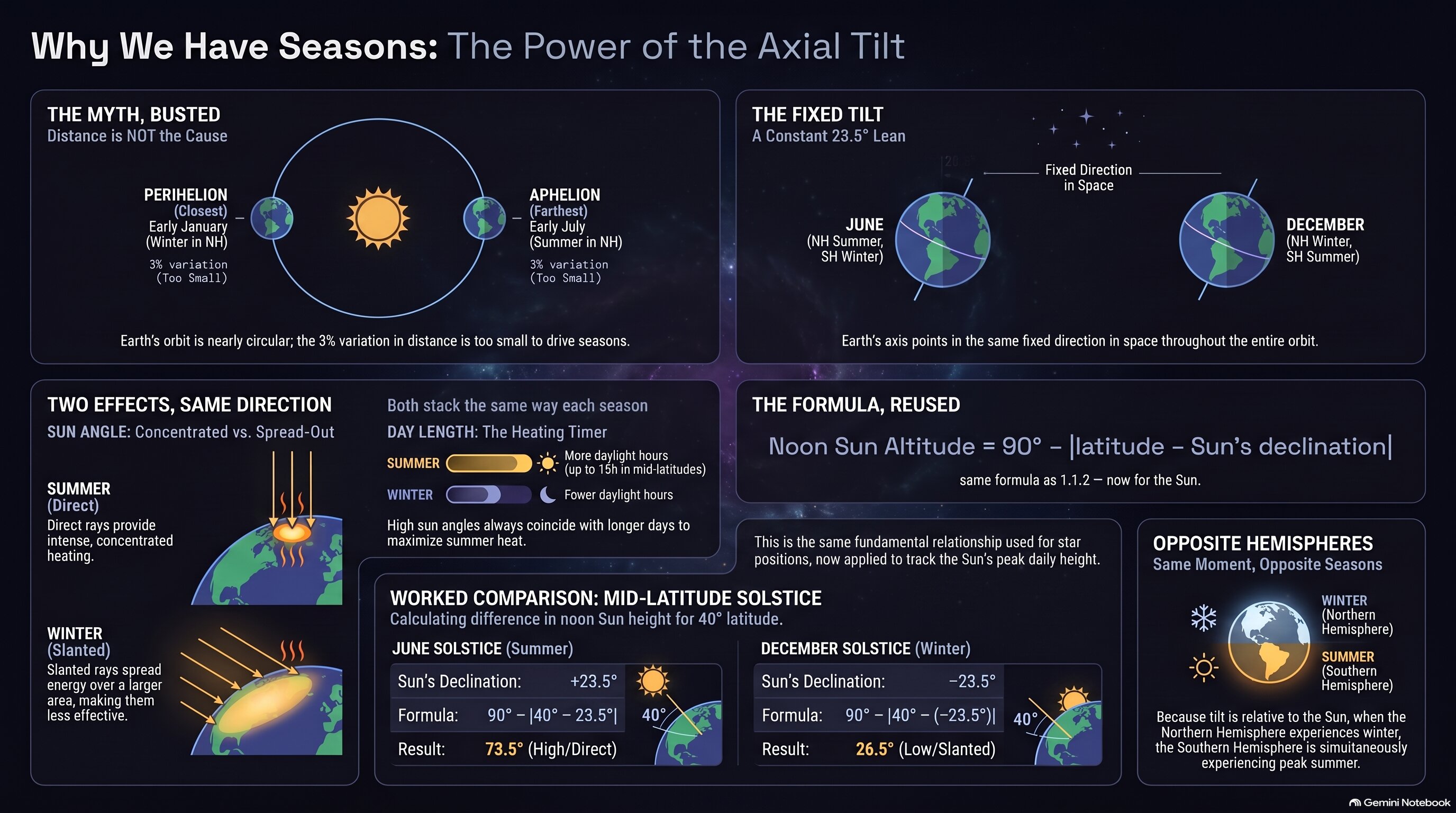
Ask most people why summer is hot and winter is cold, and you'll hear "Earth gets closer to the Sun in summer." It's the most common wrong answer in astronomy — and Earth's orbit is nearly circular, so distance barely changes at all. The real driver is Earth's 23.5° axial tilt, which stays pointed the same direction all year. As Earth orbits, that fixed tilt means the Northern Hemisphere leans toward the Sun for half the year and away from it for the other half — changing both how directly sunlight hits the ground and how many hours of daylight you get. Both effects stack in the same direction each season, which is exactly why summer feels so much hotter than the sun-angle alone would suggest.
What you'll do in this activity
- Rule out the obvious wrong answer first: Earth's distance from the Sun barely changes, and it's actually closest in January.
- Connect Earth's fixed 23.5° axial tilt to which hemisphere leans toward the Sun at different points in the orbit.
- Separate the two effects that stack up in summer: a higher sun angle, and more hours of daylight to be heated by it.
- Reuse the meridian-altitude relationship from 1.1.2 — now applied to the Sun's own changing declination across the year.
- Explain why Wisconsin's summer and Australia's summer never happen at the same time.
Why it matters
Your Eclipse Explainer project later in this unit depends on knowing exactly where the Sun sits relative to Earth and Moon at different points in the year — and the Sky Report at the end of the unit could hand you any date, in any season. This is where "any date" stops being scary.
✅ Self-Check Before You Roll On
Check off each item as you get there. These aren't grades — they're your own signal.