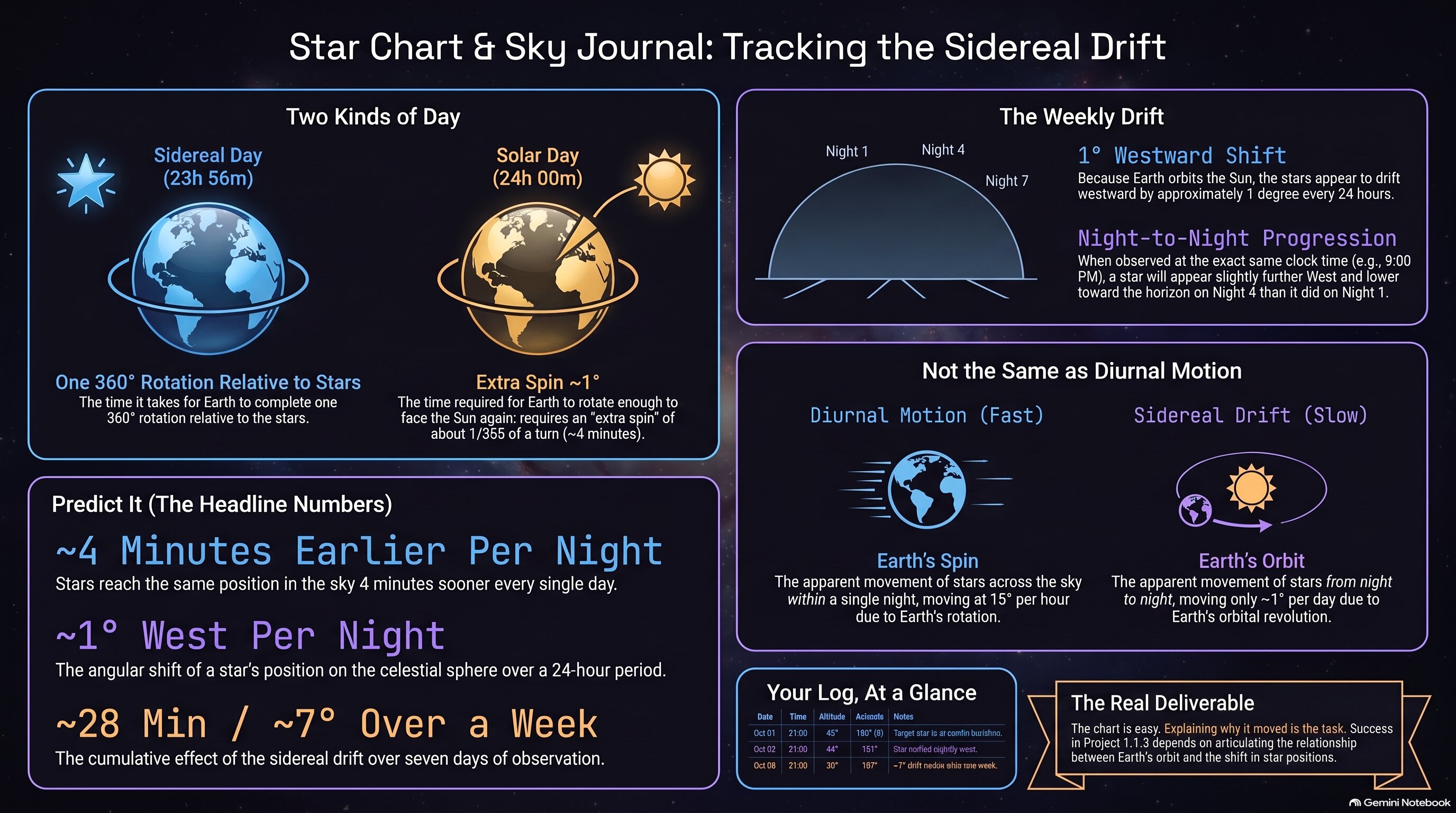
Quick reference for the sidereal/solar day difference and how the weekly drift adds up.
🧭 Plot Summary
This is where 1.1.1 and 1.1.2 stop being separate topics and start being one skill. You'll pick a constellation family, choose one fixed clock time, and log its altitude and azimuth at that exact time every night for a week. If you'd tracked its right ascension and declination instead, you'd see nothing move at all — that's the point of using alt-az here. What you'll actually watch happen is small but real: the same constellation, at the same clock time, creeps a little farther west every single night. The chart is the easy part. Explaining why it creeps — a genuinely new idea about how a day is measured — is the real task.
What you'll do in this project
- Pick a constellation family you can reliably find and track for seven nights in a row.
- Choose one fixed clock time and observation method, and log alt-az position every night at that time.
- Build a star chart from your week of logs and watch the same-time position creep westward, night after night.
- Predict the size of that weekly drift using the solar-day/sidereal-day difference, before you check it against your own data.
- Write up why it moves the way it does — the real deliverable isn't the chart, it's the explanation.
Why it matters
This is the last stop before the unit hands you a Sky Report for a date and place you don't get to pick. That problem only works if you can already predict how the sky shifts over time — not just over one night, but over days and weeks. This project is where that prediction skill gets built and tested for real, against your own data.
✅ Self-Check Before You Roll On
Check off each item as you get there. These aren't grades — they're your own signal.