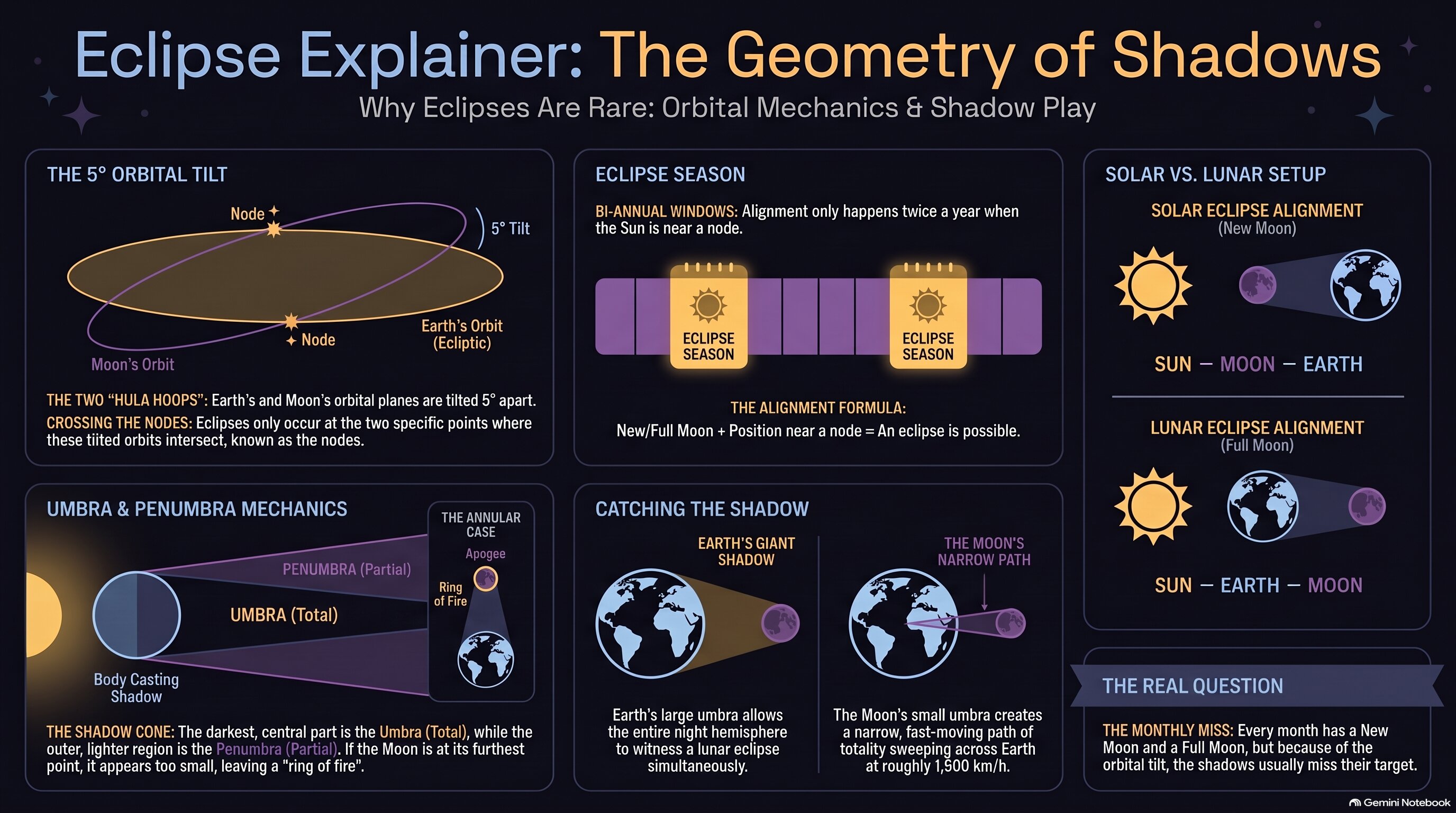
Quick reference for the tilted-orbit/node explanation and the umbra/penumbra geometry.
🧭 Plot Summary
This project answers the unit's own nagging question: the Moon orbits Earth every month, and every month brings both a New Moon and a Full Moon — so why doesn't every one of those produce an eclipse? The short answer is a 5° tilt you can't see just by looking up: the Moon's orbit doesn't sit exactly in Earth's orbital plane, so most New and Full Moons happen with the Moon slightly above or below the Sun-Earth line, not lined up with it. You'll learn exactly when that tilt does line up, how a shadow's umbra and penumbra produce total vs. partial vs. annular eclipses, and why a lunar eclipse is a whole-hemisphere event while a solar eclipse is a narrow, lucky strip of geography. Then you'll build a short, accurate explainer of it — your choice of infographic or video, with a correct geometry diagram either way.
What you'll do in this project
- Nail down the basic setup: solar eclipses need a New Moon, lunar eclipses need a Full Moon.
- Answer the unit's own essential question — why doesn't every New or Full Moon produce an eclipse?
- Learn to read umbra vs. penumbra, and total vs. partial vs. annular.
- Explain the asymmetry: why almost anyone can see a lunar eclipse, but a solar eclipse is a narrow-path event.
- Build a short, accurate explainer — infographic or video, your choice — anchored by a correct geometry diagram.
Why it matters
This is the last piece before the Sky Report — the unit's final problem hands you a date and asks whether anything (including an eclipse) will get in the way of what's visible. You can't answer that without exactly this geometry.
✅ Self-Check Before You Roll On
Check off each item as you get there. These aren't grades — they're your own signal.