Quick reference for epicycles, retrograde motion, and the Copernican model.
🧭 Plot Summary
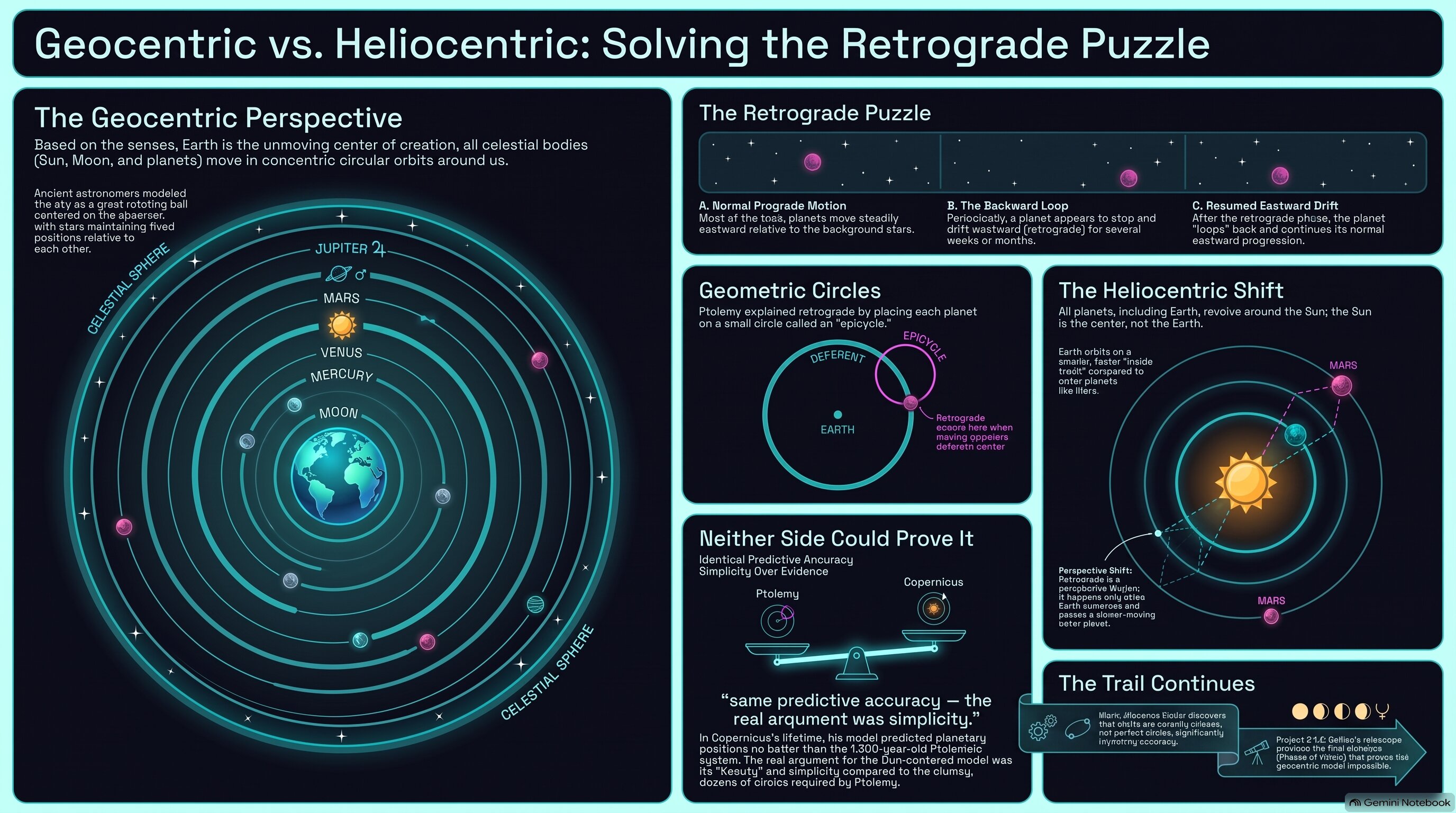
Stand still and look up, and Earth really does feel motionless while the sky turns around you — Ptolemy's Earth-centered model wasn't a mistake so much as the natural reading of direct observation, refined into a system so accurate it lasted over a thousand years. But one thing kept breaking the illusion: retrograde motion — planets that occasionally stop, drift backward against the stars, then resume forward. Ptolemy patched it with epicycles: small circles riding on bigger circles. Copernicus, over a thousand years later, showed the same backward loop falls out for free once the Sun — not Earth — sits at the center. You'll build both explanations yourself, and read what each astronomer actually argued, not just who history decided was right.
What you'll do in this activity
- Meet the ancient, intuitive case for an Earth-centered universe — and why it took real evidence to dislodge it.
- Track down the single biggest headache for any Earth-centered model: retrograde motion.
- Build, on paper, the same epicycle trick Ptolemy used to reproduce that backward loop.
- Watch the same loop fall out naturally once the Sun, not Earth, sits at the center.
- Compare Ptolemy's and Copernicus's own reasoning — not just who turned out to be right.
Why it matters
Activity 2.1.2 hands you Kepler's actual laws for how planets move — laws that only make sense once the Sun is at the center. And Project 2.1.3, The Long Argument, asks you to trace the whole evidence trail from Ptolemy through Galileo — this activity is where that trail starts.
✅ Self-Check Before You Roll On
Check off each item as you get there. These aren't grades — they're your own signal.