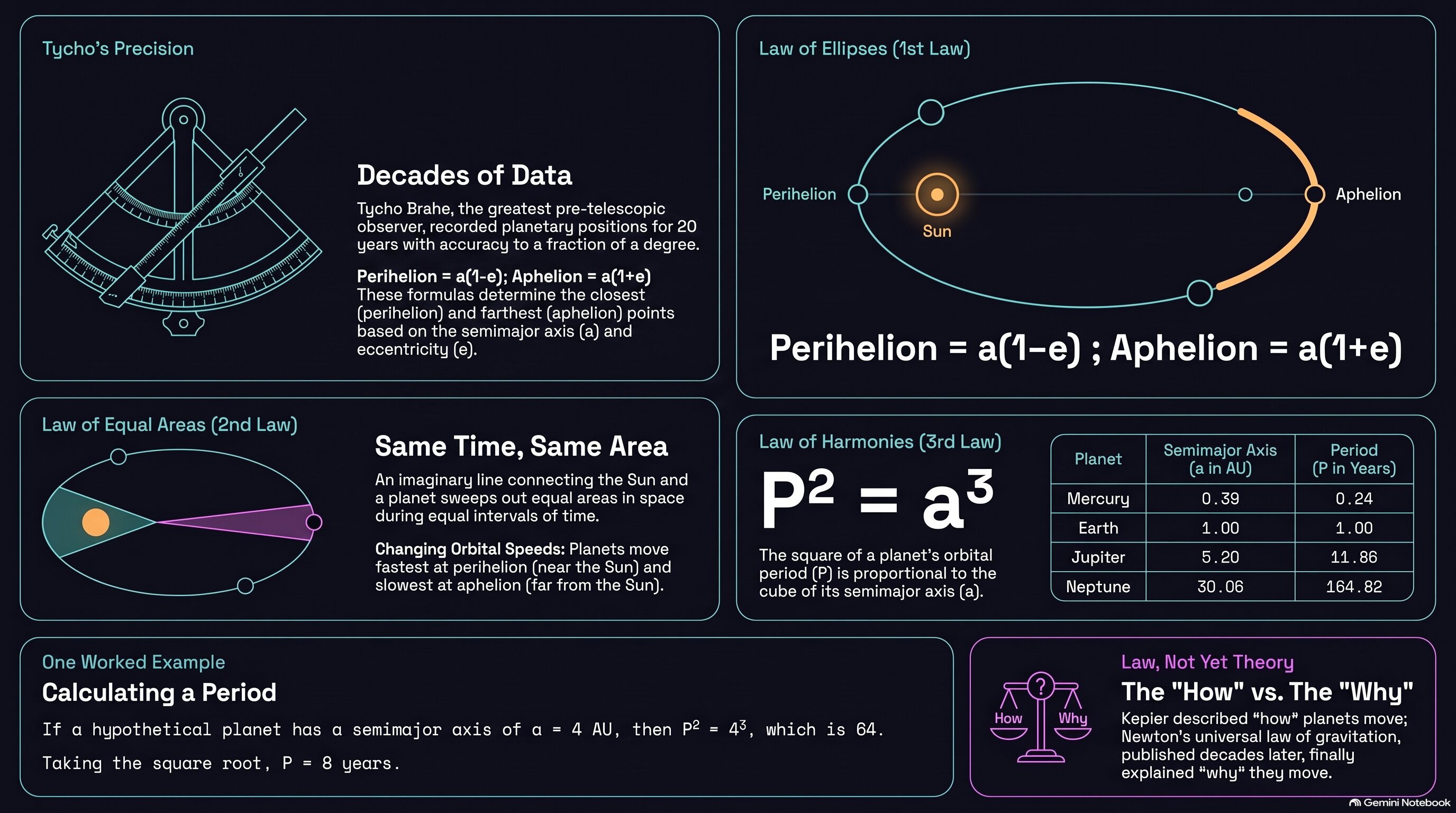
Quick reference for all three of Kepler's laws.
🧭 Plot Summary
Activity 2.1.1 ended on an unsatisfying note: Copernicus's Sun-centered model was simpler than Ptolemy's, but it wasn't actually more accurate — both still used perfect circles, and nature doesn't cooperate with that assumption. The fix came from Johannes Kepler, working from the most precise pre-telescope observations ever collected, by Tycho Brahe. Kepler discovered that planets move in ellipses, not circles, with the Sun off-center at one focus; that they speed up near the Sun and slow down far from it, in a precise, calculable way; and that a planet's orbital period and its distance from the Sun are locked together by a simple, testable equation. This is the version of heliocentrism that finally out-predicted Ptolemy — not because it was prettier, but because it matched the sky better.
What you'll do in this activity
- Meet Tycho Brahe's data — the precision Kepler needed to finally beat Ptolemy on accuracy, not just elegance.
- Learn why planetary orbits are ellipses, not circles, and where the Sun actually sits.
- Watch a planet speed up near the Sun and slow down far from it — and see why that's not a coincidence.
- Use Kepler's Third Law to connect a planet's distance to its orbital period, and check it against the real solar system.
- Close the loop from 2.1.1 — this is the evidence that actually settled the geocentric/heliocentric argument.
Why it matters
Project 2.1.3, The Long Argument, asks you to trace the full evidence trail from Ptolemy to Galileo — Kepler's laws are the strongest single piece of that trail, the moment the debate stopped being about elegance and started being about who could actually predict the sky.
✅ Self-Check Before You Roll On
Check off each item as you get there. These aren't grades — they're your own signal.