Quick reference for light-gathering power, refractors vs. reflectors, and resolving power.
🧭 Plot Summary
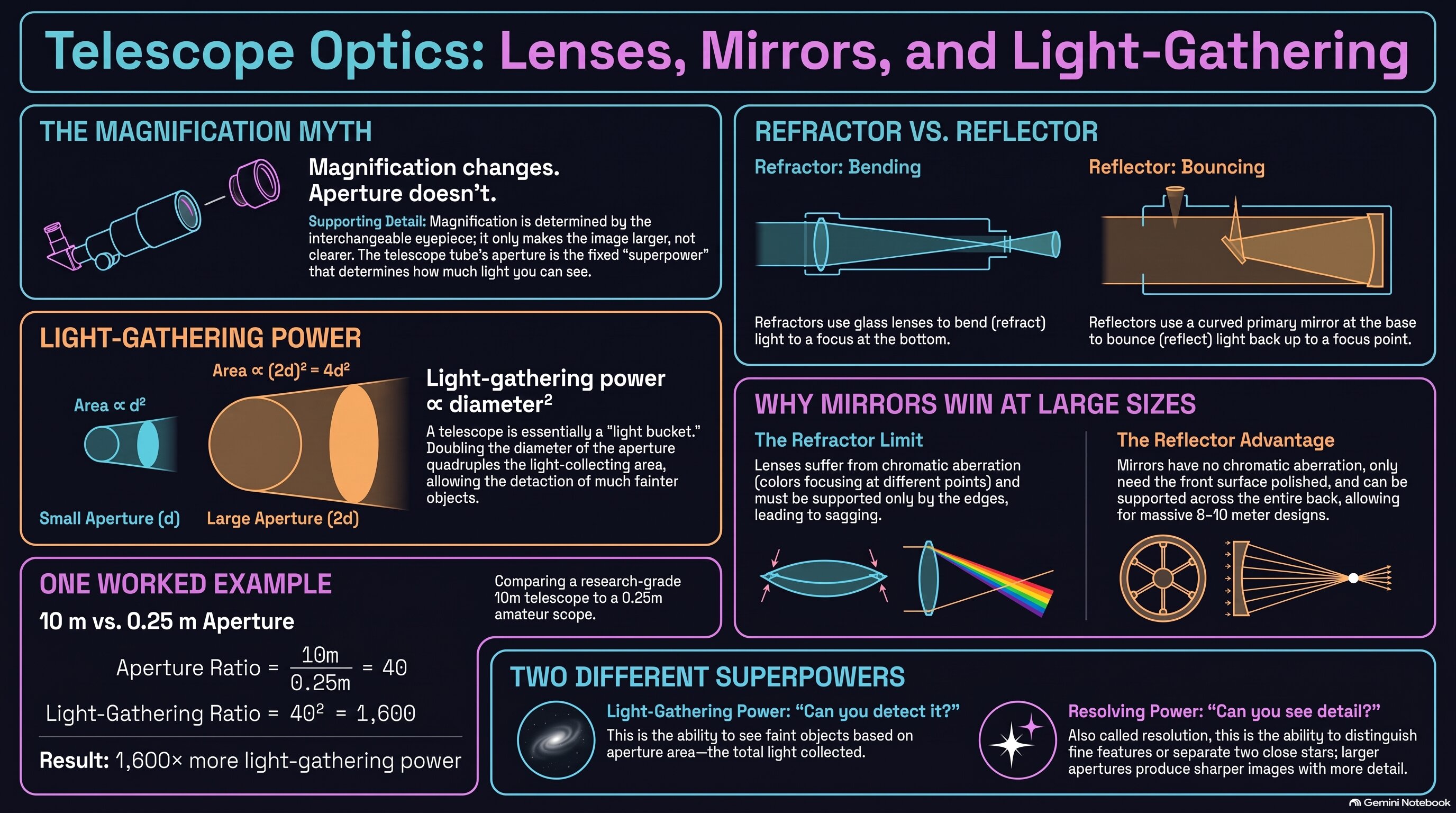
Ask what makes a telescope "powerful," and most people say magnification — how much bigger it makes things look. That's not really it, and it's not even close. Magnification comes from a small, swappable eyepiece; you can change it on the same telescope in seconds. What you can't change is the aperture — the diameter of the main lens or mirror — and that single number controls something far more important: light-gathering power, the ability to detect objects too faint to see at all otherwise. You'll compare refracting telescopes (lenses) to reflecting telescopes (mirrors), work out why almost every large research telescope today is a reflector, and learn to tell light-gathering power apart from its cousin, resolving power.
What you'll do in this activity
- Debunk the biggest myth in amateur astronomy: magnification isn't what makes a telescope powerful.
- Learn the one number that actually matters — aperture — and why light-gathering power scales with its area, not its width.
- Compare how a lens (refractor) and a mirror (reflector) each bring starlight to a focus.
- Find out why virtually every large research telescope today is a reflector, not a refractor.
- Separate two aperture-dependent superpowers that get confused: gathering light vs. resolving fine detail.
Why it matters
Project 2.2.3, Pitch the Observatory, asks you to design and defend a real instrument for a specific science question — you can't make that case without knowing exactly what aperture actually buys you.
✅ Self-Check Before You Roll On
Check off each item as you get there. These aren't grades — they're your own signal.