Quick reference for the three spectrum types and spectral fingerprints.
🧭 Plot Summary
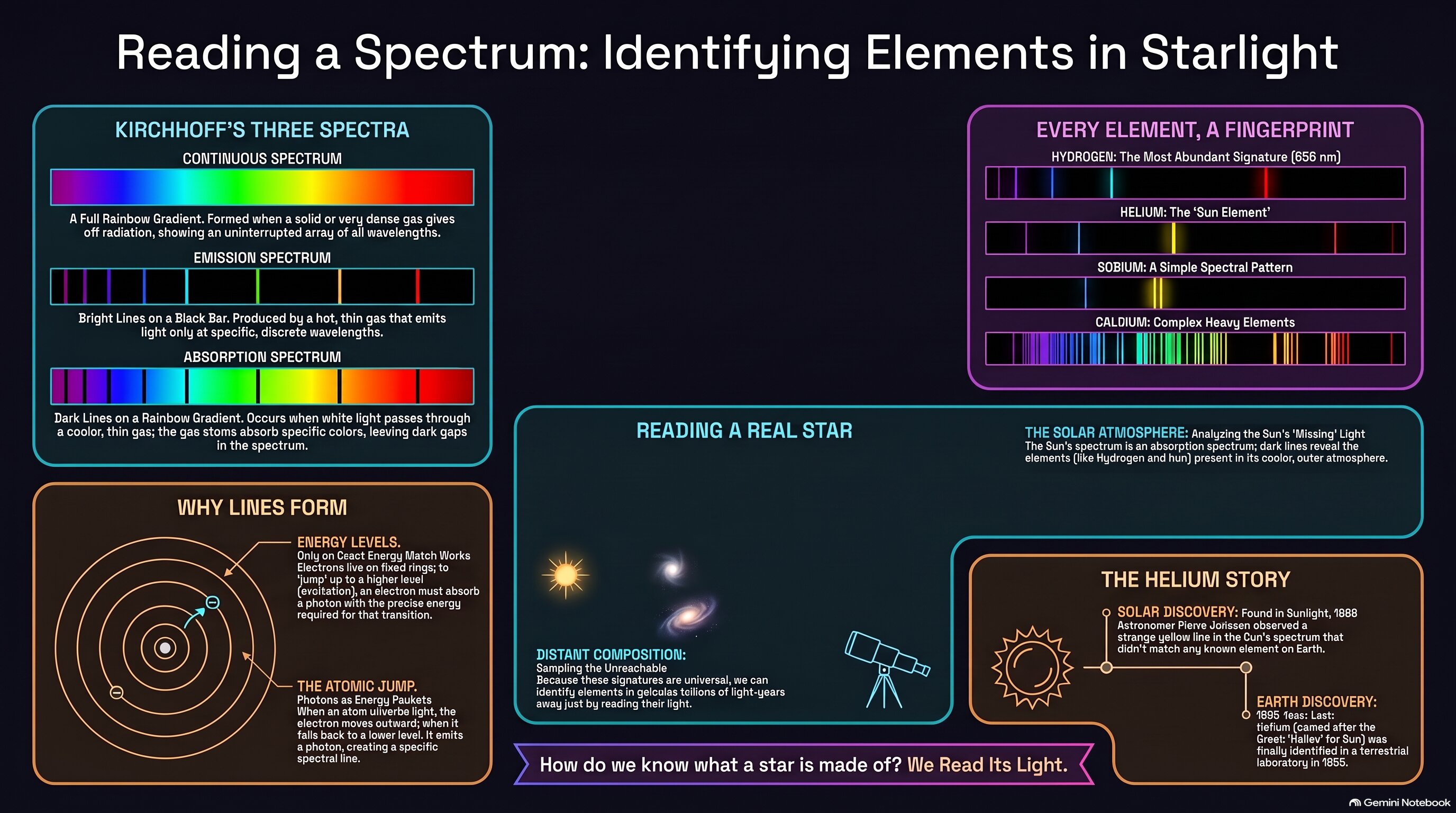
No spacecraft has ever landed on a star, and none ever will. Yet astronomers can tell you, with confidence, exactly which elements make up the Sun and stars thousands of light-years away. The trick is light itself: every element absorbs and emits only very specific wavelengths, a pattern as unique as a barcode, baked into starlight by the physics of atoms. You'll learn Kirchhoff's three types of spectra, why quantized electron energy levels force each element into its own unrepeatable pattern, and how to actually read a real star's absorption spectrum to identify what's in it — the exact skill behind one of the strangest facts in astronomy: helium was found in sunlight before it was ever found on Earth.
What you'll do in this activity
- Learn Kirchhoff's three types of spectra, and exactly what conditions produce each one.
- Connect spectral lines to quantized electron energy levels — why every element has its own unlosable fingerprint.
- Figure out why a star's spectrum shows dark absorption lines, not the pure rainbow you might expect.
- Practice matching an unknown line pattern to the element that produced it — the actual skill behind the essential question.
- Meet helium: the element discovered in sunlight decades before anyone found it on Earth.
Why it matters
Project 2.2.3, Pitch the Observatory, and Problem 2.3.1, Right Tool for the Job, both assume you can argue for spectroscopy as a real, load-bearing scientific method — not just a cool rainbow trick.
✅ Self-Check Before You Roll On
Check off each item as you get there. These aren't grades — they're your own signal.