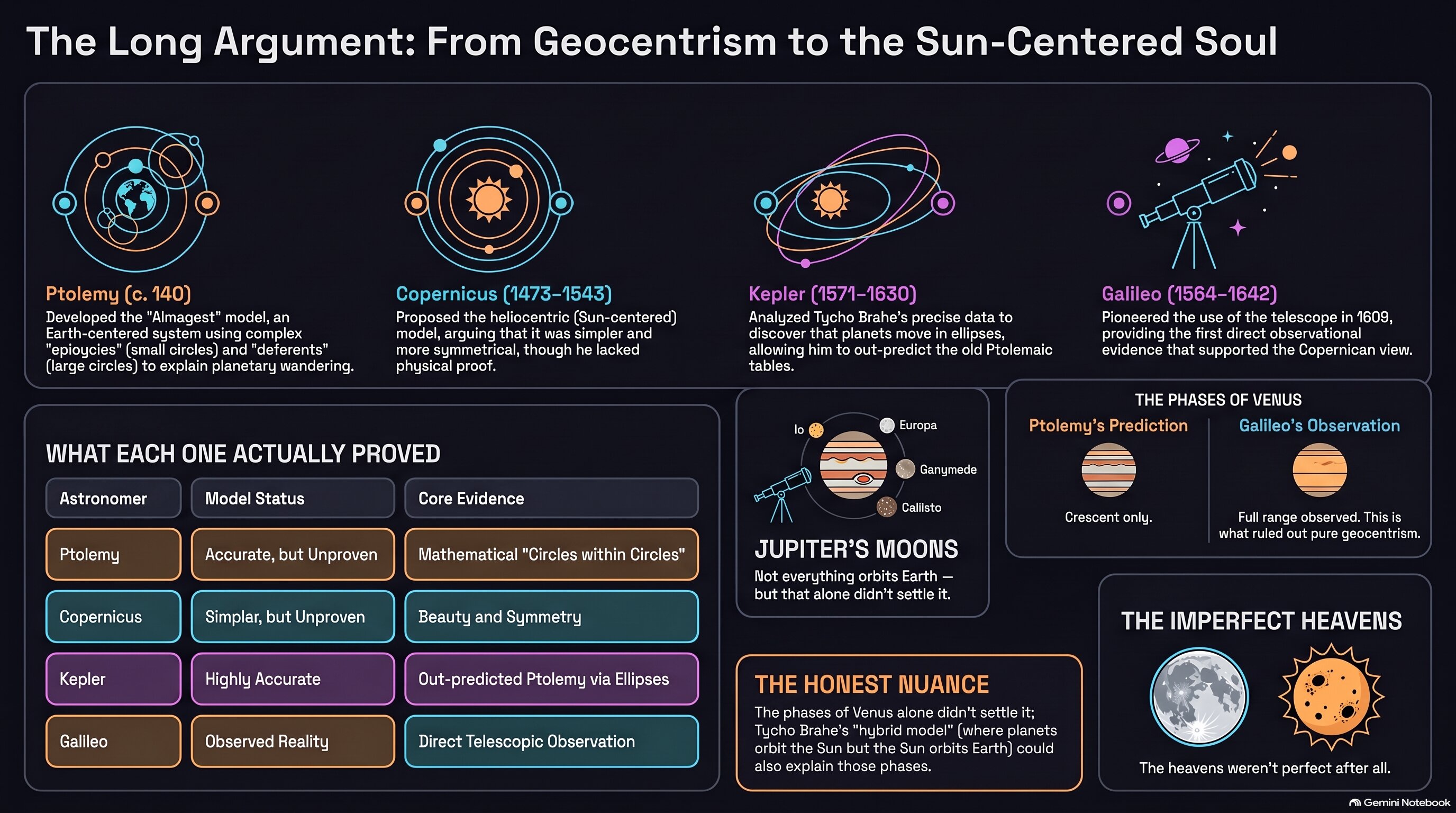
Quick reference for the full four-astronomer timeline and their specific evidence.
⏳ Plot Summary
Activities 2.1.1 and 2.1.2 gave you three-quarters of this story: Ptolemy's accurate but unproven Earth-centered system, Copernicus's simpler but equally unproven Sun-centered alternative, and Kepler's ellipses — the first real evidence that actually out-predicted Ptolemy. One name is still missing: Galileo, and the telescope, which produced a completely different kind of evidence than anything that came before it — direct observation, not just geometry on paper. You'll meet that evidence in the Deep Dive, then build a timeline or presentation tracing the whole four-astronomer arc, citing the specific evidence each one actually contributed.
1
Ptolemy
Accurate, unproven — epicycles reproduce the sky, but so does the alternative
2
Copernicus
Simpler, unproven — same accuracy, a genuinely different argument
3
Kepler
First real evidence — ellipses that actually out-predict Ptolemy
4
Galileo
Direct observation — a telescope, not a geometric argument
What you'll do in this project
Trace the argument's full arc: Ptolemy's accurate-but-unproven system, Copernicus's simpler-but-unproven alternative, Kepler's data-driven ellipses, and Galileo's telescope.
Meet the observation that finally ruled out pure geocentrism for good: the phases of Venus.
See why "proving heliocentrism" and "disproving Ptolemy" turned out to be two separate steps, not one.
Build a timeline or presentation citing the specific evidence each astronomer actually contributed — not just their names.
Why it matters
This closes out the "history" half of the unit. From here, Unit 2 turns to the tools themselves — starting with the very instrument that made Galileo's evidence possible in the first place.
✅ Self-Check Before You Roll On
Check off each item as you get there. These aren't grades — they're your own signal.