Quick reference for the electromagnetic spectrum, atmospheric windows, and matching an instrument to a science question.
🛰️ Plot Summary
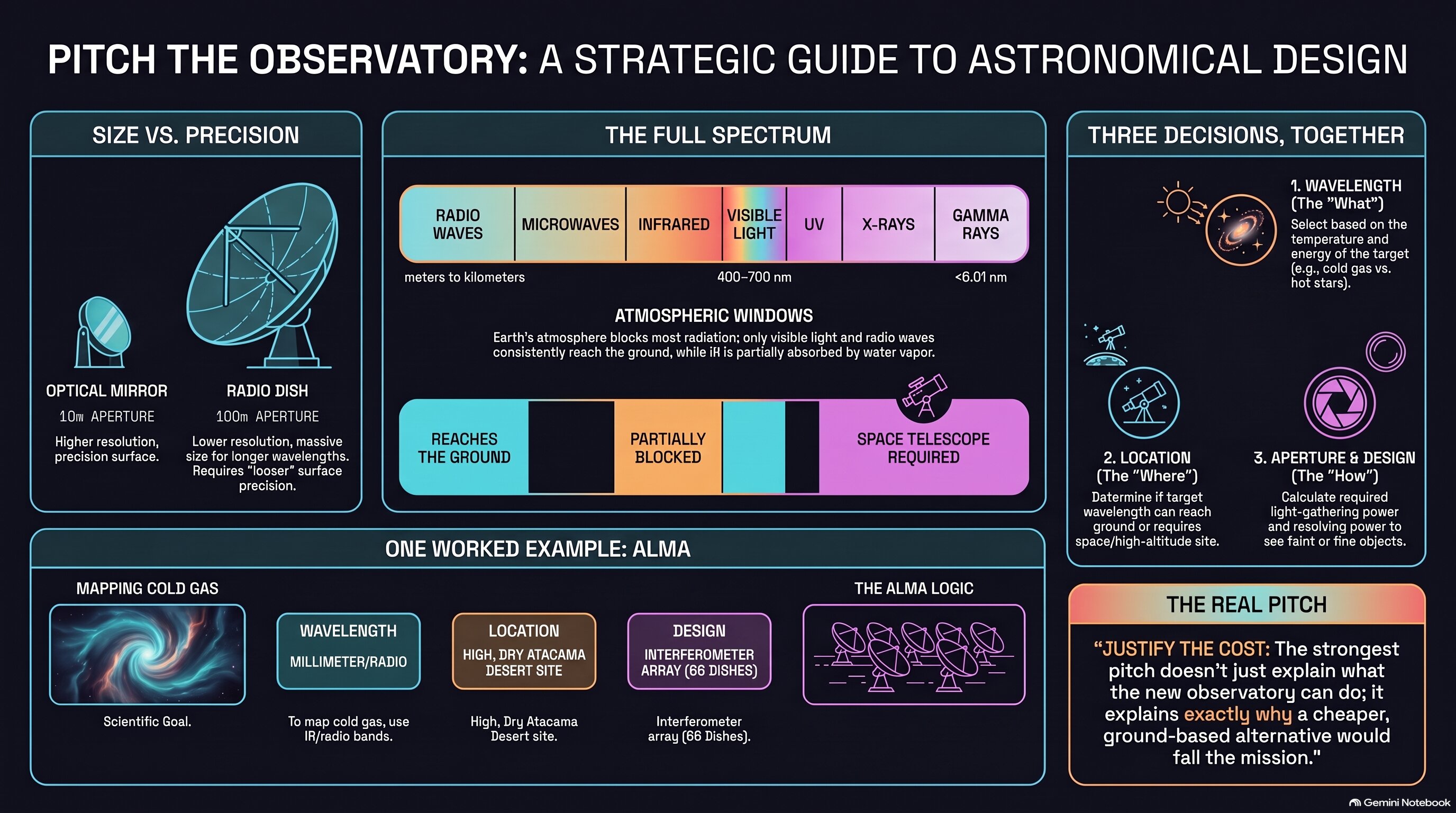
Everything so far in this half of the unit has assumed visible light — bigger lens or mirror, better view. Real observatories don't get that luxury of assumption: the electromagnetic spectrum runs from long radio waves to short gamma rays, and Earth's own atmosphere blocks most of it before it ever reaches the ground. Only visible light and radio waves pass through easily; everything else — infrared, ultraviolet, X-ray, gamma-ray — needs a dry mountaintop at best, and a telescope in space at worst. You'll meet that landscape in the Deep Dive, then design and pitch your own instrument: a specific science question, matched to the right wavelength, aperture, and location — and a real defense of why the obvious alternatives wouldn't have worked as well.
What you'll do in this project
- Meet the rest of the electromagnetic spectrum — radio through gamma-ray — and what each band actually reveals.
- Learn which wavelengths reach the ground on their own, and which ones demand a telescope in space.
- Connect a real science question to the right wavelength, instrument type, and location, together.
- Practice defending an instrument choice by explaining why the alternatives fall short.
Why it matters
Problem 2.3.1, Right Tool for the Job, hands you a real observational challenge with no template — this project is the last rehearsal before that, and the reasoning is the same both times.
✅ Self-Check Before You Roll On
Check off each item as you get there. These aren't grades — they're your own signal.