Quick reference for the four terrestrial planets — atmosphere, heat, and magnetic field.
🪐 Plot Summary
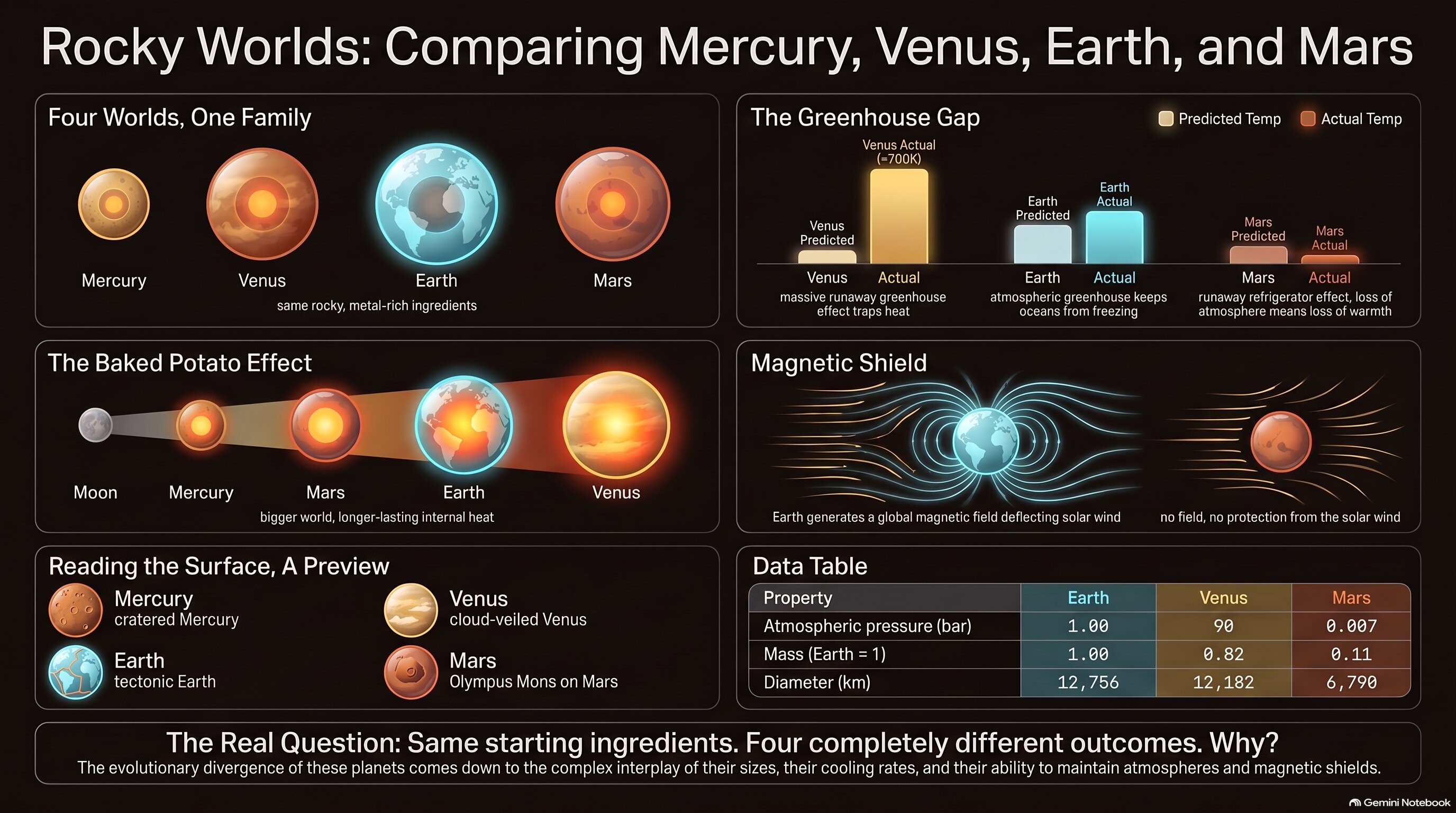
Mercury, Venus, Earth, and Mars all formed from the same rocky, metal-rich ingredients, in the same warm inner neighborhood of the solar system. If that were the whole story, they'd look a lot alike. They don't. Mercury is an airless, cratered relic. Venus is buried under a crushing, scorching runaway greenhouse atmosphere hot enough to melt lead — hotter than Mercury, despite sitting farther from the Sun. Earth split the difference and kept liquid water. Mars started out promising, with a thicker atmosphere and flowing water, and lost almost all of it. You'll trace how size, heat, and magnetic fields quietly decided each planet's fate.
What you'll do in this activity
- Meet four worlds built from the same basic ingredients — rock and metal — that turned out nothing alike.
- Compare all four atmospheres side by side: from Mercury's near-vacuum to Venus's crushing, scorching blanket.
- Learn the "baked potato effect" — why bigger worlds stay geologically alive longer.
- Connect the dots between size, internal heat, magnetic field, and what's left of an atmosphere today.
- Get a first look at each planet's signature surface features, before Activity 3.1.2 goes deeper.
Why it matters
Project 3.1.3, Habitability Report, asks you to compare two terrestrial worlds and argue which is the better target for future exploration — using exactly this reasoning, with real numbers behind it instead of a gut feeling.
✅ Self-Check Before You Roll On
Check off each item as you get there. These aren't grades — they're your own signal.