Quick reference for crater counting, the heavy bombardment, and volcanic resurfacing.
🌋 Plot Summary
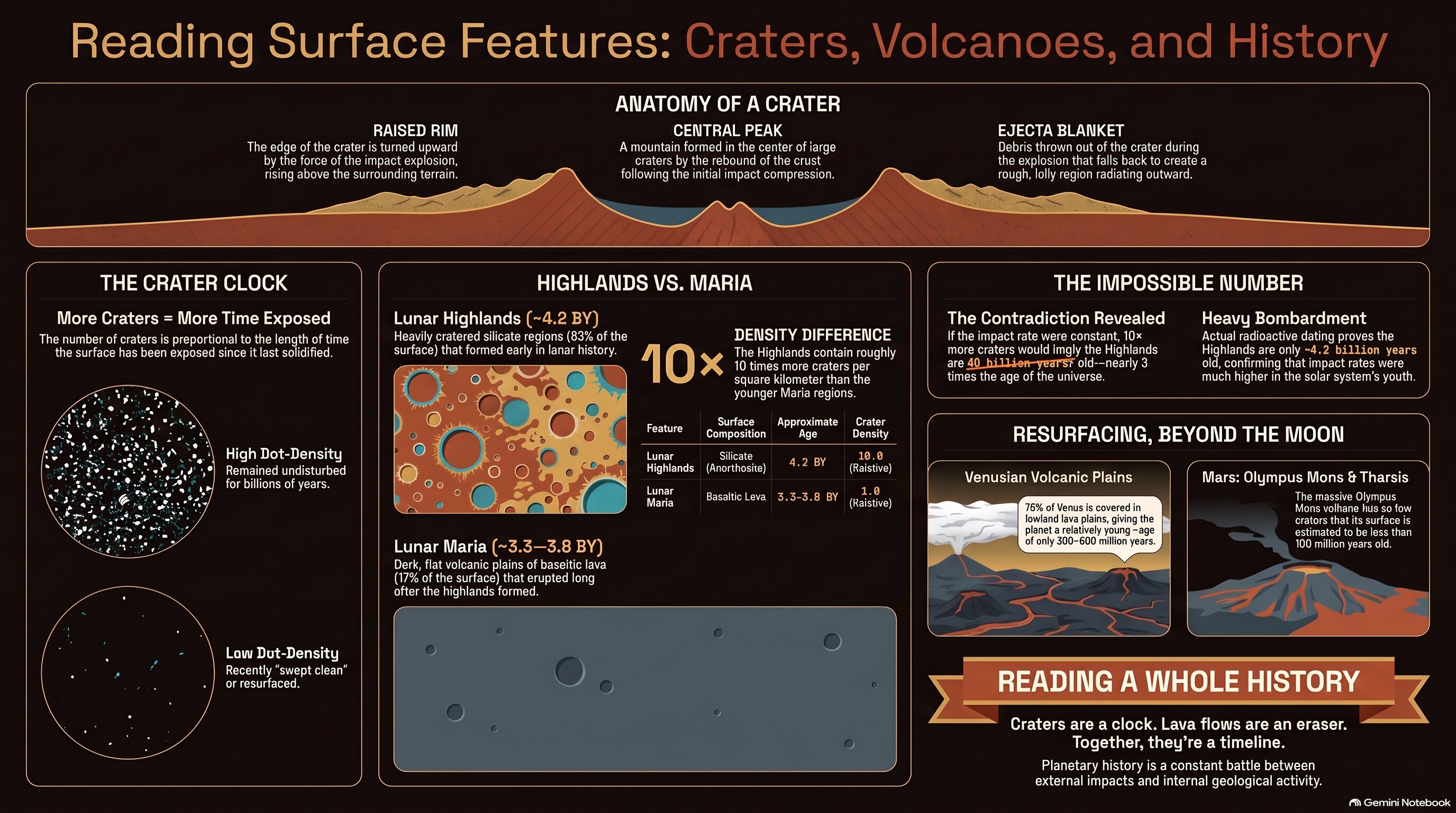
A cratered surface isn't just battered — it's a record. Since impacts have struck the solar system at a roughly steady rate for the past few billion years, counting craters on a patch of ground gives you a rough clock for how long that ground has sat undisturbed. Compare the Moon's ancient highlands to its much smoother, darker maria, and the craters alone tell a clear story — until you check that story against actual rock samples, and find something that shouldn't be possible unless the early solar system was far more violent than anyone assumed. You'll trace that discovery, then use the same reasoning to read the surfaces of Venus and Mars, where lava has quietly erased entire chapters of impact history.
What you'll do in this activity
- Learn why counting craters works as a rough clock for how long a surface has gone undisturbed.
- Compare the Moon's ancient highlands to its much-younger maria — and see the surprising discovery hiding in that comparison.
- Meet the "heavy bombardment" era, and the scientific reasoning that uncovered it.
- Watch volcanic resurfacing erase old craters, on the Moon, Venus, and Mars alike.
- Put it all together into a full geological history — the exact skill Project 3.1.3 will ask you to use for real.
Why it matters
Project 3.1.3, Habitability Report, asks you to compare two terrestrial worlds using real data — and a world's surface history, read straight off its craters and volcanic terrain, is some of the strongest evidence you'll have.
✅ Self-Check Before You Roll On
Check off each item as you get there. These aren't grades — they're your own signal.