Quick reference for the frost line, ring systems, tidal heating, and mission history.
🪐 Plot Summary
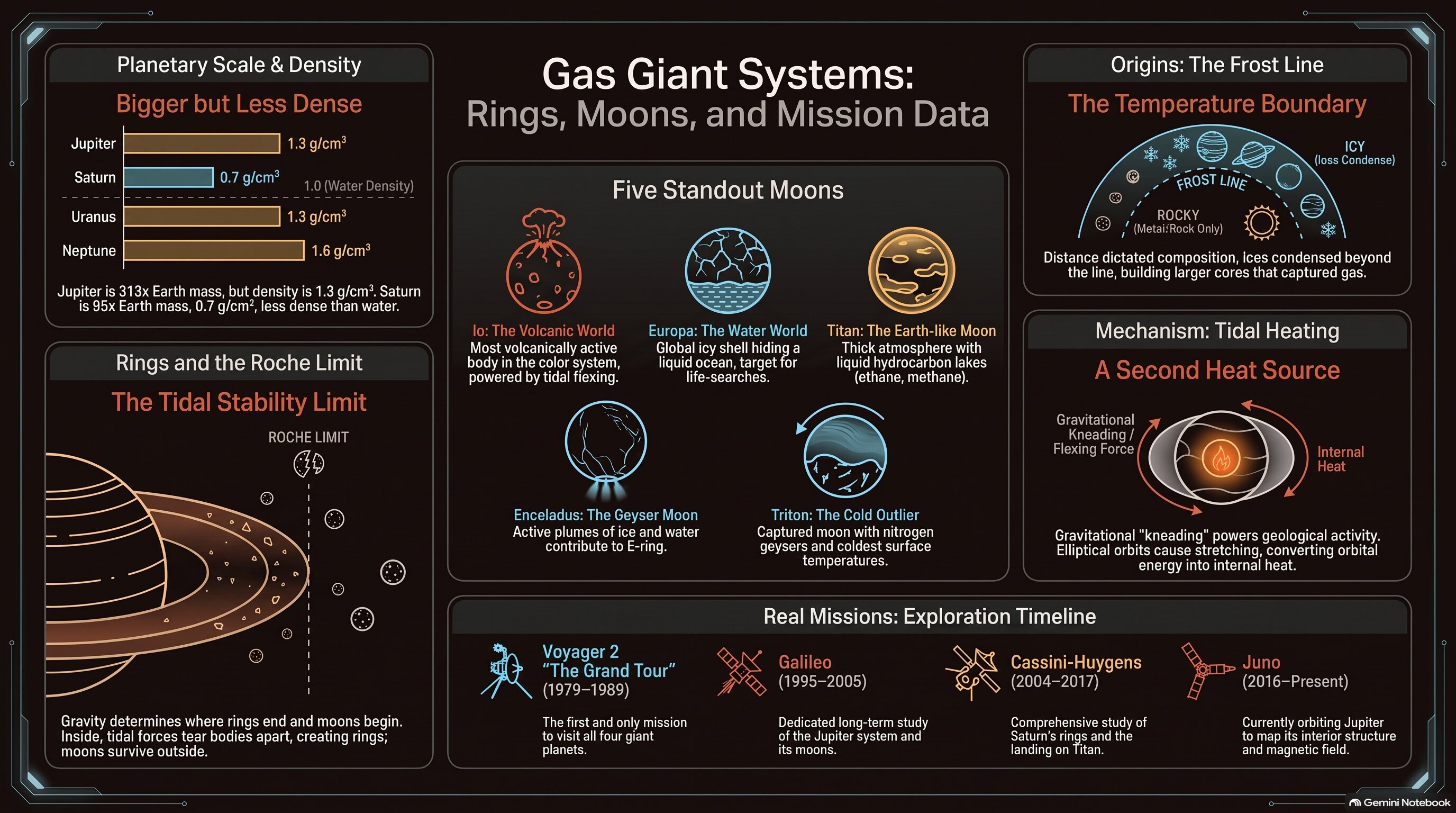
Jupiter alone could swallow more than a thousand Earths — yet if you could find a bathtub big enough, Saturn would actually float. The four outer planets get dramatically bigger the farther out they sit, while getting dramatically less dense, and that's not a coincidence. It traces back to a single temperature boundary in the young solar system, the frost line, and it shapes everything else about these worlds: their rings, their enormous moon systems, and even which of their moons turned out to be some of the most geologically interesting objects in the entire solar system.
What you'll do in this activity
- Answer the essential question directly: why do planets get bigger but less dense the farther out you go?
- Meet the "frost line" — the temperature boundary that let the outer planets grow enormous.
- Learn why every giant planet has rings, and why Saturn's just happens to steal the show.
- Meet a handful of moons stranger than the planets they orbit — some erupting, some hiding oceans.
- Trace the real missions that actually visited these worlds, from Voyager's grand tour to Cassini's plunge into Saturn.
Why it matters
Problem 3.3.1, Where Do We Send It?, closes out this unit with a real mission proposal — and several of the solar system's most exciting mission targets, like Europa and Titan, are moons you'll meet right here.
✅ Self-Check Before You Roll On
Check off each item as you get there. These aren't grades — they're your own signal.