Quick reference for the asteroid belt, comet tails, and the two distant reservoirs.
☄️ Plot Summary
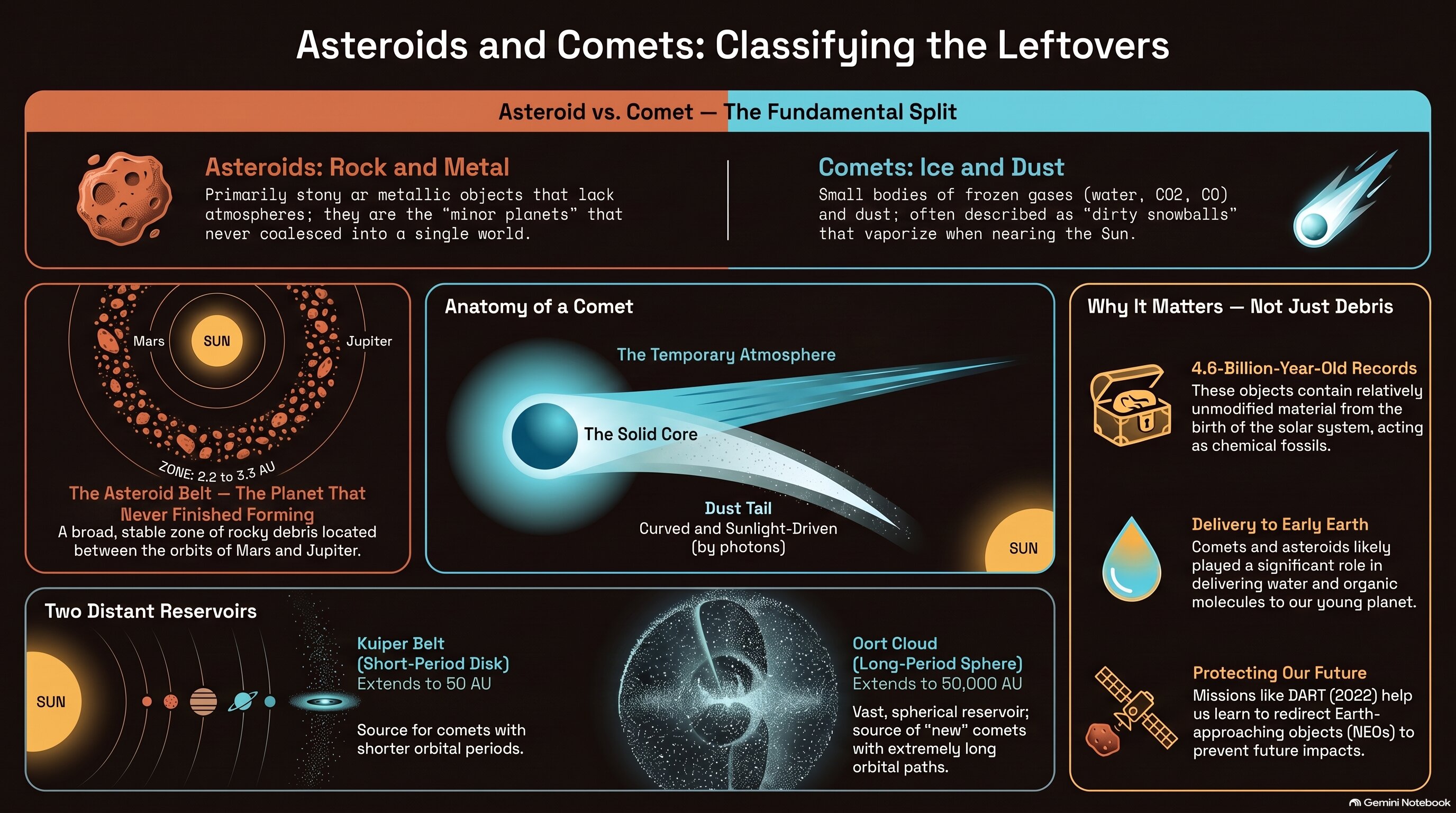
Not every chunk of rock and ice in the early solar system got to become a planet. Some got stuck in a crowded orbit between Mars and Jupiter, disrupted from ever merging by Jupiter's gravity — that's the asteroid belt. Others formed in the deep cold beyond Neptune and stayed there, or got flung out to the very edge of the Sun's influence entirely. Once in a while, one of those far-flung objects — a comet — falls back toward the Sun and puts on a show. These aren't just debris to sweep aside; they're 4.6-billion-year-old time capsules, largely untouched by the melting and resurfacing that erased that history from every planet you've studied so far.
What you'll do in this activity
- Meet the leftovers: planetesimals that never grew into planets, still carrying original solar system material.
- Tour the asteroid belt, and find out exactly why Jupiter kept it from ever becoming a planet.
- Learn what a comet is actually made of, and why its tail doesn't point where you'd expect.
- Trace comets back to two very different home reservoirs: the disk-shaped Kuiper Belt and the vast, spherical Oort Cloud.
- Answer the essential question directly: why these "leftovers" matter enough for a real spacecraft mission to slam into one on purpose.
Why it matters
Problem 3.3.1, Where Do We Send It?, closes out this unit with a real mission proposal — and a near-Earth asteroid or comet is a completely legitimate answer to "where."
✅ Self-Check Before You Roll On
Check off each item as you get there. These aren't grades — they're your own signal.