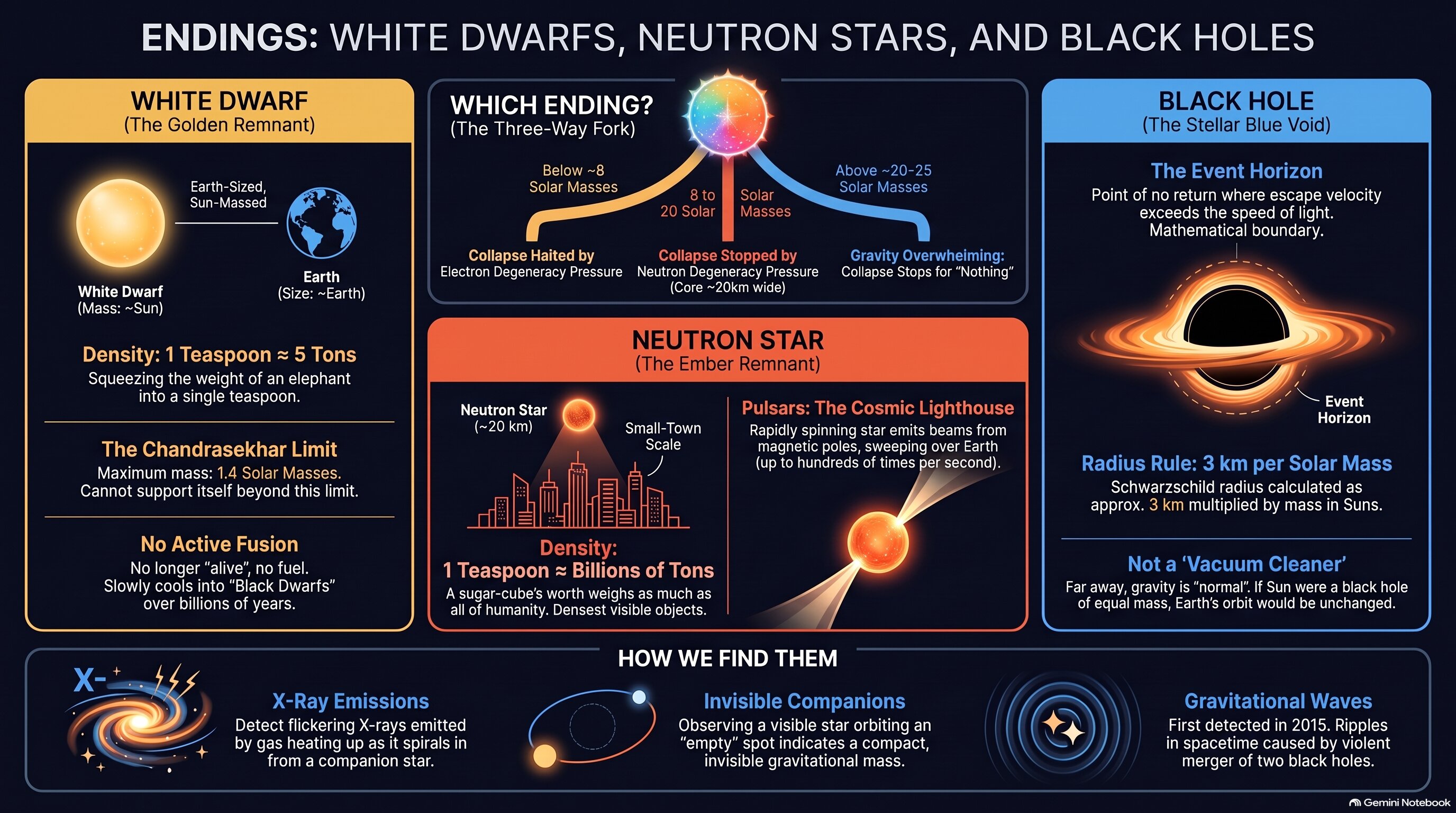
Quick reference for the three stellar remnants — size, mass, what holds each one up, and how we find them.
🕳️ Plot Summary
Every star eventually runs out of things to fuse. When that happens, nothing is left to push back against gravity, and the core collapses — until something new stops it. For most stars, that something is a crowd of tightly packed electrons, and the result is a white dwarf: the mass of the Sun squeezed into a ball the size of Earth. Heavier cores crush right past that point into a neutron star, only about 20 km across and often spinning many times a second. And the heaviest cores? Nothing stops them at all. They become black holes, regions where gravity is so strong that not even light can get out.
What you'll do in this activity
- Find out what's left when a star's fusion finally stops — and what keeps that leftover from collapsing forever.
- Pack the mass of the Sun into something the size of Earth, then learn the hard limit on how far that can go.
- Crush a stellar core down to the size of a city and watch it spin into a cosmic lighthouse.
- Cross the line where nothing — not even light — can stop the collapse, and measure the edge of a black hole.
- Put it all together: from a star's starting mass, predict exactly which ending it gets.
Why it matters
Every story needs an ending. Project 4.2.3, Life of a Star, ends on one of these three objects — and Problem 4.3.1, What Happens to This One?, asks you to predict which one an unnamed star will become, and to defend that prediction with evidence.
✅ Self-Check Before You Roll On
Check off each item as you get there. These aren't grades — they're your own signal.