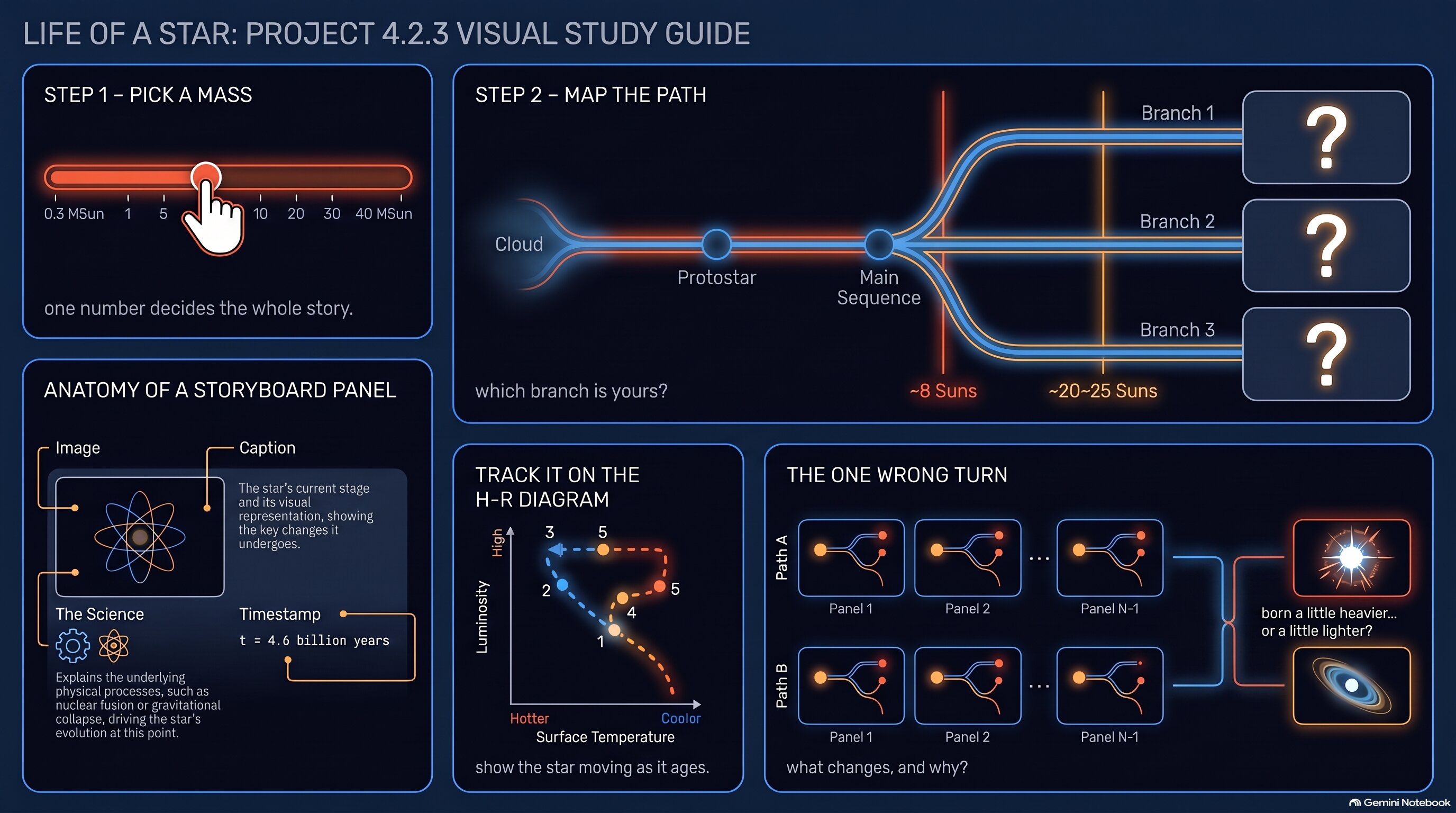
Quick reference for planning your star's story: pick a mass, map the path, and land the ending.
🎬 Plot Summary
Over the last two activities you've followed stars from their birth in cold clouds to their final remnants — and learned that mass decides nearly all of it. Now you'll tell one star's story yourself. You'll pick a starting mass, work out the path that mass forces your star down, and turn it into a storyboard or a short video, birth to death. Every stage has to be in the right order, last the right amount of time, and lead to the right ending. Nothing here is new; the challenge is getting all of it right at once.
What you'll do in this project
- Choose the one number that decides everything: the mass your star is born with.
- Work out its whole path — every stage, in order, with timescales that fit its mass.
- Tell the story as a storyboard or a 60–90 second video, from a cold cloud to whatever's left at the end.
- Track your star across the H-R diagram so the audience can see it age.
- Add the twist: one panel showing how the ending changes if your star had been born just a little heavier or lighter.
Why it matters
Problem 4.3.1, What Happens to This One?, flips this project around: instead of choosing a mass and telling the story, you'll get an unnamed star's data and have to predict its story — and defend it. Building one life cycle from scratch now is the best practice for that.
✅ Self-Check Before You Roll On
Check off each item as you get there. These aren't grades — they're your own signal.