Quick reference for the Milky Way's structure, the Sun's address, and how we mapped a galaxy from the inside.
🌌 Plot Summary
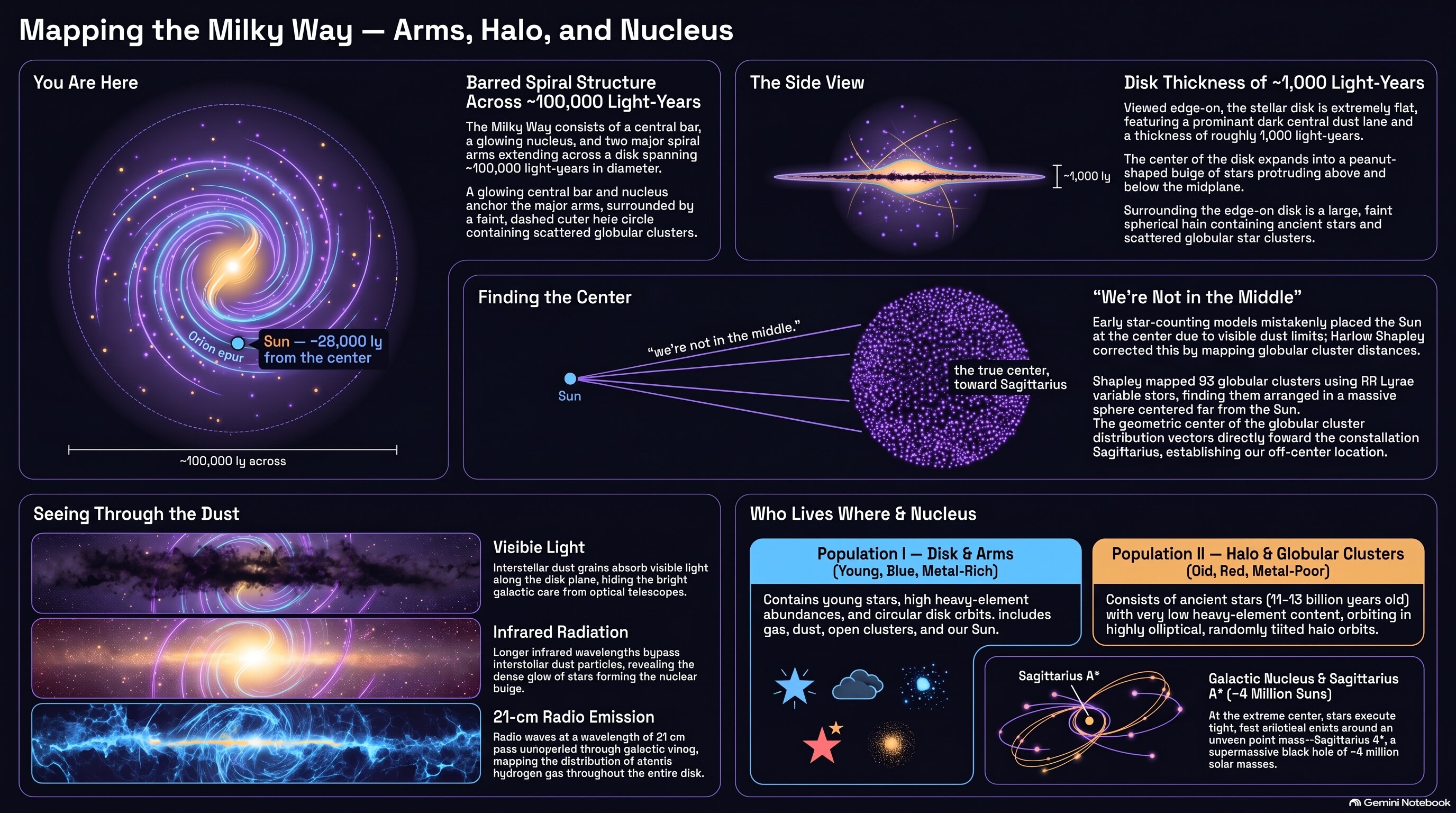
On a dark night, a faint, glowing band stretches across the sky. That band is our own galaxy, the Milky Way, seen edge-on from the inside. It's a flat, spinning disk of a few hundred billion stars wound into spiral arms, with a crowded, barred bulge at the center, a supermassive black hole at its very nucleus, and a huge, dim, spherical halo of ancient stars wrapped around it all. The hard part is that we've never seen any of this from the outside. Mapping it meant working around a problem — clouds of dust that hide most of the galaxy from view.
What you'll do in this activity
- Figure out why the pale band of the Milky Way across the night sky is actually our galaxy seen edge-on — from the inside.
- Take the galaxy apart: a flat disk with spiral arms, a barred central bulge, a nucleus, and a vast spherical halo.
- Retrace how Harlow Shapley found the galaxy's center in 1918 — and knocked the Sun out of the middle.
- Switch wavelengths to see through the dust that hides most of the galaxy from our eyes.
- Meet what lives at the very center: a black hole four million times the mass of the Sun.
Why it matters
The Milky Way is the one galaxy we can study up close. Everything you learn here becomes the reference point for the rest of the unit: Activity 5.1.2 and Project 5.1.3 sort other galaxies by comparing them to ours, and Problem 5.3.1, The Galaxy That Doesn't Add Up, hands you a galaxy whose disk spins in a way its visible stars can't explain.
✅ Self-Check Before You Roll On
Check off each item as you get there. These aren't grades — they're your own signal.