Quick reference for the tuning fork, how to assign each class, and what each galaxy type contains.
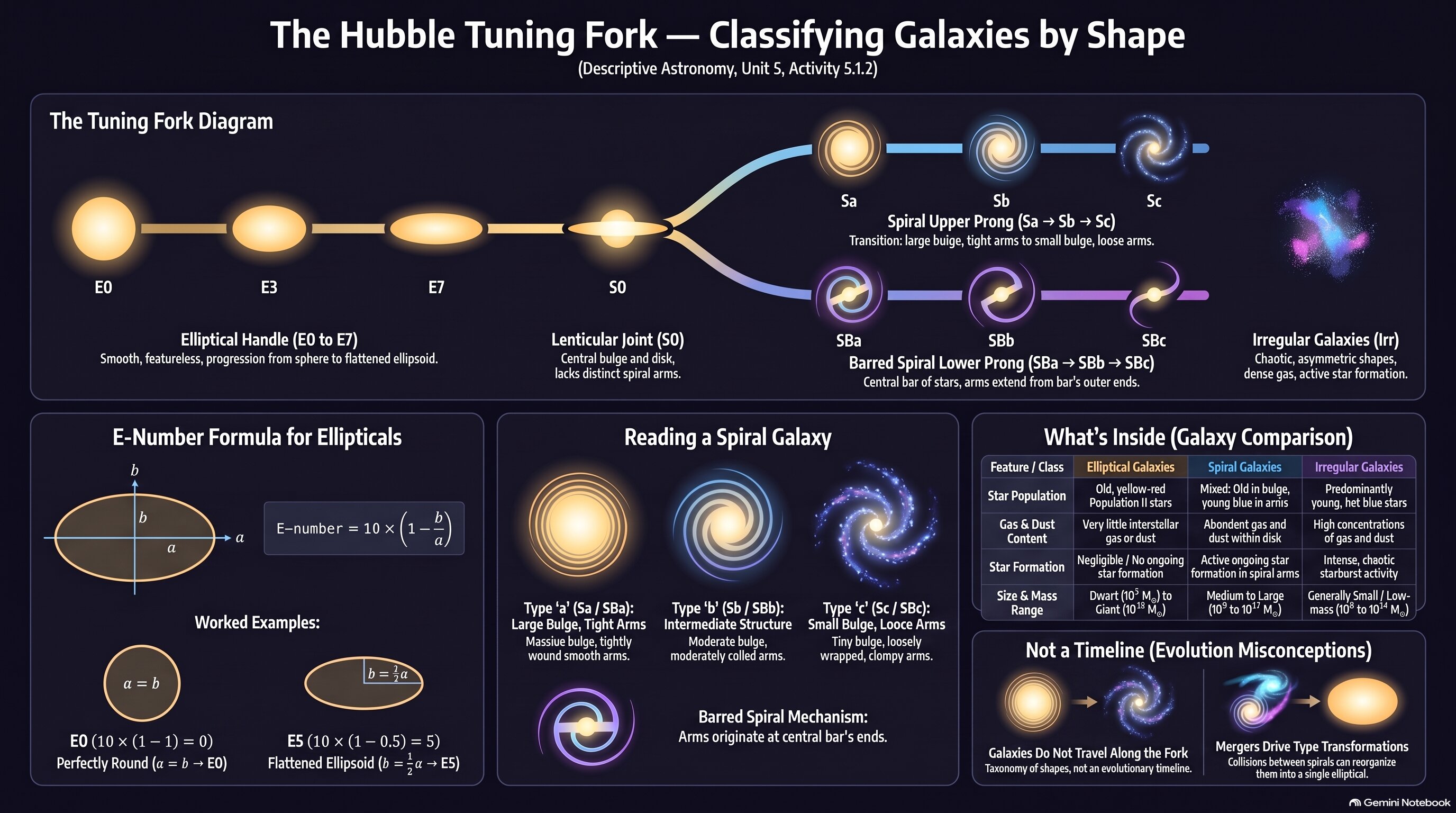
🍴 Plot Summary
A century ago, astronomers weren't sure whether anything existed beyond the Milky Way. Then, in 1924, Edwin Hubble measured the distance to the Andromeda "nebula" and found it far outside our galaxy — a whole separate galaxy of its own. Suddenly there were countless galaxies to make sense of, and Hubble sorted them the way you'd sort anything new: by shape. His tuning fork divides galaxies into smooth, round ellipticals, flat disk-shaped spirals (with or without a central bar), and shapeless irregulars. It turns out shape is more than looks: it's a clue to how old a galaxy's stars are, whether it's still making new ones, and what it has run into along the way.
What you'll do in this activity
- Settle one of astronomy's great debates: are the fuzzy spiral "nebulae" in our galaxy, or galaxies of their own?
- Learn the Hubble tuning fork — the classic way to sort galaxies by shape — and use it on real examples.
- Measure how squashed an elliptical is and how tightly a spiral is wound, and turn that into a precise class.
- Find out why shape is a clue to what's inside: old red stars, or gas, dust, and newborn blue ones.
- Watch galaxies collide and reshape each other — including the Milky Way's own future with Andromeda.
Why it matters
Project 5.1.3, Galaxy Field Guide, hands you a set of real galaxy images to identify and classify — the same skill large surveys and thousands of volunteer classifiers use to sort galaxies by the millions. This is where you learn to do it.
✅ Self-Check Before You Roll On
Check off each item as you get there. These aren't grades — they're your own signal.