Quick reference for redshift, the three expansion equations, and what an expanding universe does and doesn't mean.
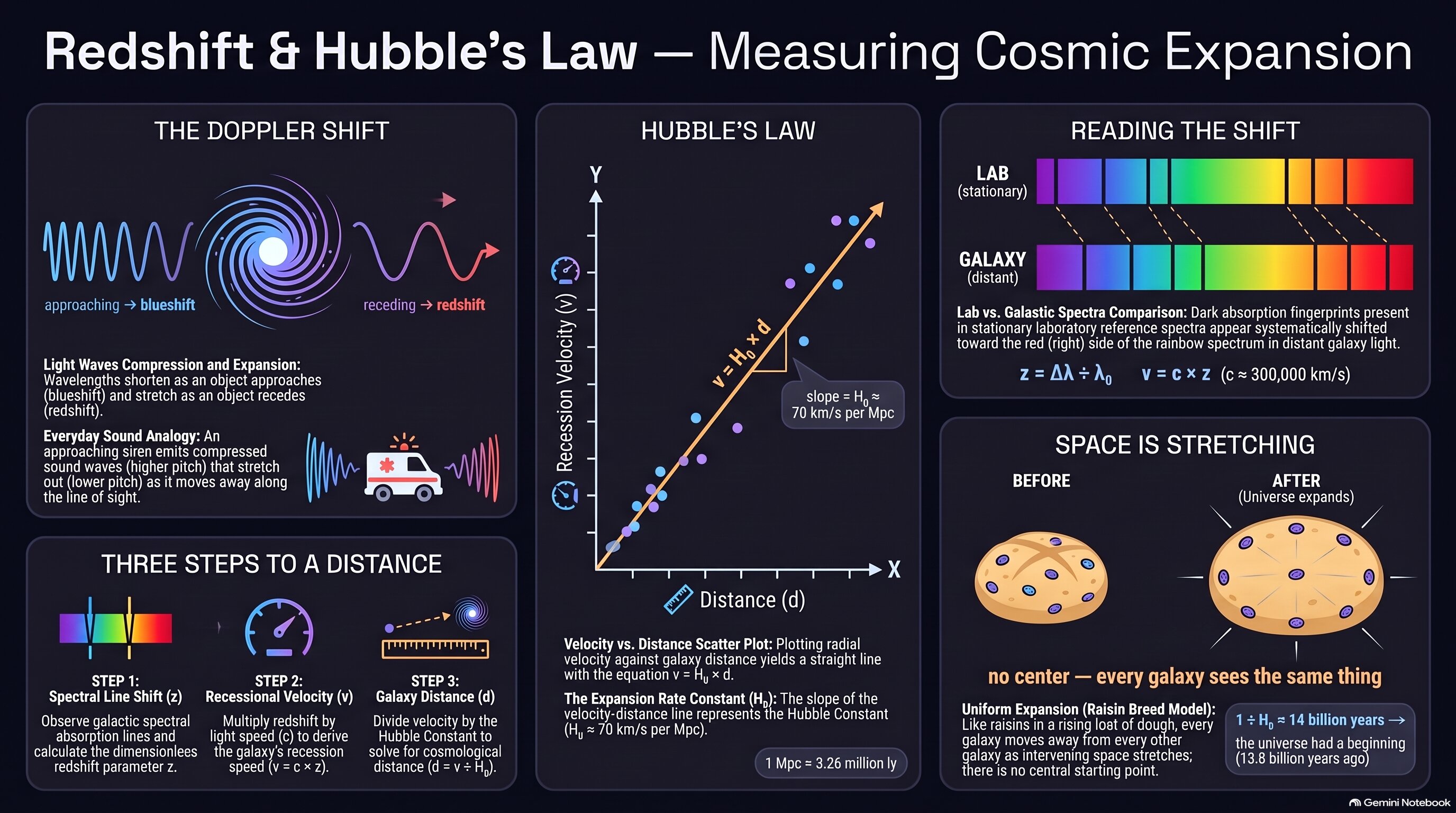
🔴 Plot Summary
In Unit 4 you learned that the dark lines in a spectrum are fingerprints of the elements. When astronomers looked at those fingerprints in other galaxies, the lines were in the wrong place — shifted toward the red end of the spectrum. That redshift means the galaxy is moving away from us, and measuring it tells you how fast. In 1929, Edwin Hubble put redshifts together with distances and found a simple, astonishing pattern: the farther away a galaxy is, the faster it's receding. That's Hubble's law, and it means the whole universe is expanding — and was once far smaller than it is today.
What you'll do in this activity
- Hear the Doppler effect in a passing siren — then see the same thing happen to starlight.
- Measure a redshift from a single spectral line, and turn it into a speed.
- Follow Edwin Hubble's 1929 discovery that the farther away a galaxy is, the faster it's moving away.
- Use Hubble's law to measure the distance to a galaxy you could never reach with a ruler.
- Wrestle with what it all means: space itself is stretching, there's no center — and the universe had a beginning.
Why it matters
Problem 5.3.1, The Galaxy That Doesn't Add Up, hands you a galaxy's redshift data and asks you to calculate its speed and distance — the exact steps you'll practice here. And the 13.8-billion-year history you'll map in Project 5.2.3 starts with the expansion you'll measure now.
✅ Self-Check Before You Roll On
Check off each item as you get there. These aren't grades — they're your own signal.