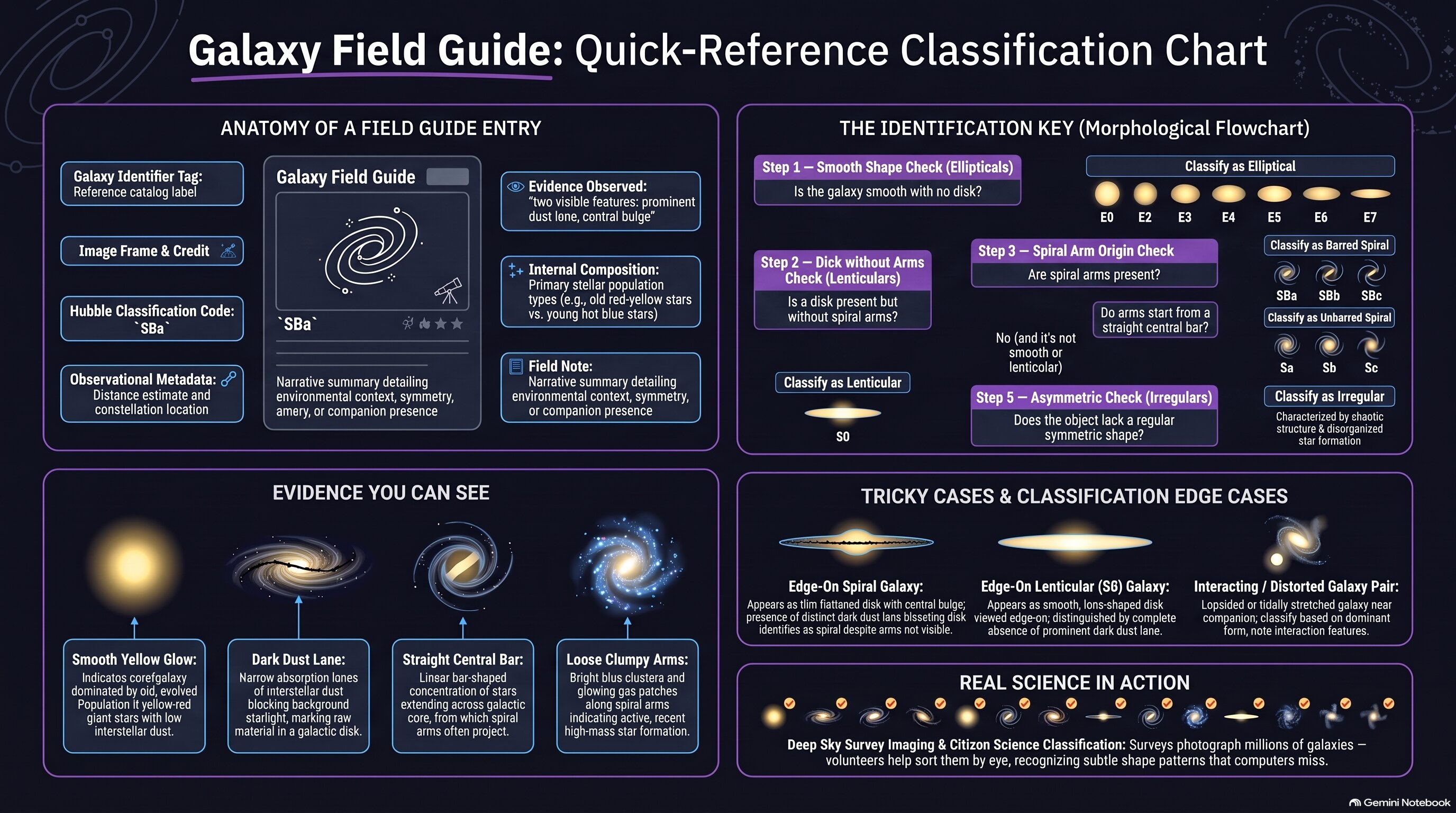
Quick reference for building a field guide entry: find, classify, justify, and key it.
📖 Plot Summary
Birdwatchers carry field guides: a key to narrow down what you're looking at, and a page for each bird with its picture and the marks that identify it. You're going to make one for galaxies. You'll choose ten real galaxies from a roster, find a real telescope image of each, and classify it on the Hubble tuning fork — backing up every call with features you can see. Each entry will predict what's inside the galaxy from its type, and the whole guide opens with an identification key that someone else could use. Nothing here is new; this is the first time you'll use it on real, messy images.
What you'll do in this project
- Pick ten real galaxies from a roster of eighteen — from Andromeda next door to giants in the Virgo Cluster.
- Find a real image of each one, from Hubble and other observatories, and classify it on the tuning fork.
- Back every classification with features you can actually see in the image.
- Build an identification key so a reader could classify a galaxy they've never seen before.
- Take on at least one tricky galaxy — seen edge-on, or bent out of shape by a neighbor.
Why it matters
Real surveys now photograph millions of galaxies — far more than professionals can sort alone — so volunteers classify them by eye, exactly the way you will here. And the galaxy at the center of Problem 5.3.1, The Galaxy That Doesn't Add Up, is one you'll need to recognize on sight.
✅ Self-Check Before You Roll On
Check off each item as you get there. These aren't grades — they're your own signal.