Quick reference for the transit and radial-velocity methods, and how combining them reveals what a planet is made of.
🪐 Plot Summary
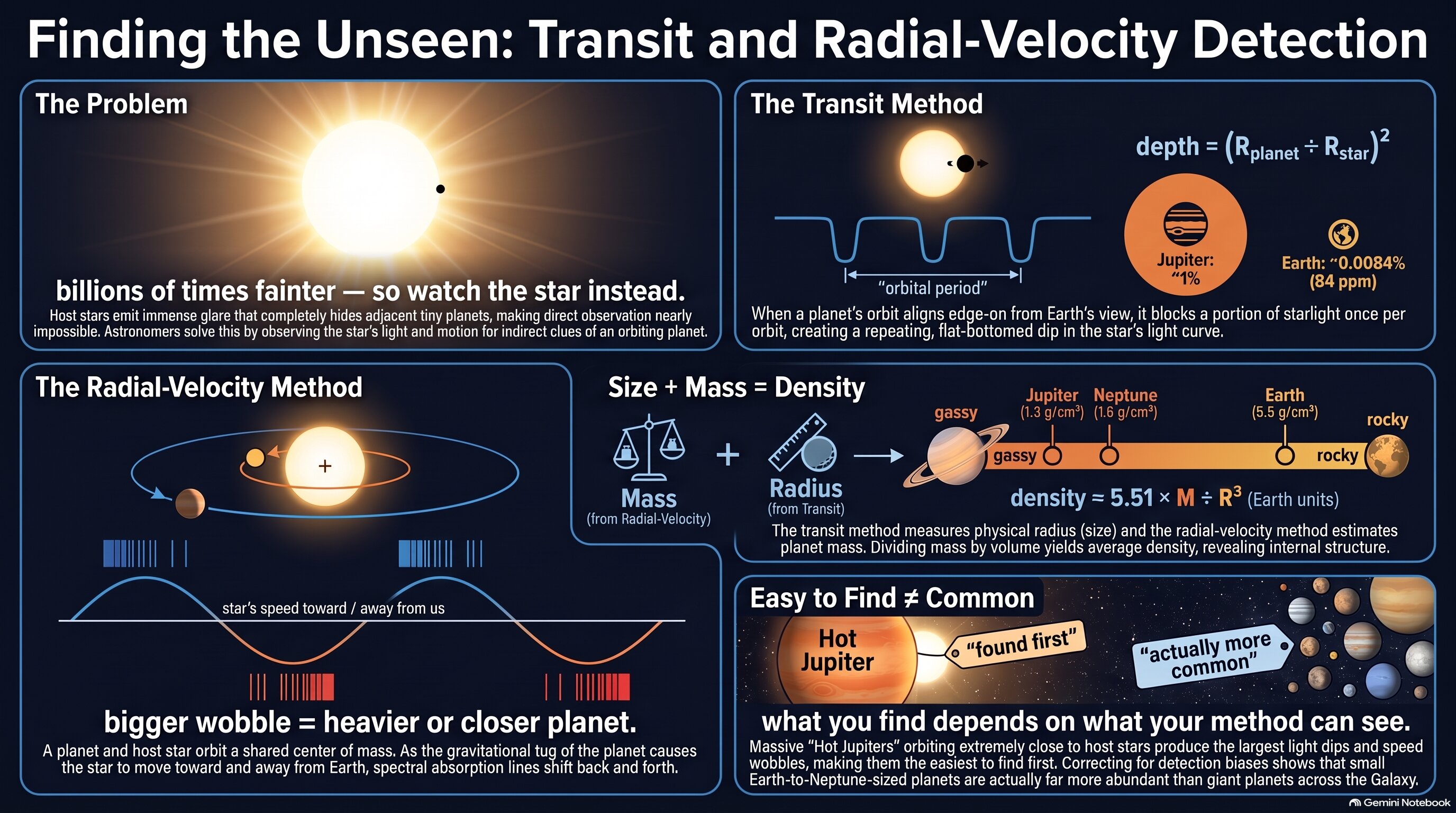
Astronomers have confirmed more than 5,000 planets orbiting other stars — exoplanets— and nearly all of them have never been seen directly. A planet is billions of times fainter than its star and sits right beside it in the glare. So astronomers watch the star instead. If a planet passes in front of it, the star dims very slightly: a transit, which reveals the planet's size. And as a planet orbits, it tugs its star back and forth in a small wobble that shows up as a Doppler shift in the star's light — the radial-velocitymethod, which reveals the planet's mass. Put size and mass together and you can tell a rocky world from a gas giant, without ever seeing either one.
What you'll do in this activity
- Face the problem head-on: a planet is billions of times fainter than its star and lost in its glare.
- Catch a planet crossing its star — a transit — and turn the tiny dip in starlight into the planet's size.
- Watch a star wobble as a planet tugs it around, and read that wobble in the star's spectral lines.
- Combine the two methods to weigh and measure a world you'll never see, and find out what it's made of.
- Crack the essential question: how does a dip or a wobble actually prove something is there?
Why it matters
Project 6.1.3, Design a World, asks you to back up an invented planet with real detection data like transit depth. And transits are also how astronomers read exoplanet atmospheres — the kind of spectrum you'll analyze in the course capstone, The Biosignature Case.
✅ Self-Check Before You Roll On
Check off each item as you get there. These aren't grades — they're your own signal.