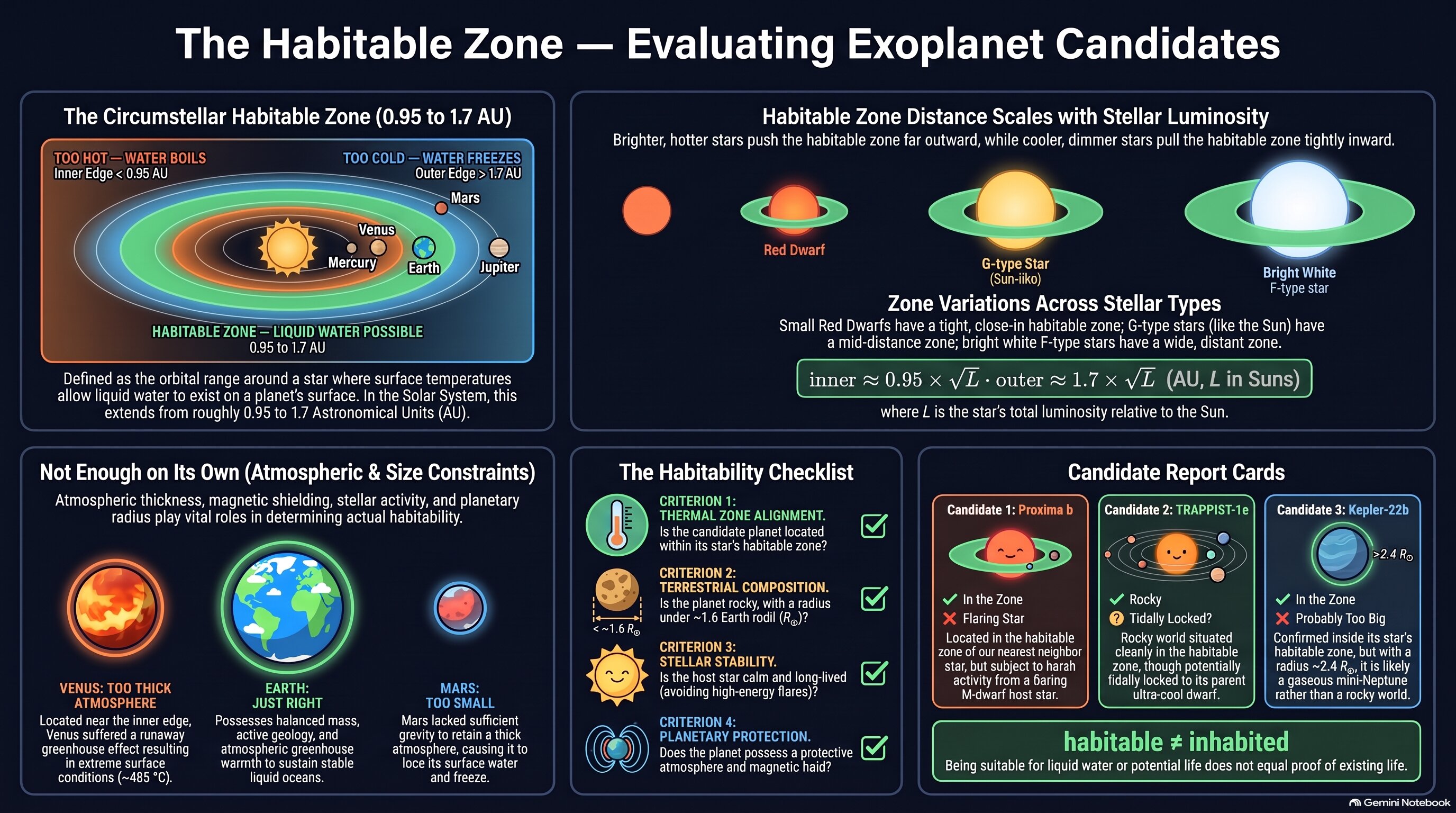
Quick reference for the habitable zone, how it shifts with the star, and the checklist for judging a candidate world.
🌍 Plot Summary
Life as we know it needs liquid water. So when astronomers find a new planet, one of the first questions is whether it orbits in its star's habitable zone— the range of distances where a rocky planet's surface could be warm enough for liquid water, but not so hot that it boils away. That zone isn't in the same place for every star: it hugs close to dim red dwarfs and sits far out around bright, hot stars. But the right distance is only the start. Venus and Mars, our own neighbors, show how much else has to go right — the planet's size, its atmosphere, and even the temperament of its star. In this activity you'll learn to weigh all of it, and judge real candidate worlds.
What you'll do in this activity
- Find the "Goldilocks" band around a star where a planet could have liquid water — not too hot, not too cold.
- Move the zone: shrink it in close around a dim red dwarf, or push it far out around a bright blue star.
- Use Venus and Mars to see why distance alone doesn't make a world livable.
- Weigh the other ingredients: a rocky surface, a good atmosphere, a magnetic shield, and a calm, long-lived star.
- Evaluate real candidates — Proxima b, the TRAPPIST-1 system, and more — and decide which deserve a closer look.
Why it matters
Project 6.1.3, Design a World, asks you to invent a planet and argue it's habitable — this is the checklist a skeptical reviewer will use on you. And the capstone, The Biosignature Case, starts with the same question: is this world even a reasonable place to look for life?
✅ Self-Check Before You Roll On
Check off each item as you get there. These aren't grades — they're your own signal.