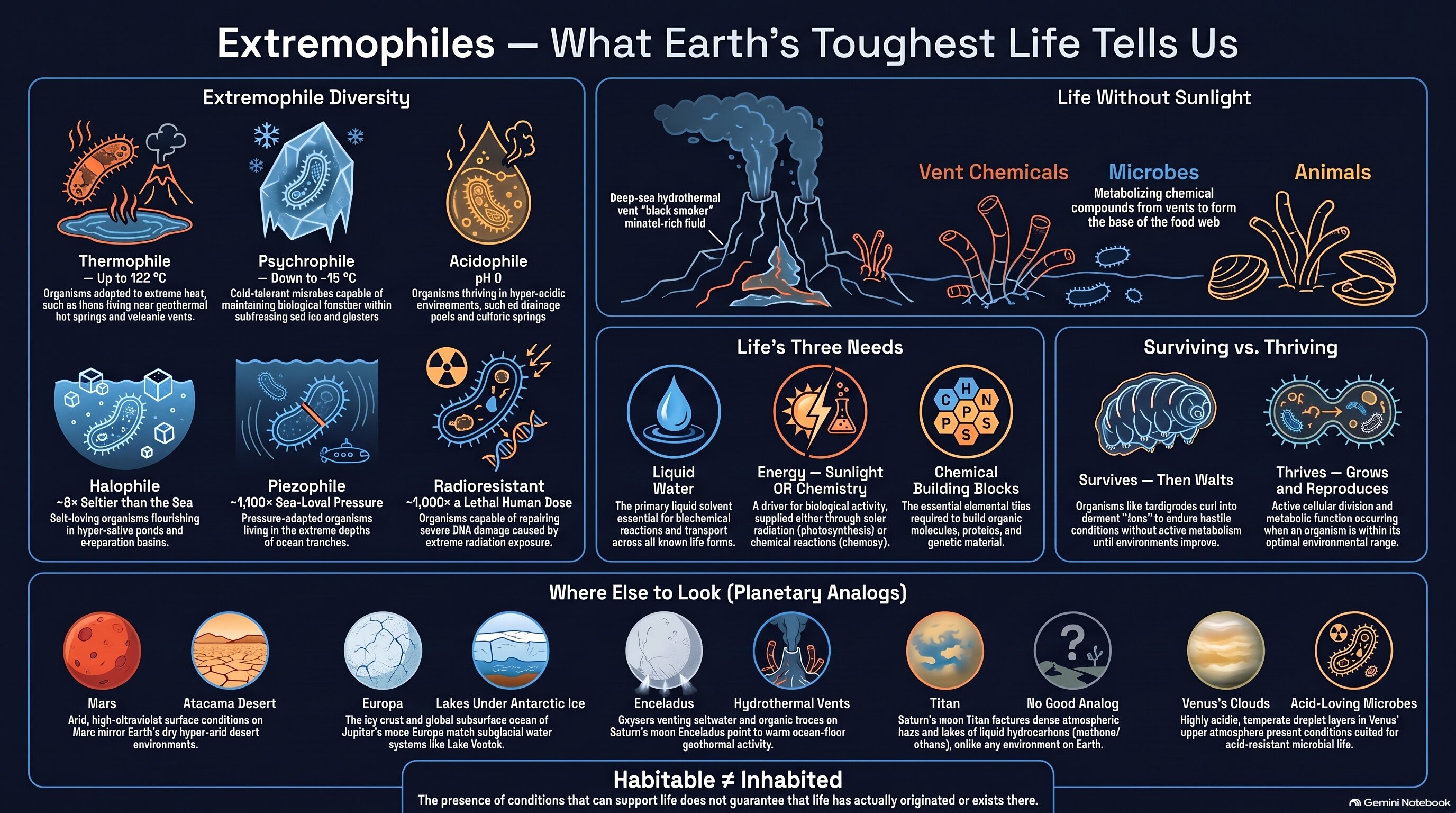
Quick reference for extremophile types, life's three needs, and the Earth analogs for other worlds.
🦠 Plot Summary
Fifty years ago, most scientists thought life needed mild conditions: moderate temperatures, fresh water, and sunlight. Then they started finding it everywhere they weren't supposed to — in boiling hot springs, in acid, in salt crusts, under Antarctic ice, and kilometers down in solid rock. These organisms are called extremophiles, and in 1977 an even bigger surprise came from the deep sea: entire ecosystems around volcanic vents that run on chemistry instead of sunlight. Together, these discoveries rewrote the list of what life really needs — and turned icy ocean worlds like Europa and Enceladus, far outside any habitable zone, into some of the best places to look.
What you'll do in this activity
- Meet life at the edges: microbes thriving in boiling springs, battery-acid pools, Arctic ice, and the deepest ocean trench.
- Find out what every living thing actually needs — and why sunlight isn't on the list.
- Dive to the deep-sea vents discovered in 1977, where whole ecosystems run on chemistry instead of light.
- Separate the true extremophiles from the tough survivors, like the famous tardigrade.
- Use Earth's toughest life to rethink where else to look: under Martian soil, in hidden moon oceans, and beyond.
Why it matters
This is the unit's second essential question in action. In Project 6.2.3, your team will propose the next space mission — and the best science goals come from knowing what life on Earth can survive. The capstone, The Biosignature Case, asks what signs such life might leave behind.
✅ Self-Check Before You Roll On
Check off each item as you get there. These aren't grades — they're your own signal.