Quick reference for mission types, matching instruments to questions, and the missions searching for life.
🚀 Plot Summary
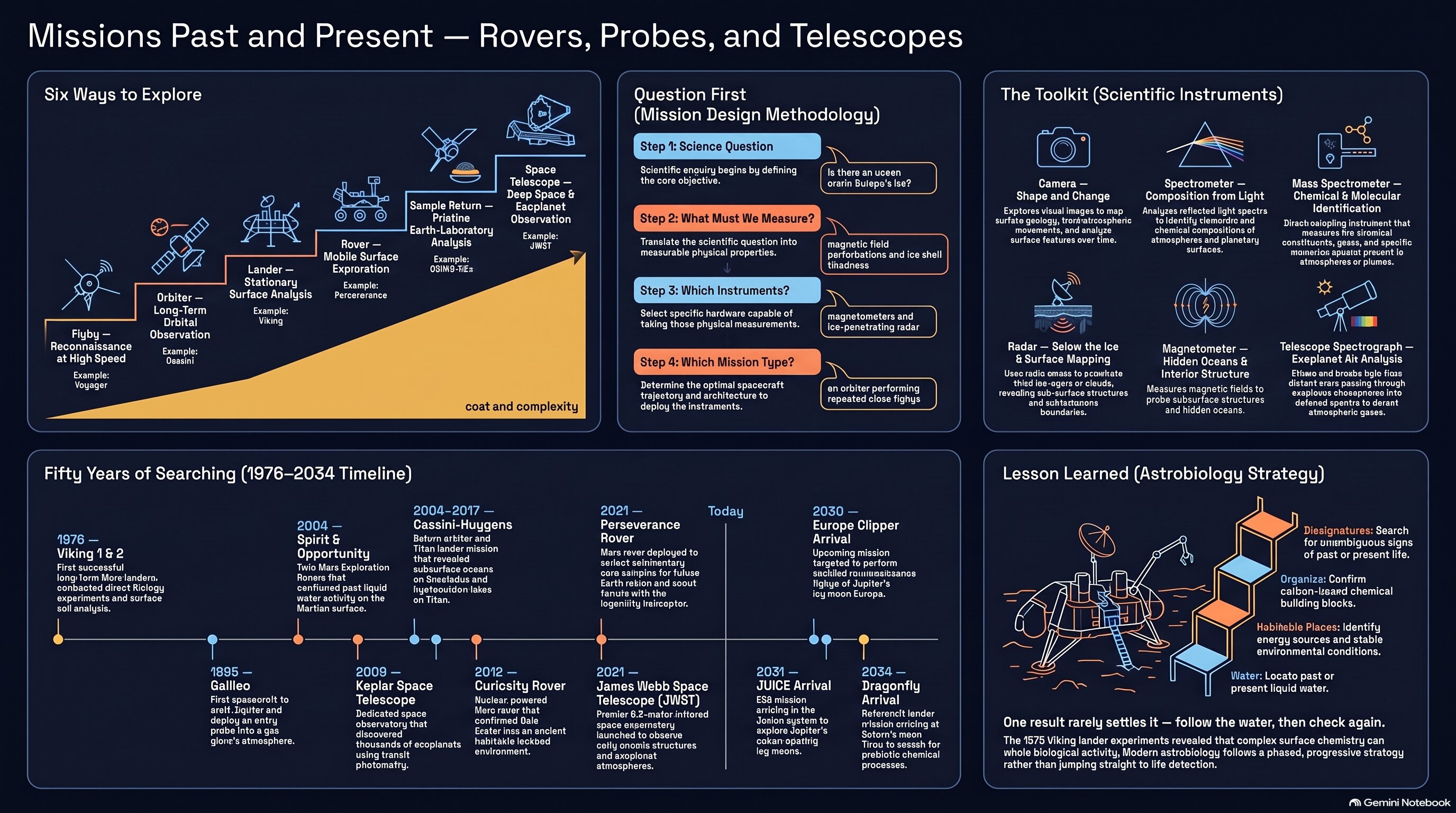
You now know where life might be hiding. The next question is how to actually check. Every space mission is a bet: years of planning and hundreds of millions of dollars, built around one clear science question and the instrumentsthat can answer it. Some missions fly past a world, some orbit it, some land and rove, some bring pieces home, and some never leave Earth's neighborhood at all — like the telescopes reading the air of distant planets. In this activity you'll see how each approach works, what fifty years of missions have taught us in the search for life, and what separates a great mission idea from a merely cool one.
What you'll do in this activity
- Compare the ways we explore: flying past, orbiting, landing, roving, bringing samples home, or watching from a telescope.
- Work backward like mission designers do — from a science question to the instruments that can answer it.
- Retrace fifty years of searching for life, from the Viking landers to today's Mars rovers.
- Follow the ocean worlds from Galileo and Cassini to the missions flying there now.
- Learn what separates a great mission idea from a merely cool one — just before you propose your own.
Why it matters
This is the direct setup for Project 6.2.3, Propose the Next Mission— the semester's biggest group build. Your team will pick a destination, a science goal, and a set of instruments, and this activity is the toolkit for making those choices well.
✅ Self-Check Before You Roll On
Check off each item as you get there. These aren't grades — they're your own signal.