Quick reference for designing a planet, building its detection data sheet, and pitching its habitability.
🌎 Plot Summary
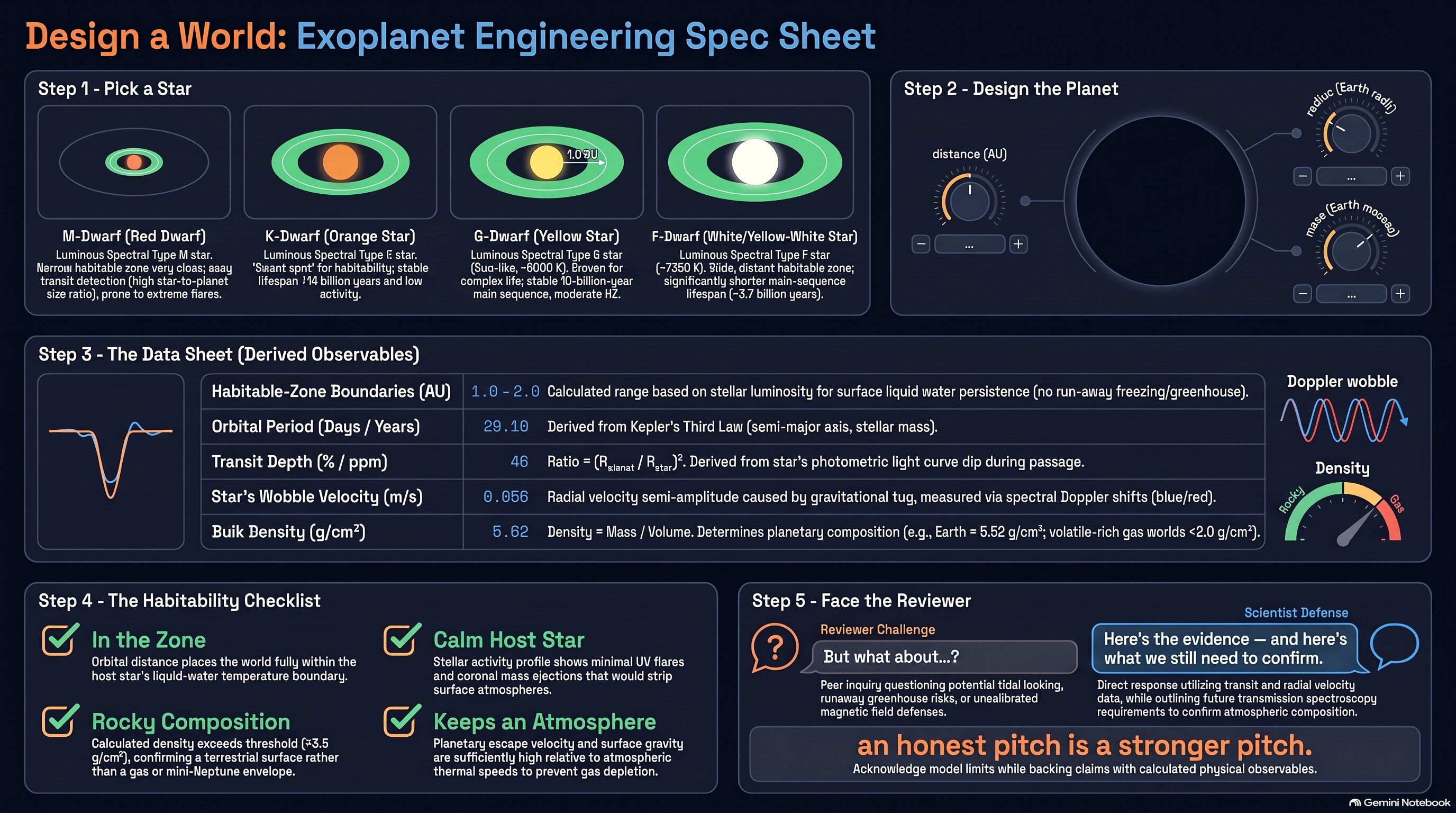
Astronomers don't just find planets — they model them, working out what a planet would have to be like for the data to come out the way it did. In this project you'll run that process in reverse. You'll choose a star, then design a planet: how far out it orbits, how big it is, and how heavy. From those choices you'll build a detection data sheet — the transit dip, orbital period, and stellar wobble a real telescope would record — and use it, along with the habitable zone and the habitability checklist, to pitch your world as a place that could hold liquid water. A good pitch is honest: it names what would still have to line up, and answers the obvious objections.
What you'll do in this project
- Pick a star — a red dwarf, a K star, a Sun-like G star, or a bright F star — and learn what it offers a planet.
- Design your world: its distance, its size, and its mass, all chosen on purpose.
- Generate the data a real telescope would record: the transit dip, the orbital period, and the star's wobble.
- Build the case that your planet could hold liquid water — and be honest about what we couldn't know yet.
- Pitch it to a skeptical reviewer, and defend it with numbers.
Why it matters
This is exactly how telescope time gets decided: scientists predict what a planet should look like, then argue it's worth observing. The course capstone, The Biosignature Case, flips it around — you'll get a real-style spectrum and have to judge whether it points to life. Designing a world first shows you what a convincing case has to include.
✅ Self-Check Before You Roll On
Check off each item as you get there. These aren't grades — they're your own signal.