Quick reference for building a mission proposal, from science question to review-panel pitch.
🛰️ Plot Summary
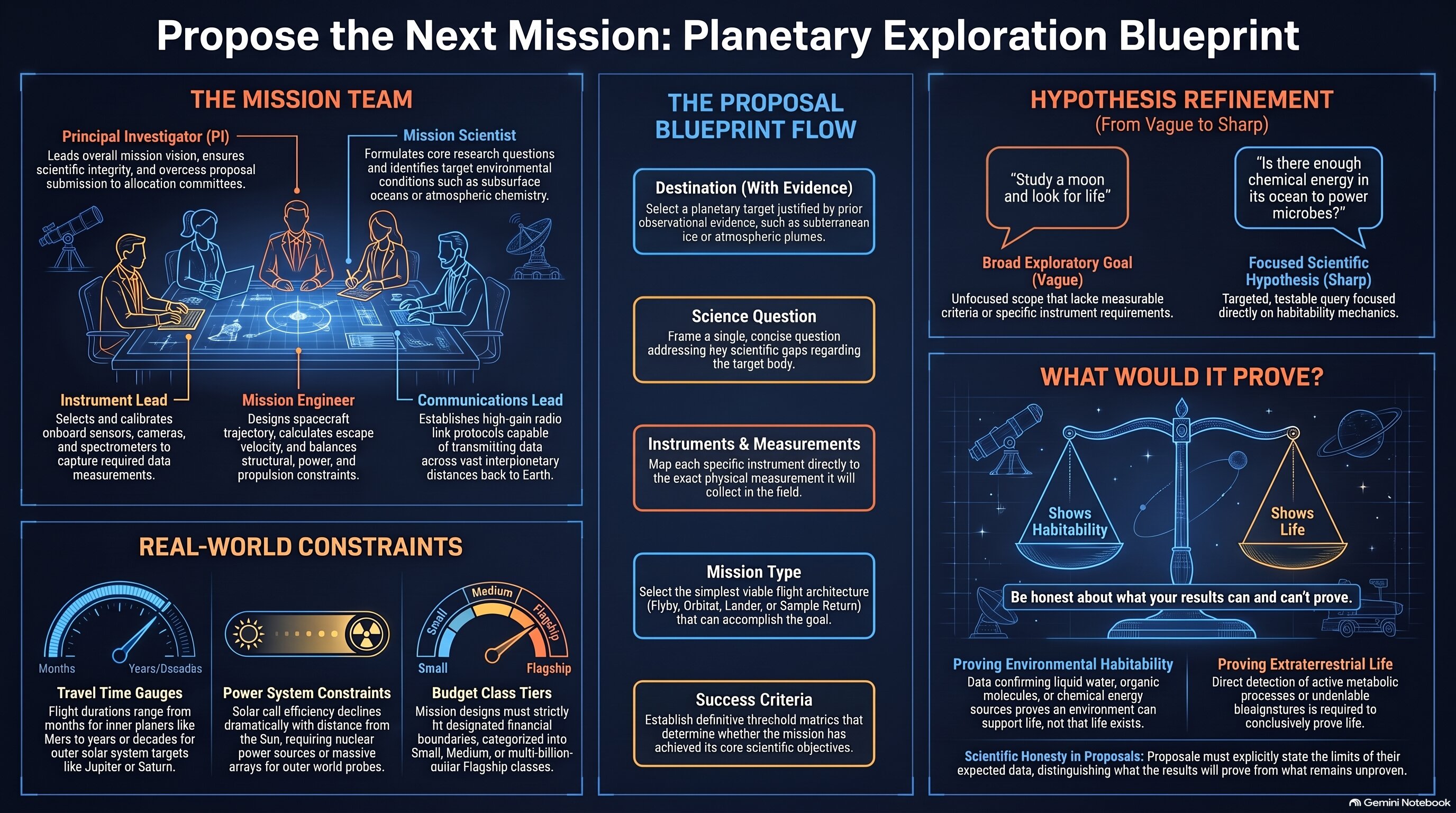
Every mission that has ever flown started as a proposal: a small team convincing a review panel that their idea deserved years of work and a slice of a limited budget. Now it's your team's turn. You'll choose a destination where the search for life (or its ingredients) could make real progress, sharpen a single science question, build an instrument payload that answers it, and pick the simplest mission typethat can carry it there. Then you'll plan the practical side — travel time, power, budget, risk — and pitch the whole thing to a review panel. It's the semester's biggest group build, and it puts nearly everything from this unit to work.
What you'll do in this project
- Form a mission team and choose a destination — Mars, Europa, Enceladus, Titan, Venus, or a telescope aimed at distant worlds.
- Sharpen a vague idea into one clear science question a mission could actually answer.
- Build a payload where every instrument earns its place, and pick the simplest mission type that works.
- Plan the real-world details: travel time, power, budget class, and the risks that could sink it.
- Pitch it to a review panel — including what your results would, and wouldn't, prove.
Why it matters
This is how real missions get chosen, and it's one of the two paths into the course capstone. In The Biosignature Case, you can either defend a call on a real-style exoplanet spectrum or develop this mission proposal into your final defense — so build it like it matters.
✅ Self-Check Before You Roll On
Check off each item as you get there. These aren't grades — they're your own signal.