In PLTW's own sequence, Activity 4.2.4 lives in Unit 4 (Digital Forensics) and covers digital signatures and PGP. It's being taught here instead, in Unit 3, because IP addressing and subnetting are prerequisite knowledge for the network you'll design in Project 2.1.3.
The original 4.2.4 content — digital signatures, PGP, identity verification — hasn't been dropped. It comes back later as a short review folded into Activity 4.2.3, once AP testing is finished.
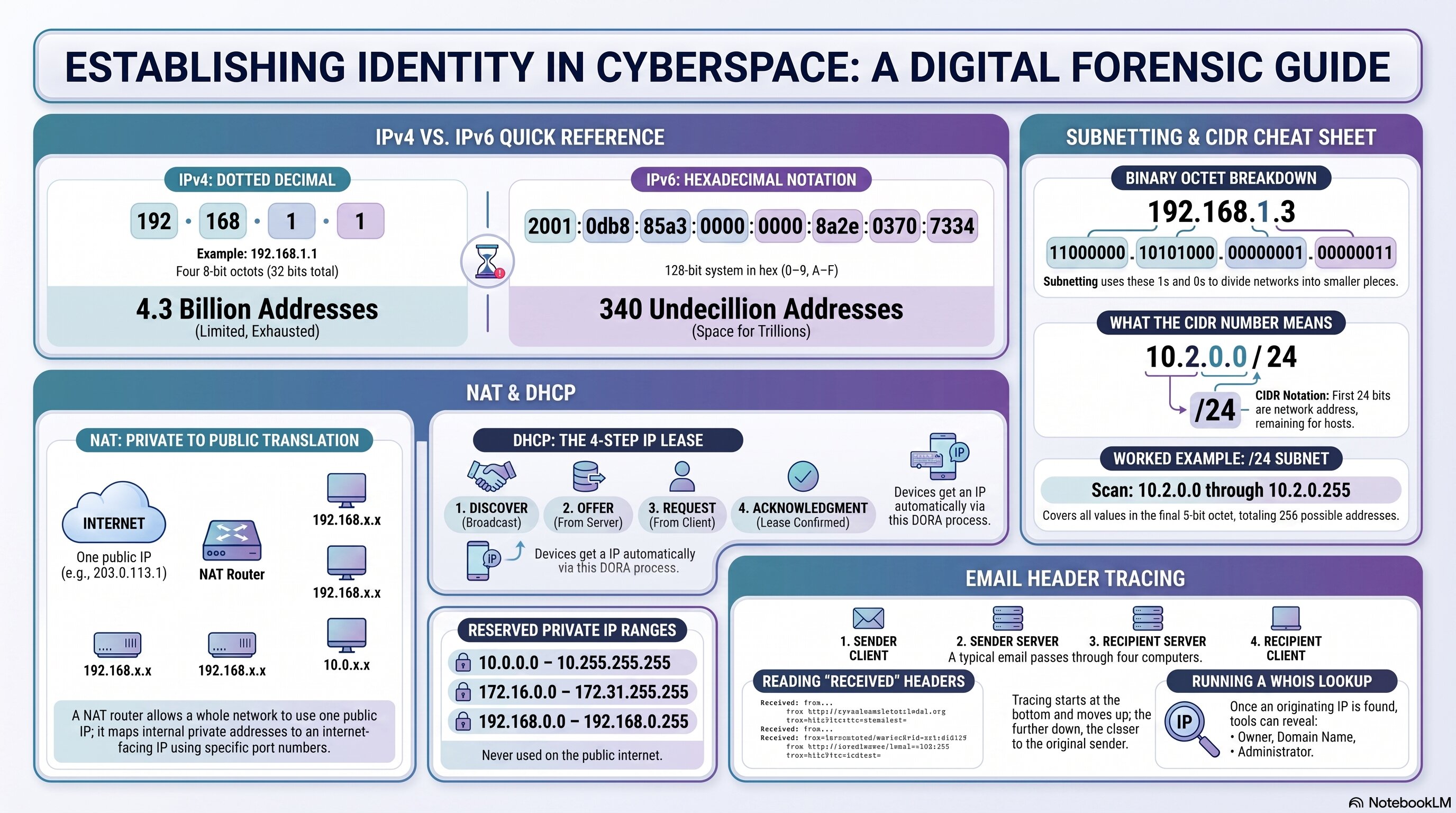
Use this as a quick reference for IPv4/IPv6, NAT, DHCP, subnetting/CIDR, and email header tracing.
🧭 Plot Summary
Before you can design a secure network, you need to actually speak the language of networking. This activity covers the addressing mechanics that make the internet function — and that you'll need fluently for the E-Commerce Architecture project just ahead.
IPv4 / IPv6
Every device's address on a network
NAT
Translates private addresses to public ones
DHCP
Automatically assigns IP addresses
Subnetting / CIDR
Divides a network into smaller pieces
You'll also learn to trace an email back to where it actually came from — reading its headers and running a whois lookup on the originating IP — a skill that connects directly back to spotting phishing and spoofed senders from Unit 1.
What you will do in this lesson
Learn the structure of IPv4 and IPv6 addresses.
Understand NAT and DHCP — the two protocols that make modern networks usable.
Practice subnetting in binary and translating it into CIDR notation.
Connect subnetting to network segmentation — DMZs, VLANs, and breach containment.
Trace an email's real origin using its headers and a whois lookup.
Why it matters
Subnetting isn't an abstract exercise — it's the exact skill you need to design a DMZ and VLANs for the e-commerce network project right after this. Without this activity, that project doesn't make sense yet.
✅ Self-Check Before You Roll On
Check off each item as you get there. These are not grades — they are your own signal.