6.3 — Refraction
When light changes speed as it enters a new material, it bends — and that bend shapes what we see.
🖼️ One-Page Visual Summary (Infographic)
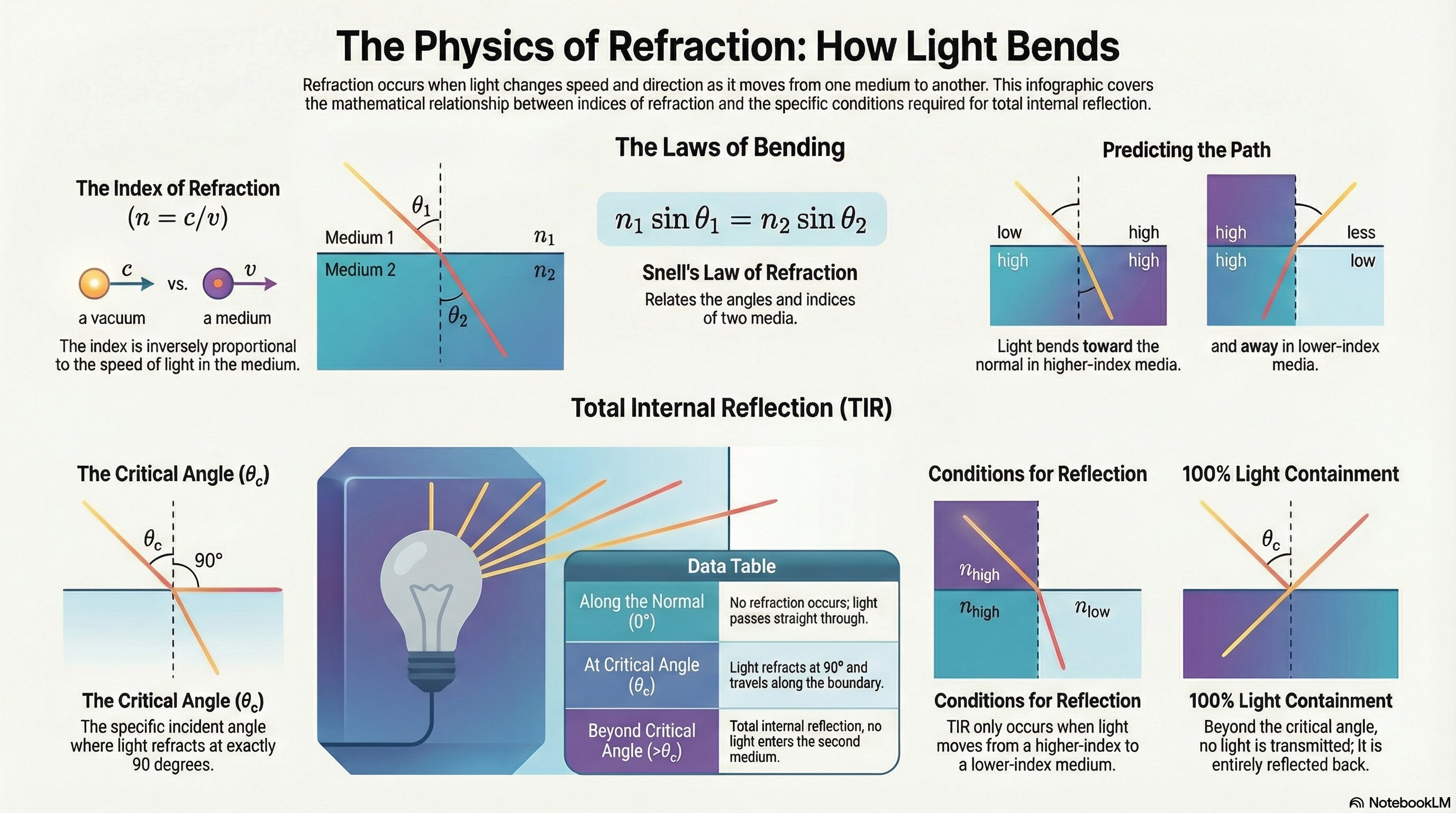
🧭 Plot Summary
Refraction is the bending of light when it passes from one medium to another. The bend happens because light travels at different speeds in different materials.
In this lesson, you’ll use ray diagrams to explain everyday “optical illusions” like a straw looking broken in water, the apparent depth of a pool, and why lenses can focus light. The big conceptual move is connecting speed change to direction change.
Why it matters:
Refraction powers lenses, glasses, cameras, microscopes, and the human eye. If you understand how and why light bends, you can explain how images form and how optical tools work.
Inside: detailed explanations, graphical relationships, mathematical reasoning, and guided practice.
✅ Self-Check
- ◻ I can explain refraction as bending caused by a change in light speed.
- ◻ I can predict which way light bends relative to the normal.
- ◻ I can explain “broken straw” and apparent depth using rays.
- ◻ I can connect refraction to how lenses form images.