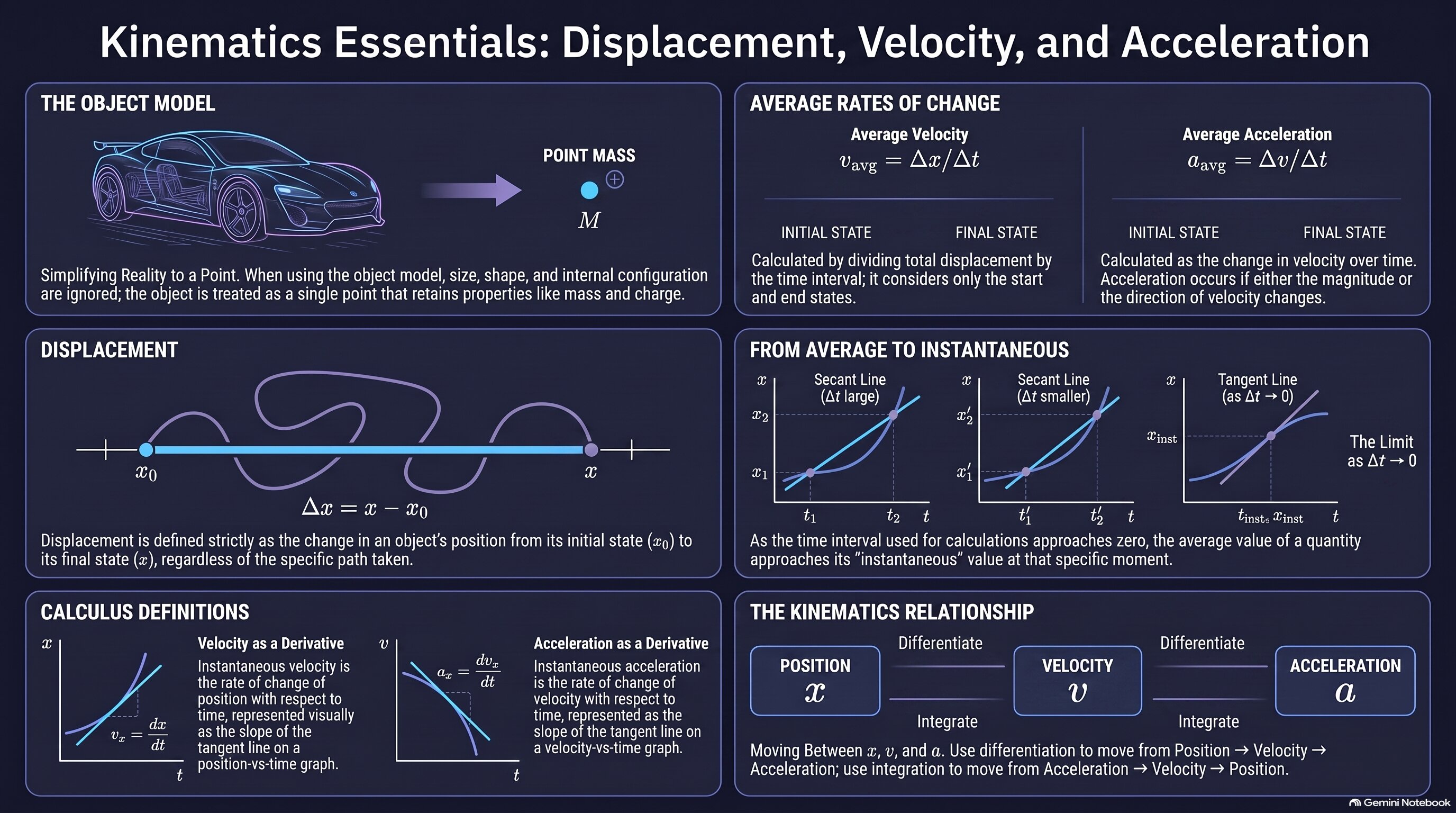
Use this as a quick reference for displacement, average vs. instantaneous rates, and the derivative definitions of velocity and acceleration.
🧭 Plot Summary
This is the lesson where calculus officially joins the course. You already know how to find average velocity and acceleration — divide the change by the time it took. But "average" hides everything that happened in between. To capture what's happening at a single instant, you shrink the time interval down toward zero — and what you get in the limit is the derivative. Instantaneous velocity is the derivative of position with respect to time; instantaneous acceleration is the derivative of velocity with respect to time. Once you can differentiate, you can also integrate — moving backward from acceleration to velocity to position.
What you'll do in this lesson
- Apply the object model — treating an object as a single point for the purposes of kinematics.
- Calculate displacement, average velocity, and average acceleration from initial and final states.
- Recognize that acceleration exists whenever velocity's magnitude or direction changes.
- Understand instantaneous values as the limit of average values as the time interval shrinks to zero.
- Write and interpret instantaneous velocity as a derivative: vx = dx/dt.
- Write and interpret instantaneous acceleration as a derivative: ax = dv/dt.
- Differentiate a position function to get velocity, and a velocity function to get acceleration — and integrate in reverse.
Why it matters
Every equation in this course that starts with "instantaneous" secretly means "derivative." Get comfortable with vx = dx/dt and ax = dv/dt now, because from here forward, differentiation and integration are the primary tools you'll reach for — not just the average-rate formulas from AP Physics 1.
✅ Self-Check Before You Roll On
Check off each item as you get there. These aren't grades — they're your own signal.