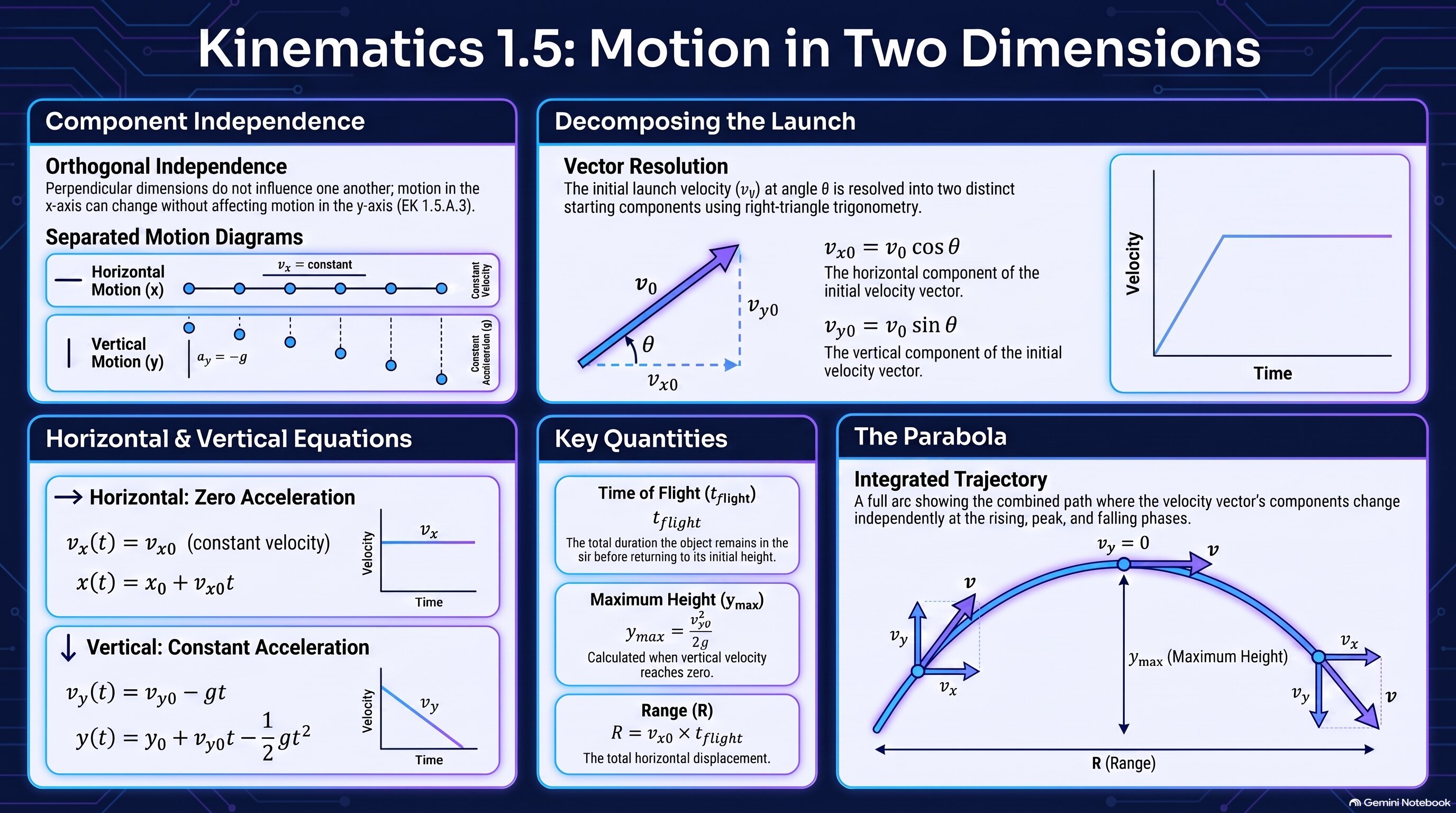
Use this as a quick reference for component independence, the projectile motion equations, and finding time of flight, height, and range.
🧭 Plot Summary
Every tool you've built this unit — vector components, derivatives, the kinematic equations, motion graphs — comes together in this lesson. The big idea is deceptively simple: motion in two or three dimensions can be split into completely independent one-dimensional motions along each axis, and each of those can be solved using everything you already know. Projectile motion is the star example — zero acceleration horizontally, constant acceleration g vertically — and by treating those two directions separately, you can find exactly where and when a thrown object lands.
What you'll do in this lesson
- Separate two-dimensional motion into independent horizontal and vertical components.
- Recognize that velocity and acceleration can be different — and change differently — in each direction.
- Apply the one-dimensional kinematic equations from Lesson 1.3 separately to each component.
- Identify projectile motion as the special case with zero horizontal acceleration and constant vertical acceleration (g).
- Solve for a projectile's time of flight, maximum height, and range.
- Connect the horizontal and vertical component graphs to the overall parabolic trajectory.
Why it matters
This is the payoff lesson for Unit 1. Everything from vector components (1.1) to derivatives (1.2) to motion graphs (1.3) gets applied at once here — and the same component-splitting habit you build with projectiles will reappear constantly for the rest of the course, well beyond falling objects.
✅ Self-Check Before You Roll On
Check off each item as you get there. These aren't grades — they're your own signal.