Use this as a quick reference for scalars, vectors, and direction in 1D.
🧭 Plot Summary
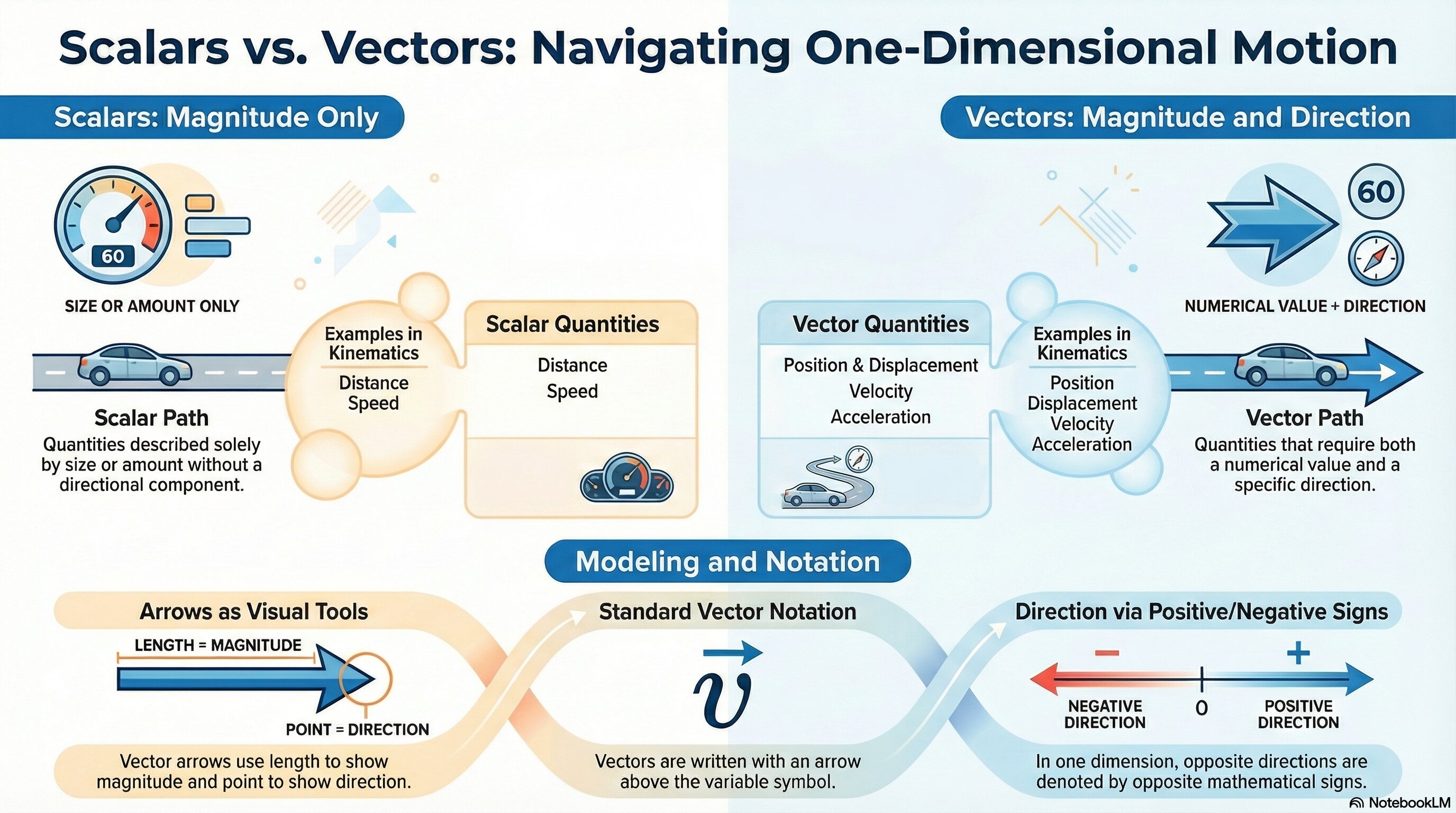
In this lesson, we build the foundation for everything that comes after. Physics uses two kinds of quantities: scalars, which are just a number, and vectors, which have a number and a direction. Once you know the difference, you'll use positive and negative signs to handle direction in one-dimensional problems — no arrows needed. We finish by introducing the first kinematic equation that ties velocity, acceleration, and time together.
What you'll do in this lesson
- Distinguish scalars (magnitude only) from vectors (magnitude and direction).
- Identify distance and speed as scalars; position, displacement, velocity, and acceleration as vectors.
- Represent vectors as arrows — longer arrow means larger magnitude.
- Use positive and negative signs to encode direction in one-dimensional problems.
- Add or subtract vectors in one dimension by treating opposite directions as opposite signs.
- Apply the kinematic equation vₓ = v ₓ₀ + aₓt to connect velocity, acceleration, and time.
Why it matters
Every quantity in AP Physics 1 is either a scalar or a vector. Getting this distinction right from the start means you'll never confuse speed with velocity, or distance with displacement — two mistakes that cost points on every kinematics problem on the AP exam.
✅ Self-Check Before You Roll On
Check off each item as you get there. These aren't grades — they're your own signal.