Use this as a quick "big picture" reference while working with Δx, v, and a.
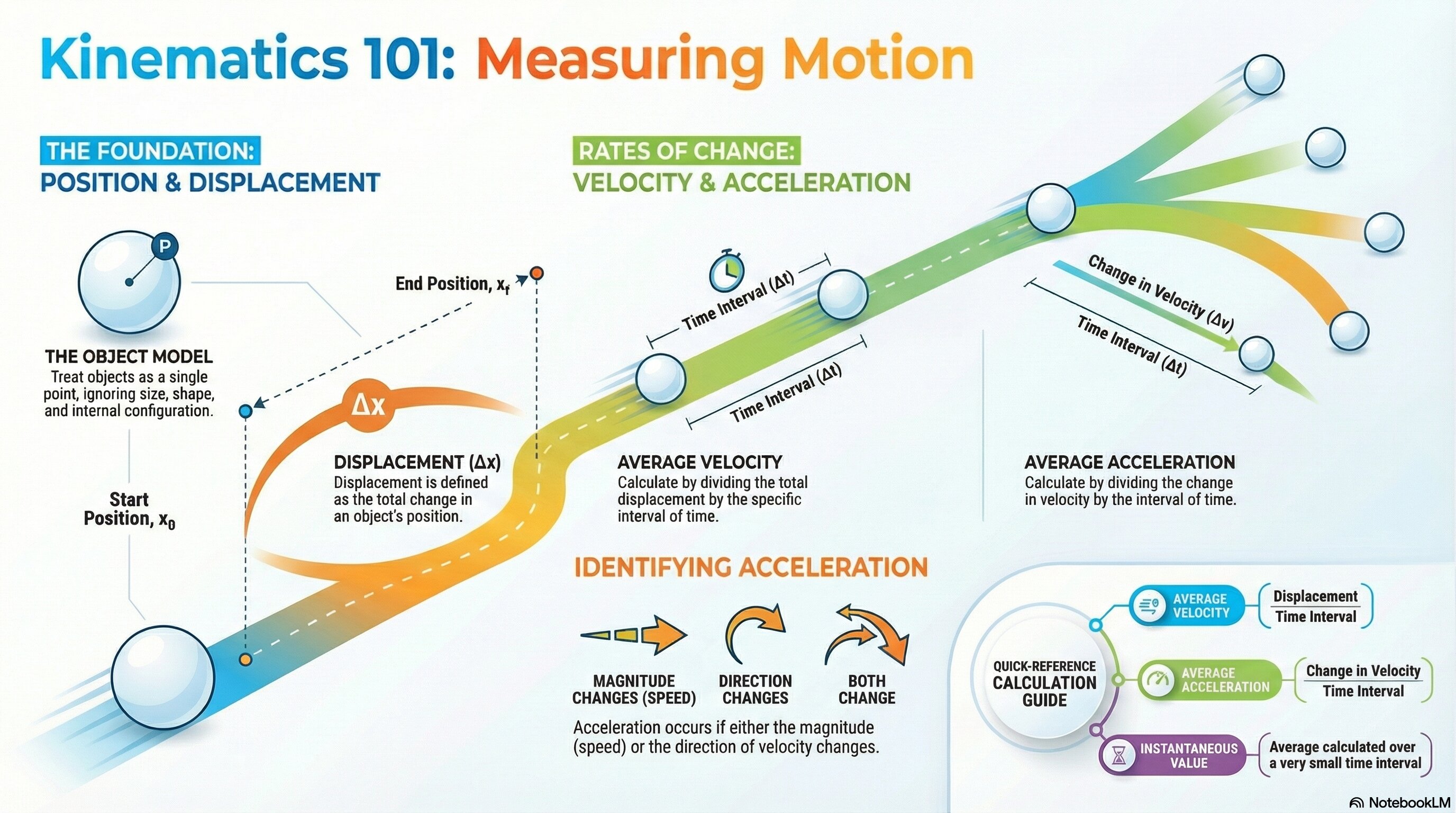
🧭 Plot Summary
In this lesson, we build the three big ideas that describe how things move. First, we use the object model — we treat any moving object as a single point so the math stays simple. Then we define displacement (how far and which direction something moved), use it to find average velocity, and use velocity changes to find average acceleration. We finish by connecting those averages to instantaneous values — what's happening at one exact moment in time.
What you'll do in this lesson
- Use the object model: treat a moving object as a single point, ignoring size, shape, and internal parts.
- Define displacement as the change in an object's position (Δx = x − x₀).
- Calculate average velocity by dividing displacement by the time it took (v̄ = Δx / Δt).
- Calculate average acceleration by dividing the change in velocity by the time it took (ā = Δv / Δt).
- Identify when an object is accelerating — any time its speed or direction changes.
- Connect average values over very small time intervals to instantaneous velocity and acceleration.
Why it matters
Displacement, velocity, and acceleration are the building blocks of everything in Unit 1. Every graph, every equation, and every lab this unit connects back to these three ideas. Get solid on them now and the rest of kinematics will make a lot more sense.
✅ Self-Check Before You Roll On
Check off each item as you get there. These aren't grades — they're your own signal.