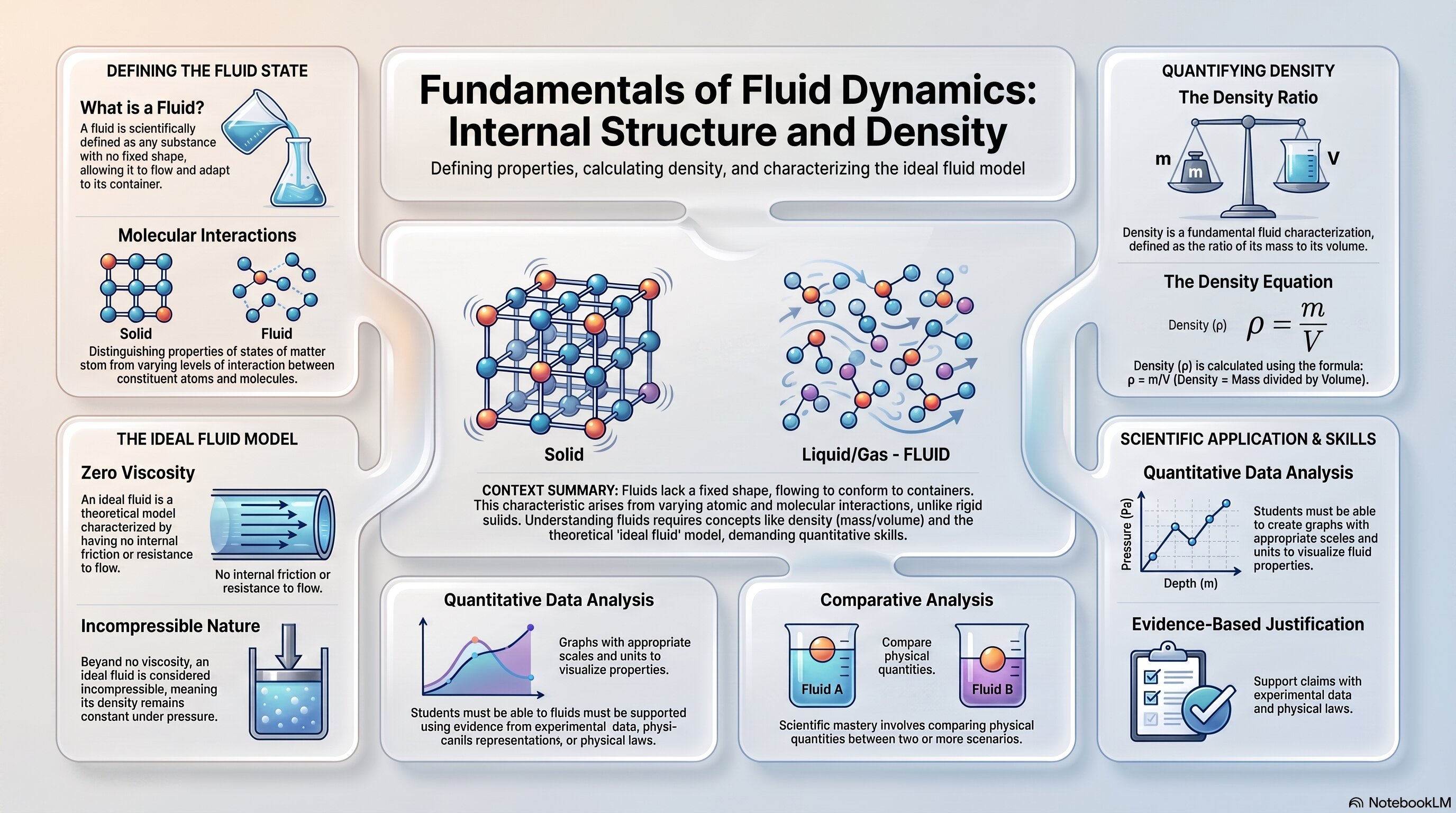
Use this as a quick reference for what defines a fluid, the density ratio, the ideal fluid model, and the comparison/justification skills this lesson builds.
🧭 Plot Summary
Unit 8 opens by asking what actually makes a fluid a fluid. The answer comes down to how tightly and rigidly the atoms or molecules inside a substance interact. Solids hold a fixed shape because their particles are locked into place. Fluids — liquids and gases alike — have no fixed shape, because their particles interact weakly enough to flow and take the shape of whatever contains them.
Once something is a fluid, the most useful single number for describing it is density: the ratio of its mass to its volume, ρ = m/V. And to make the math of the rest of this unit tractable, we'll spend most of it working with an idealization — the ideal fluid — which is both incompressible (its volume never changes) and has zero viscosity (no internal friction at all).
Solid, fluid, and the ideal model
What you will do in this lesson
- Explain why solids, liquids, and gases behave differently based on molecular interactions.
- State that a fluid is a substance with no fixed shape — it flows to fill its container.
- Define density as ρ = m/V, the ratio of mass to volume.
- Calculate density, mass, or volume from the other two quantities.
- State the two defining properties of an ideal fluid: incompressible and zero viscosity.
- Compare densities across fluids and justify claims using experimental data.
Why it matters
Every idea in the rest of Unit 8 — pressure, buoyancy, flow — rests on density. This is also the unit where precise vocabulary matters most on the AP exam: mass, weight, volume, size, and density are five different things, and mixing them up is the single most common way students lose free-response points in this unit.
✅ Self-Check Before You Roll On
Check off each item as you get there. These are not grades — they are your own signal.