Use this as a quick reference for the pressure definition, absolute vs. gauge pressure, and the vertical column formula.
🧭 Plot Summary
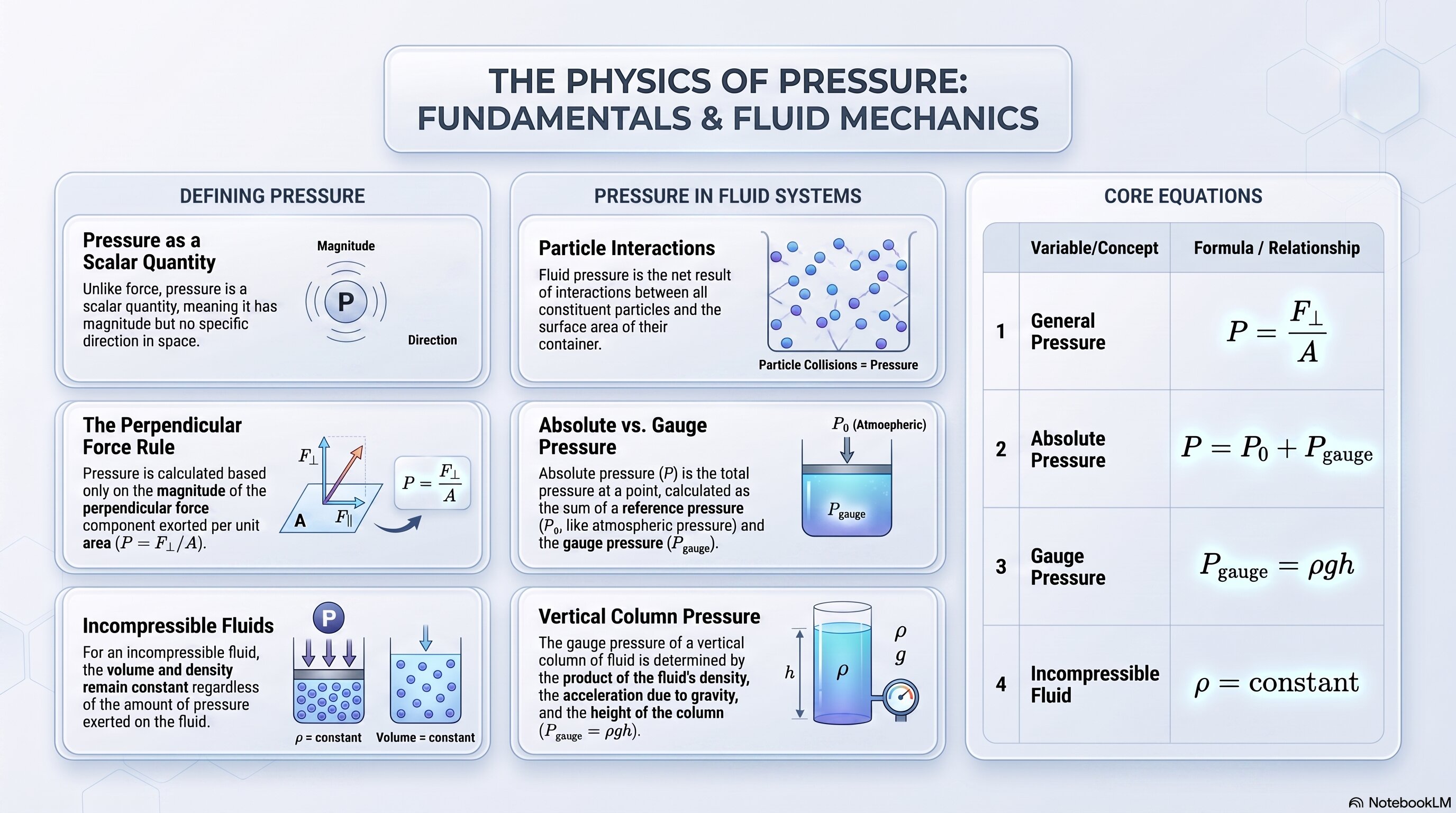
Pressure is force spread across an area — specifically, the perpendicular component of that force, divided by the area it acts on. That's the whole definition: P = F⊥/A. But unlike force, pressure is a scalar. It has a magnitude and that's it — no arrow, no direction of its own.
Inside a fluid, pressure comes from something more chaotic than a single applied force: it's the collective result of countless particle collisions against a surface. And because pressure builds with depth, we split it into two pieces — gauge pressure(the extra pressure due to the fluid itself, P_gauge = ρgh) and absolute pressure (gauge pressure plus whatever reference pressure — usually atmospheric — is already there): P = P₀ + P_gauge.
Three pieces of the pressure picture
What you will do in this lesson
- Define pressure as P = F⊥/A — force per unit area, using only the perpendicular component.
- State that pressure is a scalar quantity, with magnitude but no direction.
- State that an incompressible fluid's volume and density stay constant regardless of pressure.
- Explain that fluid pressure results from the collective interactions of all the fluid's particles with a surface.
- Apply absolute pressure = reference pressure + gauge pressure, P = P₀ + P_gauge.
- Calculate gauge pressure in a vertical fluid column using P_gauge = ρgh.
Why it matters
This answers one of Unit 8's essential questions directly: why don't you feel the miles of air above you pushing you down? Atmospheric pressure is real and substantial — but it acts on every surface of your body from every direction at once, so the net effect you feel is zero. Divers feel the difference immediately, because water is far denser than air and pressure builds fast with depth.
✅ Self-Check Before You Roll On
Check off each item as you get there. These are not grades — they are your own signal.