Use this as a quick reference for Newton's laws in fluids, the source of buoyancy, and the Archimedes' principle derivation.
🧭 Plot Summary
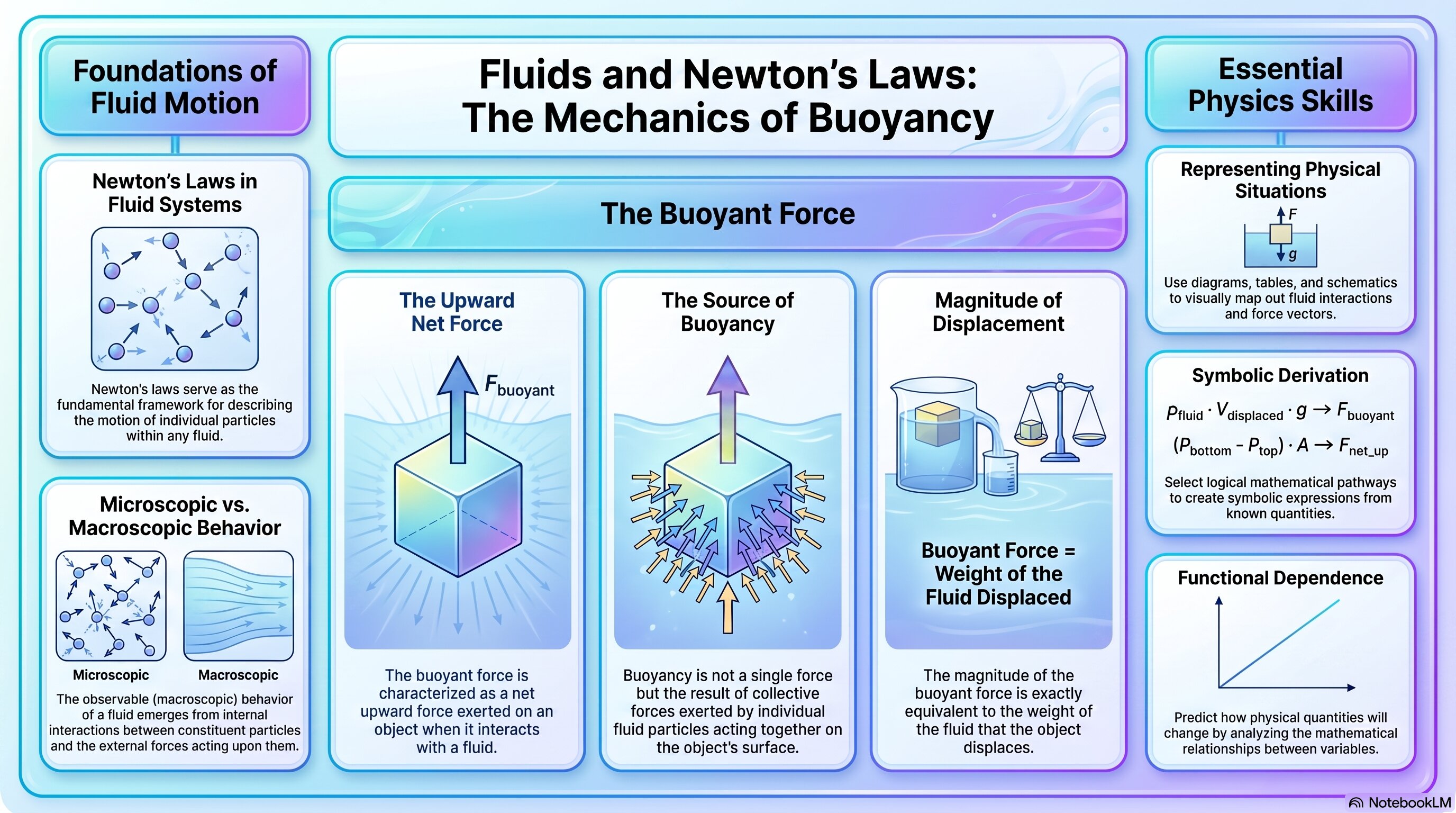
No new laws of physics show up in this lesson — just Newton's laws, applied to something messier than a single rigid object. Every particle inside a fluid still obeys F = ma; a fluid's observable, macroscopic behavior is just the sum of countless microscopic particle interactions plus whatever external forces act on the fluid as a whole.
That framework explains one of the most useful forces in this unit: the buoyant force. It's not a special new kind of push — it's the net effect of fluid pressure being larger at greater depth (Lesson 8.2), acting more strongly on the bottom of a submerged object than on its top. The result, after the dust settles, is Archimedes' principle: the buoyant force equals the weight of the fluid the object displaces.
Building buoyancy from pressure
What you will do in this lesson
- State that Newton's laws describe the motion of individual particles within a fluid.
- Explain that a fluid's macroscopic behavior emerges from particle interactions plus external forces.
- Define the buoyant force as the net upward force a fluid exerts on a submerged or floating object.
- Explain that buoyancy comes from pressure differences across an object's surface — not a single applied force.
- Derive and apply Archimedes' principle: F_buoyant = ρ_fluid V_displaced g.
- Predict how buoyant force changes with volume displaced or fluid density.
Why it matters
This directly answers Unit 8's opening essential question: why do some objects float while others sink? It's never about which object is "heavier" in some absolute sense — it's a comparison between the object's actual weight and the buoyant force it displaces. Get that comparison right, and the float-or-sink question always has a clean answer.
✅ Self-Check Before You Roll On
Check off each item as you get there. These are not grades — they are your own signal.